biochem lab quiz 2 content
 Call Kai
 Learn
 Practice Test
 Spaced Repetition
 Match
 Flashcards
 Knowt Play
 Podcast
1/38

Earn XP
Description and Tags
Proteins, activity calculations, Ion exchange chromatography, Abs. vs time, Bradfrod Assay, LDH Assay, Beer's Law, PI and pH
Name | Mastery | Learn | Test | Matching | Spaced | Call with Kai | Chat |
|---|
No analytics yet
Send a link to your students to track their progress
39 Terms
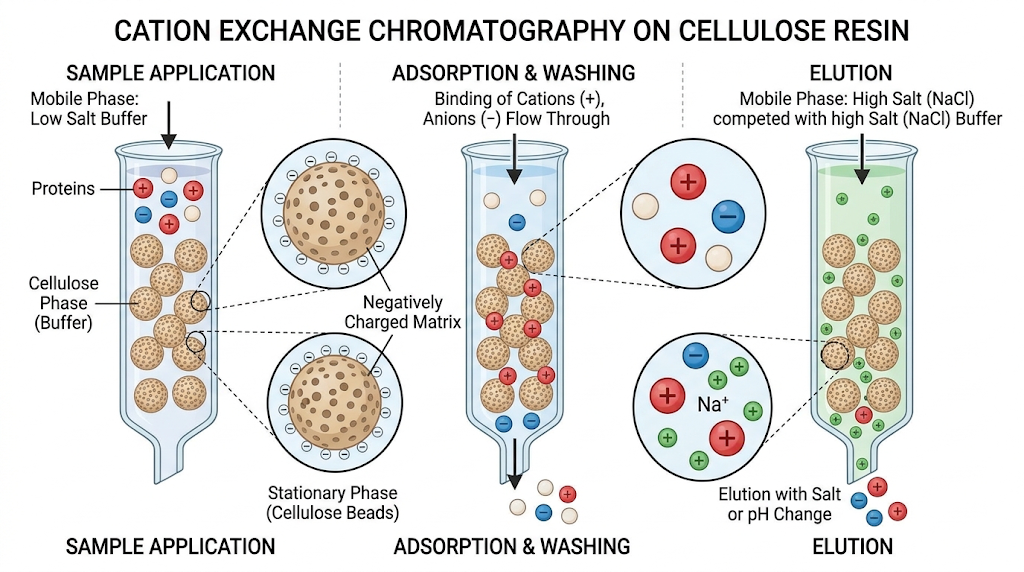
Define Ion Exchange Chromatography.
A technique used to separate ions and polar molecules based on their affinity to the ion exchanger. It involves passing a mixture through a column filled with stationary phase that contains charged groups, allowing selective binding of target ions.
What are the two types of Ion Exchange Chromatography?
Cation exchange and anion exchange.
What is a cation exchange IEX used for?
It is used to separate and purify positively charged ions (cations) from a mixture by utilizing a negatively charged resin that binds cations selectively.
What is the Isoelectric point?
The Isoelectric point (pI) is the pH at which a particular molecule or protein carries no net electric charge, resulting in minimal solubility and maximal aggregation. It is an important property in protein purification and characterization.
pI > pH
indicates a net positive charge on the protein, leading to its migration towards the negative electrode during electrophoresis.
pI < pH
indicates a net negative charge on the protein, causing it to migrate towards the positive electrode during electrophoresis.
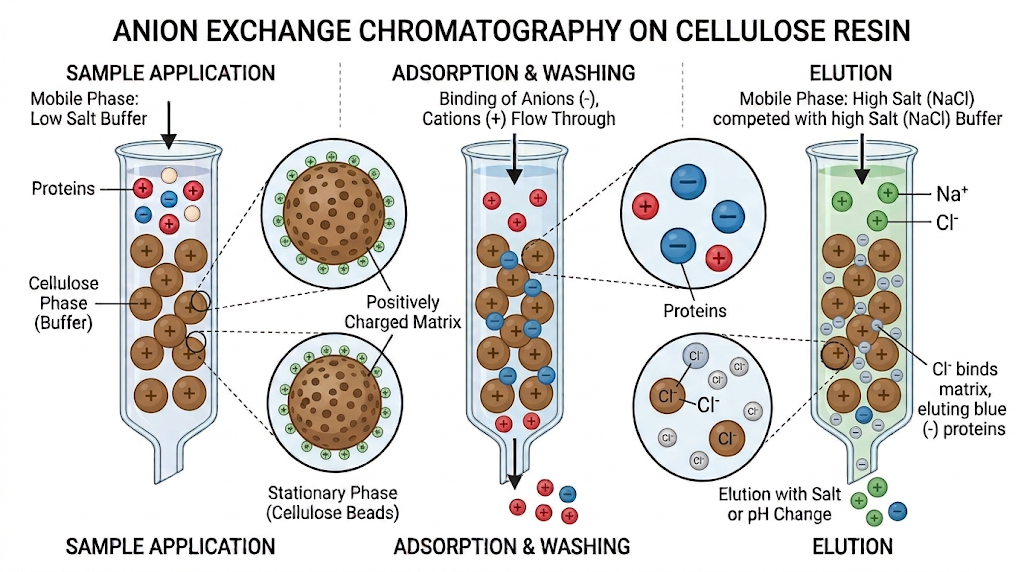
What is a anion exchange IEX used for?
Anion exchange IEX is used for the purification of negatively charged molecules, such as proteins or nucleic acids, by allowing them to bind to a positively charged resin while unbound substances are washed away.
pH > pI
The protein is positive net charge, causing it to migrate towards the negative electrode in electrophoresis.
pH < pI
The protein has a net negative charge, leading to migration towards the positive electrode during electrophoresis.
How do you solve for pI?
To solve for pI (isoelectric point), average the pKa values of the acidic and basic functional groups around the pH at which the molecule carries no net charge.
What is the Zwitterion point?
The zwitterion point refers to the pH at which a molecule possesses both positive and negative charges that balance each other, thus having no net charge.
Beer-lambert Law
is a linear relationship between absorbance and concentration of a solution, expressed as A = elc.
Why is Ammonium sulfate used at different concentrations?
Ammonium sulfate is used at different concentrations to precipitate proteins based on their solubility. This process allows for the effective separation and concentration of the desired protein from the solution.
Define a Bradford assay
A Bradford assay is a colorimetric protein assay that uses Coomassie Brilliant Blue dye to measure protein concentration, indicating a shift in absorbance at 595 nm.
what does pH equal to?
pH= pka + log[HA][A−]
Tryptophan, Trp, W has absorbance at what?
Tryptophan, Trp, W has absorbance at approximately 280 nm, which is due to its indole side chain.

Tyrosine, Tyr Y has absorbance at what?
Tyrosine, Tyr, Y has absorbance at approximately 280 nm, attributed to its phenolic side chain.

Phenylalanine, Phe, F has absorbance at what?
Phenylalanine, Phe, F has absorbance at approximately 280 nm, primarily due to its benzyl side chain.

what is the LDH assay?
pI = (pka1+pka2)/2, how do you know which pka’s to use?
you pick the two pkas that bracket the neutral zwitterion where the amino acid has a net charge of zero.

Determine the pI of the amino acid lysine? pka’s are the following: 2.2 (carboxyl), 9.0 ( -amino), and 10.5 (side-chain amino acid).
The pI of lysine is calculated using the two pKa values that bracket the zwitterionic form of the amino acid, which are 9.0 and 10.5. Thus, the pI is calculated as pI = (9.0 + 10.5) / 2 = 9.75.
Bradford assay vs LDH assay
The Bradford assay is a colorimetric protein assay based on the binding of Coomassie Brilliant Blue dye to proteins, used for determining protein concentration. In contrast, the LDH assay measures lactate dehydrogenase activity, often used to assess cell viability and tissue damage.
In a Bradford assay linear plot state what all the values in the linear equation stand for
y = Absorbance of unknown sample ( or standards)
m= slope of standard curve
x = concentration of your unknown protein (or standard)
b = Y-intercept ideally 0
How do you solve for concentration of your protein of interest in a Bradford assay? pipets were in microLiters and graph is in miliLiters
equation set up like this x= (y-b)/m but make sure to convert units properly to match the graph scale.
Bradford assay measure what?
total protein concentration not enzymatic activity.
What does the LDH assay measure?
The formation of NADH from NAD+ by UV-Vis Spectrophotometric , in which the plot will show delta A/ delta t.
NAD+ to NADH what to what?
Lactate to pyruvate
Why NAD+ to NADH and not vice versa
This is because NADH has a distinct absorbance at 340nm and can participate in redox reactions.
What is the charge of LDH at pH 8.5 and how does it compare to the pI?
At pH 8.5, LDH is negatively charged because the pH is above its isoelectric point (pI), hence an anion exchanger is used.
What does the elution section of the IEX do?
incoming high concentrations of counter ions outcompetes the protein for binding sites on the resin.