2.3: Healthcare Financing and Reimbursement Methods
 Call Kai
 Learn
 Practice Test
 Spaced Repetition
 Match
 Flashcards
 Knowt Play
1/67

There's no tags or description
Looks like no tags are added yet.
68 Terms
How money moves through the US Healthcare System?
Healthcare needs must be financed— patients need a way to pay for the services they receive
Healthcare financing refers to the mechanisms that provide funds to pay for healthcare services
Health insurance is the primary financing mechanism for most Americans
Insurance is not the only source of financing; other sources include:
Public programs
out-of-pocket payments
charity care
Financing connects patients and providers by creating a mechanism for provders to receive payments for delivering care
Financing makes healthcare possible by
moving resources from payers to healthcare providers so patients can receive needed services.
What is healthcare financing?
refers to any mechanism that gives people the ability to pay for healthcare services
Common financing sources
private health insurance
employer-sponsored plans
individual marketplace plans
public insurance
medicare
medicaid
CHIP
VA and Military Health
out-of-pocket payments
paid directly for services
charity/uncompensated care
community health centers
free clinics
emergency departments
Many sources contribute to Healthcare Financing
Insurance companies
compete for enrollees and negotiate with providers
pay for covered healthcare services
Health plans
offer different coverage levels, provider networks, and costs
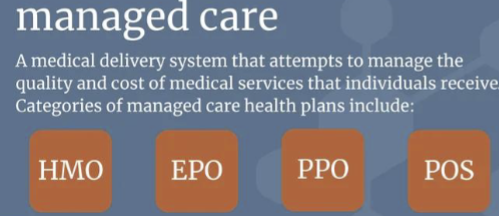
Examples: HMO, PPO, EPO, POS, and HDHP
Employers
Often offer health insurance as an employee benefit
typically contribute toward insurance premiums
Government programs
provide coverage for specific eligible populations
primarily funded through taxes
Examples: Medicare, Medicaid, CHIP, VA health care, and Marketplace subsidies
Patients also contribute
Premiums, deductibles, copays, coinsurance, and other out-of-pocket payments
Health insurance increases access to care

Health insurance pays healthcare providers
Patients receive care from hospitals, clinics, physicians, pharamacies, and other healthcare providers
Health insurance reimburses providers for covered healthcare services
Payments may be made to:
Hospitals and clinics
Physicians and other clinicians
Pharmacies
Other healthcare providers
Reimbursement is the payment providers receive for services delivered to insured patients
The amount and method of payment depend on the insurance plan, covered service, and reimbursement
Insurance helps patients access care while providing the payment that supports continued healthcare delivery
Moral Hazard
People may use more healthcare because insurance reduces the amount they pay out of pocket
Provider-Induced demand
Providers may recommend or deliver more services when reimbursement encourages additional care
providers are reimbursed for each individual service they deliver
a physician may determine that one test is clinically sufficient, but additional reimbursables services may include:
CT scans
Lab tests
Each additional service can generate additional reimbursement for the provider or healthcare organization
create a financial incentive to increase the volume of services provided
payment is tied primarily to the quantity of services, rather than directly to the quality or outcomes of care
Fee-for-Service
More services = More payment
Risk***
possibility that an individual will need healthcare services in the future
Risk** definition
person may be healthy today but experience an unexpected illness, injury, or medical emergency
unexpected health events create a sudden need for medical care and significant healthcare costs
examples of health risks include:
accidents and injuries
heart attacks
pneumonia and other illnesses
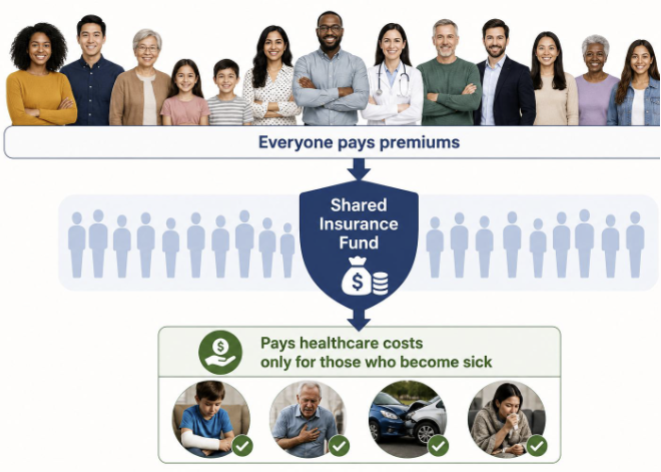
Because we cannot predict exactly who will need care or when, individuals face uncertainty about future healthcare expenses
health insurance helps protect individuals from the financial risk of unexpected healthcare costs
Risk pooling
spreads healthcare costs across a large group of insured individuals
Whos who? READ

Underwriting**
process insurers use to evaluate risk when determining insurance coverage and pricing
insurers assess the likelihood that an individual or group will require healthcare services and generate costs
historically, underwriting considered factors such as:
age
health history
smoking/tobacco use
occupation
pre-existing medical conditions
Risk assessment could influence whether coverage was offered, restricted, or priced differently
Under the Affordable Care Act (ACA), health insurers in the individual and small-group markets generally cannot deny coverage or charge higher premiums because of pre-existing health conditions
However, insurers may still use certain permitted factors, such as age, geographic location, tobacco use, and family size, when setting premiums
Cost sharing
portion of healthcare costs that patients are responsible for paying

Premium
amount you pay to keep your health insurance coverage active
paid every month (or paycheck)
paid whether you use healthcare or not
similar to a subscription fee
PREMIUM =
Cost of having insurance
Deductible
amount you pay for covered healthcare services before your insurance begins paying

DEDUCTIBLE =
PAY FIRST
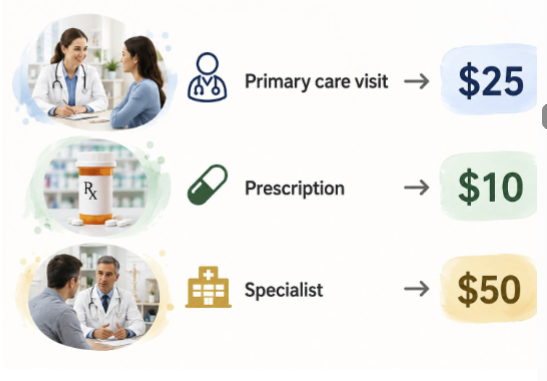
Copay
fixed dollar amount you pay each time you receive certain healthcare services
same amount
no matter what the visit costs
Coinsurance
percentage of healthcare costs you pay after meeting your deductible

Why doesn’t one insurance plan fit everyone?
People have different healthcare needs, budgets, and preferences, so one insurance plan cannot work equally well for everyone
Young and healthy adults
typically use fewer healthcare services
may prioritize lower monthly premiums
Families with children
may need pediatric visits, prescriptions, and preventive care
often value broader family coverage
Older adults
more likely to need frequent visits, medications, and specialist care
may prioritize more comprehensive coverage and lower out-of-pocket costs
College students
often have limited budgets and occasional healthcare needs
may prioritize affordability and covenient access
Different needs lead to different insurance plans
choosing a plan involves balancing:
expected healthcare needs
premiums and out-of-pocket costs
provider access and covered services
protection from unexpected healthcare expenses
The goal is to match insurance coverage with healthcare needs, financial risk, and affordability
People have different healthcare needs and face different levels of financial risk
Insurance plans vary to provide different combinations of coverage, cost, and financial protection
Employer-sponsored insurance
coverage offered through an employer
Government programs
Medicare, Medicaid, CHIP, and VA health care
Individual Marketplace plans
coverage purchased directly by individuals
High-deductible health plans (HDHPs)
generally lower premiums but higher deductibles
Employer-Sponsored Insurance: Expanded
Who buys it?
employers purchase or offer the plan
Who pays?
employer and employee usually share the premium
Who uses it?
working adults and their families
Advantages
Largest source of private insurance in the US
Lower premiums because employers contribute
often covers dependents
Limitations
coverage may end if employment ends
plan choices may be limited
Self-Funded Employer Plans
Who buys it?
Large employers
Who pays medical claims?
the employer pays employees’ healthcare claims directly
Who administers it?
Insurance companies often process claims but do NOT assume the financial risk
Advantages
greater flexibility
potential cost savings
customized employee benefits
Limitations
employer assumes financial risk
most practical for large organizations

Individual Marketplace insurace
Who buys it?
individuals purchase their own insurance
Where?
ACA Health Insurance Marketplace
Who uses it?
Self-employed
Gig workers
Early retirees
People without employer coverage
Advantages
Guaranteed availability
Premium subsidies for eligible individuals
essential health benefits included
Limitations
higher premiums without subsidies
networks may be narrower
Managed care plans
Coordinate care while controlling healthcare costs
Advantages
lower costs
coordinated care
Limitations
network restrictions
referral requirements (some plans)
Managed care plans: Health Maintenance Organization (HMO)
Who uses it?
Individuals seeking lower healthcare costs
families who prefer coordinated care
How does it work?
choose a primary care provider (PCP)
PCP coordinates your care
PCP referrals usually required for specialists
Must use providers within the HMO network
Advantages
Lower premiums
Lower out-of-pocket costs
Strong emphasis on preventive care
Limitations
limited provider network
referral required for most specialists

Managed care plans: Preferred Provider Organization (PPO)
Who uses it?
Individuals wanting greater flexibility
patients who frequently use specialists
How does it work?
no primary care provider required
no referral needed for specialists
can see providers outside the network
lower costs when staying in-network
Advantages
maximum provider flexibility
no referral requirements
large provider networks
Limitations
higher premiums
higher out-of-pocket costs

Managed care plans: Exclusive Provider Organization (EPO)
Who uses it?
People wanting lower premiums than PPOs
Individuals comfortable using one provider network
How does it work?
No primary care referral required
Must use providers within the EPO network
Out-of-network care generally not covered (except emergencies)
Advantages
Lower premiums than PPOs
No specialist referrals
Simpler than HMOs
Limitations
Very limited out-of-network coverage
Less provider choice than PPOs

Managed care plans: Point of Service (POS) plans
Who uses it?
Individuals who want flexibility with coordinated care
Families who occasionally need out-of-network specialists
How does it work?
Choose a primary care provider (PCP)
PCP coordinates your care
referrals are usually required for specialists
can receive out-of-network care, but at a higher cost
Advantages
lower costs when using in-network providers
access to out-of-network providers if needed
combines features of HMOs and PPOs
Limitations
referrals usually required for specialists
higher out-of-pocket costs for out-of-network care
more complex benefit structure
Good thing to review*** for the multiple parts

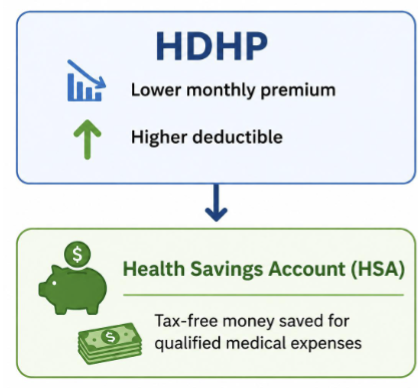
High-deductible health plans (HDHPs) and Health Savings Accounts (HSAs)
Best for
healthy individuals
young families with few medical expenses
people who want to save for future healthcare costs
Advantages
lower premiums
triple tax advantage of HSAs
Savings roll over year to year
Limitations
higher upfront costs before insurance begins paying
Medicare
Who’s covered?
Adults 65 yrs and older
Younger people with certain disabilities
People with End-Stage-Renal Disease (ASRD) or ALS
How is it funded?
Federal government
Payroll taxes
Beneficiary premiums and general tax revenues
Medicare: 4 major parts
Part 1: Hospital Insurance
covers inpatient hospital stays, skilled nursing care, hospice care
Part 2: Medical Insurance
covers doctor’s visit, preventive service, medical equipment
Part 3: Private plans covering Part 1 + 2 (Medicare advantage)
Offered by private insurance companies approved by Medicare
Part 4: Prescription Drug coverage
helps cover cost of medicine at pharmacy
Medicaid
Who is covered?
Low-income adults
Children
Pregnant women
Older adults with limited income
Individuals with disabilities
Who runs it?
Federal Government
State government
Key Features?
Income based eligibility
States administer the program
Benefits vary somewhat by state
Children’s Health Insurance Program (CHIP)
Purpose
Provides insurance for children whose families earn too much for Medicaid but cannot easily afford private insurance
Who is covered?
Children
Some pregnant women (state option)
Funded by
Federal
State governments
Benefits
Preventive care
Physician visits
Hospital care
Vaccines
Prescriptions
Veterans Health Administration (VA)
Who is covered
Eligible military veterans
How care is delivered
Unlike most program, the VA
owns hospitals
employs healthcare professionals
Services
Primary care
Specialty care
Mental health
Rehabilitation
Long-term care
The VA is an__
integrated healthcare delivery system, not simply an insurance plan
Military Health System (TRICARE)
Who is covered?
Active-duty military
National Guard & Reserve (eligible members)
Military retirees
Dependents
Care Settings
Military treatment facilities
Civilian provider networks
Provide comprehensive healthcare to military families worldwide
TRICARE support healthcare access for __
service members and their families throughout military service and retirement
Private insurance
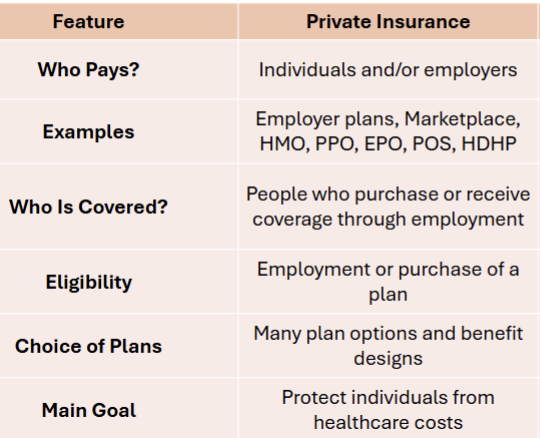

Public Insurance

Who pays?: Individuals
monthly premiums
deductibles, copays & coinsurance
Who pays?: Employers
contribute toward employee premiums
may fully fund health plans
Who pays?: Government
Funds Medicare, Medicaid, CHIP, VA & TRICARE
Supported by federal and state tax revenues
Who pays?: Taxes
payroll taxes support Medicare
Federal & state taxes fund public programs
Health care is paid for through a ____
combination of individuals, employers, government, and taxes
Why does reimbursement matter?
Provider reimbursement determines how healthcare providers are paid for delivering care
Why it matters
Influences healthcare spending
Affects provider behavior and decision-making
Impacts quality of patient care
Shapes healthcare system performance
Common Payment Models
Fee-for-Service (FFS)
Capitation
Salary
Bundled Payment
Value-Based Payment
Fee-for-Service (FFS)
How does it work
Provider is paid for every service performed
Each visit, test, or procedure generates a separate payment
Advantages
encourages access to services
simple payment method
Limitations
may encourage more services than necessary
can increase healthcare costs
Example
office visit
x-ray
blood test
surgery
EACH service is billed separately**
Capitation
How does it work?
Provider receives a fixed payment per patient
payment is made regardless of the number of visits
Advantages
encourages preventive care
controls healthcare costs
rewards keeping patients healthy
Limitations
may discourage unnecessary services
risk of underproviding care
Example
primary care practice receives $40 per patient per month
Salary
How does it work?
Provider receives a fixed salary
income does not depend on the number of patients seen
Advantages
stable income
less financial pressure
encourages teamwork
Limitations
fewer incentives to increase productivity
performance incentives may be limited
Example
Physicians employed by:
Kaiser Permanente
Veterans Health Administration
Academic medical centers
Bundled Payment
How does it work:
One payment covers all services related to a single episode of care
Covers:
Hospital stay
Physician services
Rehabilitaion
Follow-up care
Advantages:
Encourages coordination
Improves efficiency
Reduced unnecessary spending
Limitations
Complex to organize
Providers share financial risk
Example:
Total knee replacement bundle
one payment covers surgery through recovery
Value Based Payment
Goal
Providers are rewarded for quality rather than quantity
Performance Measures
Better patient outcomes
Higher quality of care
Patient satisfaction
Lower healthcare coss
Fewer hospital readmissions
Advantages
Improves quality
Encourages preventive care
Focuses on patient outcomes
Limitations
Requires quality measurement
More complex than traditional payment
Better outcomes = Better payment
ACA Payment Reform- Why change was needed?
The traditional Fee-for-Service System
Providers were paid for each service delivered
More visits, tests, and procedures = more reimbursement
Focused on volume of care
Problems with the old model
rising healthcare spending
fragmented care
limited coordination between providers
few financial incentives to improve quality or outcomes
ACA goal
Shift payment incentives from quantity of services to quality of care
ACA Payment Reform— The Shift to Value
Value-Based Care Rewards Providers for:
Better patient outcomes
Higher quality of care
Better patient experience
Preventing unnecessary hospitalizations
Coordinated, efficient care
Examples of ACA payment models
accountable care organizations (ACOs)
Patient-centered medical homes (PCMHs)
Bundled payments
Hospital value-based purchasing
Readmissions reduction program
Public insurance programs serve different populations,
each designed to meet the needs of specific eligible groups
Private and public insurance
have different roles
Healthcare is financed
through multiple sources
Provider payment methods shape
healthcare delivery
US payment reform is shifting from volume to value,
rewarding better quality, improved patient outcomes, care coordination, prevention, and more efficient use of healthcare resources