biopharmaceutics kinetics
 Call Kai
 Learn
 Practice Test
 Spaced Repetition
 Match
 Flashcards
 Knowt Play
1/15

There's no tags or description
Looks like no tags are added yet.
16 Terms
kinetics
the rate at which processes occur.
Energetics
For a chemical reaction to occur,
it is necessary for the molecules
involved to possess a certain
minimum amount of energy,
known as the activation energy
• The energies of a population of
molecules are given by the
Maxwell–Boltzmann distribution
homogenous and heterogenous processes
Homogeneous processes occur in one phase, most usually in the gas
phase or in solution. The processes are uniform throughout the whole
reacting mass.
• Heterogeneous processes involve more than one phase: for instance,
a solid dissolving into a liquid.
These processes frequently can only occur at the phase boundary, and their
rates depend on the supply of fresh material to this boundary. (eg: sugar cube
in water)
molecularity
The molecularity of a reaction describes the number of reactant
molecules involved in forming the product.
• Some reactions, particularly decomposition processes, are
unimolecular, in that only a single molecule is involved in the
reaction. A generic example of such a process would be as follows:
A→B
N2O5 →2NO2 +12O2
• An unimolecular reaction occurs when a molecule rearranges itself
to produce one or more products.
Biomolecular process A+B→C, CH3CH2Br + H2O → CH3CH2OH + HBr
• In an unimolecular process, a molecule will react if it has sufficient
energy to overcome the activation energy barrier (i.e. the energy of
the molecule must be greater than the activation energy).
• The number of high-energy molecules depends on how many molecules are
present (their concentration in solution or pressure in a gas) and the
temperature, in accordance with the Maxwell–Boltzmann distribution (see
Fig. 7.1).
• In a bimolecular process, two molecules must collide with sufficient
energy (and in an appropriate orientation) to react, and the likelihood
of collision depends on the concentration of each species.
A+B→C
Rate laws and order of reaction
Rate laws (Rate equations) are mathematical expressions that describe
the relationship between the rate of a chemical reaction and the
concentration of its reactants.

order of reacctions
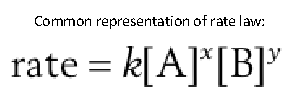
The order of reaction can be defined as the power dependence of
rate on the concentration of all reactants
The order of the reaction with respect to the reactants A and B is x and
y respectively. The overall order of the reaction is x + y.
rate laws and order of reaction
Zero-order processes
• First-order processes
• Pseudo-first-order processes
• Second-order processes
zero order processes
Zero-order processes
The reaction rate is completely independent of the concentration of the
reactants.
first order processes
A first-order reaction can be defined as a chemical reaction for which the
reaction rate is entirely dependent on the concentration of only one
reactant.
In such reactions, if the concentration of the first-order reactant is doubled,
then the reaction rate is also doubled
First-order processes are the most common processes in
pharmaceutics.
▪ drug decomposition during storage
▪ the passage of drugs from one body compartment to another (e.g. from the
lumen of the intestine into the blood)

second order processes
H+ + OH- → H2O
• This reaction is therefore expected to be second order, and the rate
equation can be written as
rate = k [H+ ] [OH- ]
pseudo-first-order processes
CH3CH2Br + H2O → CH3CH2OH + HBr
• This reaction is therefore expected to be second order, and the
rate equation can be written as
rate = k [CH3CH2Br] [H2O ]
Pseudo-first-order processes
• CH3CH2Br + H2O → CH3CH2OH + HBr
• This reaction is therefore expected to be second order, and the rate equation
can be written as
rate = k[CH3CH2Br][H2O]
• However, this reaction takes place in an aqueous solution, where the concentration of
CH3CH2Br will be much less than the concentration of H2O. Thus, the concentration of
H2O will barely change during the reaction: if the concentration of CH3CH2Br is, say, 0.1 M
(a realistic value), then at most 0.1 M of water will be consumed if the reaction goes to
completion, leaving 55.5 M, or 99.8% of the original concentration.
• In such situations, it is reasonable to make the assumption that the concentration of
water is constant throughout the reaction, and thus the reaction will appear to be first
order, with a rate constant k′ (where k′ = k[H2O]).
This gives rate = k′[CH3CH2Br]
• many drug hydrolysis reactions in aqueous solution follow this type of kinetics
half life
The half-life (t1/2 ) is the time taken for the concentration of a
substance of interest to decline to half its initial value.
• For instance, for the process A → products, t1/2 is the time
taken for [A]0 to decline to [A]0/2.
• Half-life is a particularly useful concept when we are
considering drug concentration in the blood, as it gives us an
idea of the length of time for which the drug persists in the
body. It also has uses in a range of other situations.
complex reactions
Consecutive reactions
• A→B→C
• Parallel (side) reactions
• A → B (rate constant k1 ) A → C (rate constant k2 )
• Reversible reactions
A → b + c
effects of temp on reaction rate
In the vast majority of cases, increasing the temperature at which a
reaction occurs will increase its rate
• As a rule of thumb, a 10°C rise typically doubles the rate constant.
• Two molecules must collide with sufficient energy to overcome the
activation energy barrier.
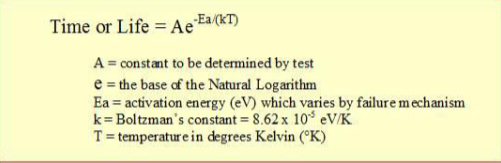
Arrhenius equation
in this, k is the rate constant, A is a pre-exponential factor, Ea is the
activation energy for the reaction, and T is the temperature in kelvin (K)
(0 °C = 273.15 K). The exact physical meaning of A is complex, but it can
be thought of as the maximum possible rate constant if the reaction
were infinitely hot.
Arrhenius equation is very widely used in pharmaceutics, most
commonly in determining the shelf life of medicines.
• To do this, formulations are commonly aged at elevated temperatures
(much greater than the intended storage temperature) and the rate
of reaction is determined at these temperatures.
• Once Ea has been determined, it is possible to back-calculate the
expected rate of decomposition at room temperature.