regulation of gene expression in eukaryotes: post-transcriptional and post translational regulation
 Call Kai
 Learn
 Practice Test
 Spaced Repetition
 Match
 Flashcards
 Knowt Play
1/37

There's no tags or description
Looks like no tags are added yet.
Name | Mastery | Learn | Test | Matching | Spaced | Call with Kai | Chat |
|---|
No analytics yet
Send a link to your students to track their progress
38 Terms
much of the processing of pre-mRNA occurs during (?)
transcription
capping
addition of a methyl cap to the 5’ end of the mRNA
occurs during transcription
polyadenylation
addition of a poly-A tail to the 3’ end of the mRNA
after mRNA synthesis has finished
splicing
removal of introns
usually during transcription but can occur post-transcription
capping factors attach a CAP structure to the 5’ end of the mRNA when about (?) nucleotides of the mRNA 5’ end are synthesised
25
5’ cap contains a 5’-5’ (a) bridge between a methylated (?) and the 5’ end of the mRNA transcript
(a) triphosphate bridge
(b) guanosine

CAP functions
signals correct 5’ end of the mRNA
assists export of mRNA from the nucleus
required for initiation of translation
protects mRNA from 5’ degradation by RNases
splicing requires splicing sequences in the mRNA (list 2)
intron/exon boundary sequences
branch point A sequences in the intron

RNA complexes called (?) carry out the splicing
small nuclear ribonucleoproteins (snRNPs)
what is the type of RNA in snRNPs?
small nuclear RNAs (snRNAs)
snRNAs in snRNPs can base pair with the splicing sequences in the mRNA

two step mechanism of splicing (explain)
step 1
the branch point adenine in the intron has no base pair to the snRNA
it attacks the 5’ splice exon intron junction (5’ splice site) → cuts the sugar phosphate backbone of the RNA at this point
the released 5’ end of the intron becomes covalently linked to the 2’ -OH group of the ribose of the adenine nucleotide to form a branched structure
step 2
the free 3’-OH end of the released exon reacts with the start of the 3’ splice exon intron junction
this joins the two exons together into a continuous coding sequence
the intron is released as a lariat structure → eventually degraded in the nucleus

the three most important snRNPs for splicing are:
U1, U2 and U6

U1
recognises the 5’ splice site


U2
recognises the lariat branch-point site through complementary base pairing between snRNAs and mRNAs

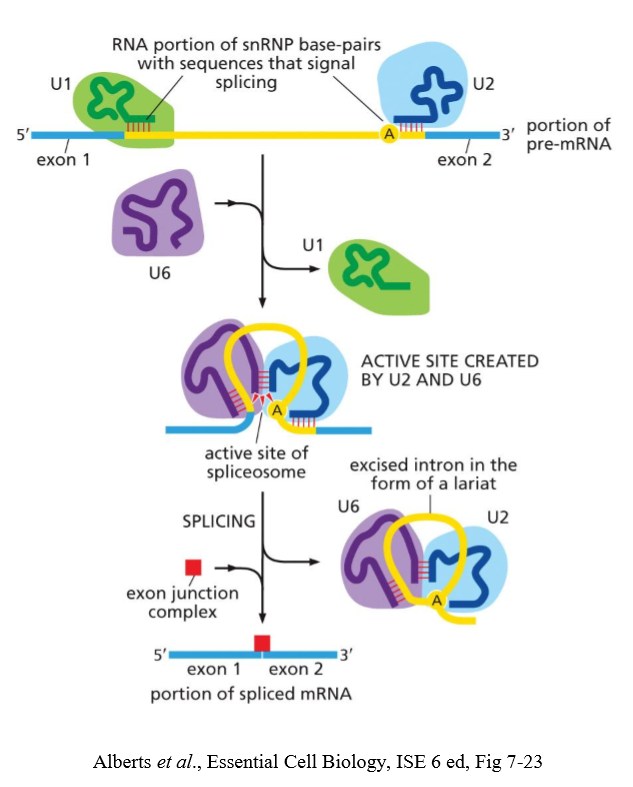
U6
double-checks the 5’ splice site by displacing U1 and base-pairing with the same intron sequence (5’ splice site) itself
this improves the accuracy of splicing


conformational changes in (list 2) drive the formation of the spliceosome active site → splicing occurs
U2 and U6


after splicing the spliceosome deposits RNA-binding proteins (aka?) on the mRNA
exon junction complex
this marks the splice site as successfully completed

some pre mRNAs are (?) spliced by: (list two forms)
alternatively
inclusion or exclusion of exons (or introns)
using alternative splice sites in exons
alternative splicing results in a number of different (?) from one gene
mRNAs → increases diversity of proteins

fruit flies regulates (?) splicing to generate stage-specific protein isoforms, a key mechanism for development, sex determination, neuronal wiring and muscle function
alternative
for example, alternative splicing of the Tra protein determines if a functional Tra protein is made → required to make a female fruit fly

the regulation of alternative splicing requires some regulatory proteins that bind to sequences in introns or exons → this binding interferes with binding of (?) thereby preventing splicing at a splice site
snRNPs
our genome has only about 20,000 protein coding (?)
genes
introns make up about 26% of the human genome
humans produce between 80,000 and 400,000 different proteins, despite only having 20,000 protein coding genes, due to (?)
alternative splicing
polyadenylation components (list 3: protein, factor, enzyme)
cleavage and polyadenylation specificity factor (CPSF)
cleaves 3’ end of the pre-mRNA during transcription
poly-A-polymerase (PAP)
recognises poly A signal on the mRNA
binds about 10 nucleotides behind the signal and adds hundreds of adenines
poly-A-binding proteins
assembles on poly-A-tail and determines final poly-A-tail length
protects mRNA 3’ end
polyadenylation protects the mRNAs (a) end from degradation by (b)
(a) 3’ end
(b) RNase
proteins that bind to the mRNA after processing for export to the cytosol (list 3)
CAP-binding protein
poly-A-binding proteins
exon junction complex
these proteins interact with export proteins that allow mRNA export through the (?) complex
nuclear pore
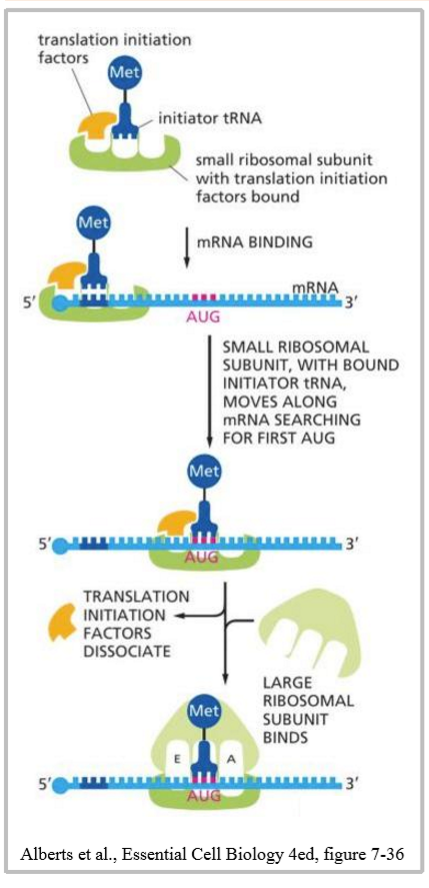
translational control in eukaryotes (explain)
CAP binding protein is exchanged for elongation factor eIF4
translation IFs, tRNA with methionine and the small ribosomal SU (SSU) assemble
loaded SSU binds to mRNA 5’ CAP
SSU scans the mRNA for an AUG
the large ribosomal SU binds, translation initiation factors dissociate
3’ and 5’ mRNA loop forms

polyribosomes
several ribosomes bind to one mRNA to synthesise many copies of the same protein
mRNAs are degraded in the nucleus or cytosol if:
they are not correctly processed
lack one of the three proteins that assist export (CAP binding protein, poly-A-tail binding protein, exon junction complex)
they are not needed anymore
eukaryotic mRNA half life span
several minutes to over 24 hours
degradation of the poly-A-tail is via what enzyme?
3’ to 5’ exonucleases
decapping enzyme removes the 5’ cap followed by degradation of mRNA in 5 to 3’ direction by what enzyme?
5’ to 3’ exonucleases
post-translational modification
covalent modifications of amino acids of a protein after its biosynthesis
PTMs diversify and specify protein function by: (list 4)
promoting protein folding
improving protein stability
regulating protein activity
targeting protein to the cell membrane
proteins to be degraded are marked by covalent addition of several copies of a protein called:
ubiquitin

the proteasome (multiprotein complex): what does it do?
recognises polyubiquitin marked proteins
marked proteins are unfolded by the stopper and channeled into the central cylinder of the proteasome
inside the cylinder are several proteases that degrade the marked protein

name the 7 steps of regulation of gene expression in eukaryotes
