Public Health Science : Chapter 1-5 [ 302 ] EXAM REVIEW
 Call Kai
 Learn
Learn Practice Test
 Spaced Repetition
 Match
Match Flashcards
 Knowt Play
1/84

There's no tags or description
Looks like no tags are added yet.
Name | Mastery | Learn | Test | Matching | Spaced | Call with Kai | Chat |
|---|
No analytics yet
Send a link to your students to track their progress
85 Terms
Population
Requires more than one individual
These individuals share one or more common characteristics
People in a particular place—-with discernible geopolitical boundaries
A set of commonalities—-one or more characteristics shared by members of the population
Health
A state of complete physical, mental, and social well-being
Not merely the absence of disease or infirmity
A fundamental right of every human being
Regardless of race, economic or social condition, religion, or political belief
Public health
Is the science of protecting and improving the health of families and communities through the promotion of healthy lifestyles, research for disease and injury prevention, and detection and control of infectious diseases.
To promote and protect the health of people and the
communities where they live, learn, work, and play.
Public health : Centers for Disease Control and Prevention (CDC) Foundation Definition
Public health is the science of protecting and improving the health of families and
communities through the promotion of healthy lifestyles, research for disease and injury
prevention, and detection and control of infectious diseases
Public Health
The science and art of preventing disease, prolonging life, and promoting health through organized societal efforts (Winslow definition).
Population Health
The health outcomes of a group of individuals, including the distribution of such outcomes within the group
Population Health Science
The study of the conditions, mechanisms, and interventions that shape health outcomes across population groups.
WHO Health Definition
A state of complete physical, mental, and social well-being, and not merely the absence of disease or infirmity (1948)
Edwin Chadwick (Mid-1800s, UK)
Spearheaded London's sanitation movement. Linked clean water supply and sewage removal directly to economic productivity, arguing that poor health caused economic decline
Lemuel Shattuck (1850, US)
Published the landmark survey in Massachusetts cross-tabulating mortality by age, sex, occupation, socioeconomic status, and geographic location, establishing vital statistics systems.
20th-Century Achievement [ 1900-1999 ]
Vaccinations
Motor-vehicle safety improvements
Safer workplaces & Occupational injury drops
Control of infectious diseases through sanitation
Decline in deaths from heart diseases & stroke
Safer and healthier foods
Healthier mothers and babies
Family planning and contraceptive access
Fluoridation of drinking water
Recognition of tobacco use as a health hazard
21st Century Achievements (2001–2010 Expansion)
• Vaccine-preventable disease reduction
• Prevention and control of infectious diseases
• Tobacco control (policy & tax measures)
• Maternal and infant health advances
• Motor vehicle safety enhancements
• Cardiovascular disease prevention
• Occupational safety milestones
• Cancer prevention & early detection
• Public health preparedness & emergency response
• Childhood lead poisoning prevention
THE DALY EQUATION:
DALY = YLL + YLD
YLL (Years of Life Lost):
Measures premature mortality.
Formula: = N × L (where N = number of deaths, L = standard life expectancy at age of death).
YLD (Years Lived with Disability):
Measures non-fatal health loss and reduced functioning.
Formula: ____= I × DW × D (where I = incident cases, DW = disability weight [0 to 1], D = duration).
Level of Prevention : Primordial
Timing/Focus: Far Upstream (Societal/ Environmental)
Primary Objective: Eliminate environmental or social conditions that express risk factors
Key Example: National policies banning trans fats or mandating clean air regulations.
Level of Prevention :Primary
Timing/Focus: Pre-pathogenesis (Before Disease Onset)
Primary Objective: Prevent initial disease occurrence or adoption of elevated risk behaviors
Key Example: Routine childhood immunizations, smoking cessation programs for healthy youth
Level of Prevention :Secondary
Timing/Focus: Subclinical Disease (Early Detection)
Primary Objective: Detect and treat asymptomatic disease early to reduce prevalence and impact.
Key Example: Mammograms, Pap smears, routine blood pressure screening, colonoscopies
Level of Prevention : Tertiary
Timing/Focus: Clinical Disease (Post-Diagnosis)
Primary Objective: Slow disease progression, prevent target organ damage, and rehabilitate
Key Example:Cardiac rehabilitation post-infarction, physical therapy, glycemic control in diabetes.
Universal Prevention
Applied to the entire general population regardless of individual risk
Ex. Water Fluoridation
Selective Prevention
Targeted at specific subgroups exhibiting above-average risk factors
Ex. Exchange for IV drug users
Indicated Prevention
Targeted at high-risk individuals exhibiting early detectable warning signs or biological markers
Ex. Pre-diabetes programs
Sensitivity
Probability that a diseased person screens positive
[True Positives / (True Positives + False Negatives)]
High sensitivity minimizes false negatives
Specificity
Probability that a non-diseased person screens negative
[True Negatives / (True Negatives + False Positives)]
High specificity minimizes false positives.
WHO Screening Criterion
Screening is only justified if there is established scientific proof that treatment initiated during the asymptomatic/subclinical stage yields superior outcomes compared to treatment started after symptoms emerge
Health Equality
Distributing identical resources equally to everyone, regardless of existing baseline advantages or disadvantages.
Health Equity
Providing customized resources according to specific social needs so that everyone has a fair and just opportunity to attain their full health potential.
Health Disparities / Inequities
Avoidable, unfair, and systematic differences in health outcomes driven by social, economic, or geographic disadvantage
Ex.Black Americans having 2x higher stroke mortality than White Americans
The 5 Social Determinants of Health [ Domains ]
Economic Stability
Education Access & Quality
Healthcare Access & Quality
Neighborhood & Built Environment
Social & Community Context
Economic Stability
Poverty, employment, food security, housing stability, commercial pressure.
Education Access & Quality
High school graduation, literacy, early childhood education, higher education access
Healthcare Access & Quality
Health insurance coverage, health literacy, culturally competent provider availability.
Neighborhood & Built Environment
Quality housing, access to transportation, clean water/air, walkability, crime exposure
Social & Community Context
Social cohesion, civic participation, exposure to discrimination, structural racism.
Socio-Ecological Model
Illustrates that health behaviors are not purely individual choices but are shaped across nested levels of influence
Individual / Intrapersonal
Biological factors
Age
Sex
Genetic susceptibility
Personal knowledge
Personal habit
Interpersonal / Social Network
Family Dynamics
Peer Influences
Partner
Support
Social modeling
Organizational / Institutional
Workplace Environments
School Policies
Local Community Organizations
Community / Neighborhood
Built Environments
Neighborhood deprivation
Local availability of healthy food
Societal / Policy
National laws
Federal excise taxes
Commercial marketing regulations
Structural forces
Critical Period Mode
Exposure during a specific developmental window causes permanent structural or functional changes
Ex. Maternal smoking during fetal development causing low birth weight
Sensitive Period Model
Exposure during a specific window has a disproportionately strong effect, though impact can still occur at other times
Ex. Peer smoking initiation during adolescence
Chain of Risk Model
A sequential domino cascade where one exposure leads directly to another risk factor
Ex. Adolescent smoking leading to alcohol use, leading to illicit drug dependence
Accumulation of Risk Model
The total cumulative burden of multiple exposures over time gradually damages physiological systems
Ex. Decades of smoking leading to noncommunicable disease mortality
Life Course Epidemiology
Studies how early exposures influences chronic disease risk decades later
WHO Screening Principles
1. The condition must be an important health problem with a known natural history.
2. There must be a recognizable latent or early asymptomatic stage.
3. A suitable, acceptable, and accurate screening test must exist.
4. Crucial Rule: Evidence must prove that early treatment before symptom onset produces superior health outcomes compared to treatment started after symptoms arise.
Interventions are systematically categorized into four distinct levels…
Primordial
Primary
Secondary
Tertiary
Epidemiological Transition:
The historic shift in population mortality from communicable/infectious diseases (1900) to noncommunicable diseases (NCDs) such as heart disease, cancer, and diabetes.
Global Disparities:
In low-income countries, 6 of the top 10 leading causes of death remain infectious/communicable (e.g., lower respiratory infections, diarrheal diseases).
In high-income countries, 9 of 10 leading causes are NCDs
US Mortality Trends:
In 2021, COVID-19 emerged as the 3rd leading cause of death (>400,000 deaths). Life expectancy in the US began declining in 2014, driven primarily by the opioid epidemic (>121,000 overdose deaths in 2021)
Social Ecological Perspective
Our health is produced through a variety of levels: from an individual’s family members and friends, social networks, neighborhoods and cities, countries, and global influences
Life Course Perspective
Our health is produced throughout the sequential phases of our life. The social ecological and life course dimensions create a useful matrix for understanding the health of populations.
Social Ecological Perspective : Model Graph

Life Course Perspective : Model Graph

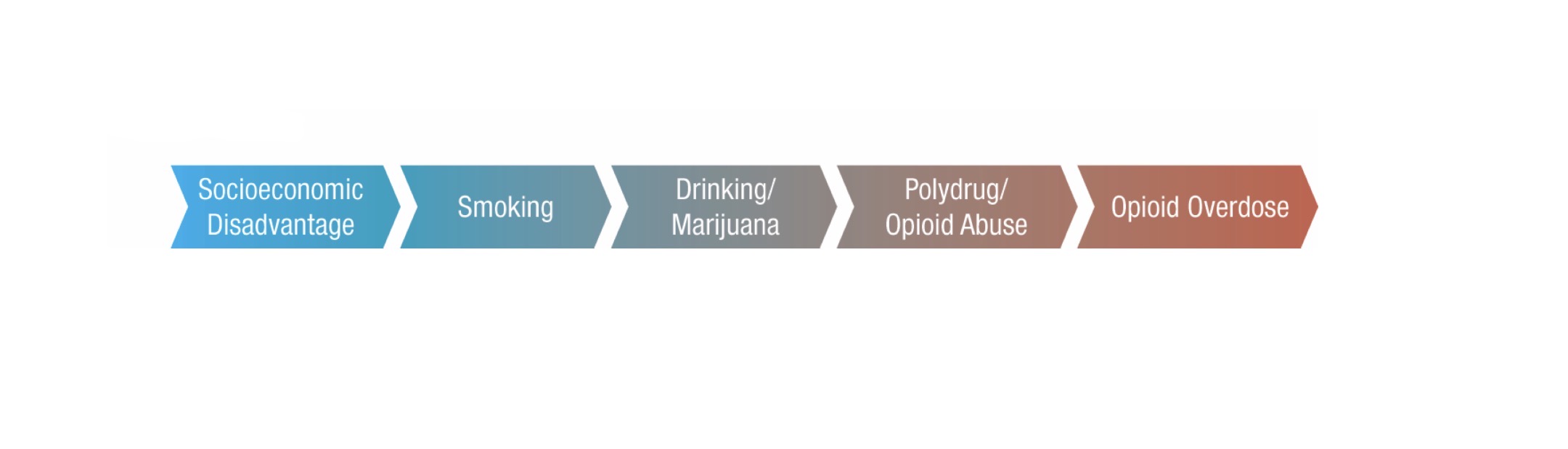
Chains of Risk [ Lecture Notes ]
Involve exposures that occurs in series
This may involve a domino-like sequence risks
Sometimes risk chains escalate, setting the individual on course toward a serious a fatal outcomes
Applied to describe cascades of health-promoting behaviors
Chains of Risk : Model
Accumulation of Risk [ Lecture Notes ]
Cumulative exposures or shocks occurring exposures throughout the life course increase the risk of disease later in life irrespective of timing
Accumulation of Risk : Model

1900s Leading Causes of Death
Influenza and Pneumonia
Tuberculosis
Gastrointestinal Infections
Heart Disease
Stroke
2000-2010s Leading Cause of Death
Heart Disease
Cancer
Unintentional Injuries
Chronic Lower Respiratory
Stroke
2020s Leading Cause of Death
Heart Disease
Cancer
COVID-19
Unintentional Injuries
Stroke
Level of Prevention : Quaternary
Prevent harm from over-medicalization or unnecessary interventions.
Ex.Matching glucose control levels to specific patient populations to avoid overmedication.
The Early Days of Public Health:
Human societies employed hunting and gathering as their predominant subsistence strategies.
Survival of early humans depended on mobility in search of water and sustenance.
At a most basic level, a primary indicator of health was staying alive.
Mid-1800s London: Edwin Chadwick advocated for improving living conditions in order to improve health….
• He argued that improved health would improve productive output and reduce social costs.
• The tie-in to public health was his proposal to provide clean water and remove wastes.
• Aligned the emerging field of public health with the economic priorities of government.
1700s and early 1800s Average life expectancy was…
Hovered around 35 to 40 years
The Evolution of Public Health in the United States: 1700s
Congress established the U.S. Marine Hospital Service (MHS)
Marked the birth of federal public health care and the direct precursor to the U.S. Public Health Services
MHS dealt with the health problems of sick and disabled seamen
MHS was the predecessor of the United States Public Health Services ( USPHS )
The Evolution of Public Health in the United States: 1800s
Chadwick advocated for improving living conditions in order to improve health
The Evolution of Public Health in the United States: Early 1900s
United States Public Health Service (USPHS ) was established
The Evolution of Public Health in the United States: Mid 1900s
Creation of the U.S. Department of Health, Education, and Welfare ( USDHEW )
The Evolution of Public Health in the United States: Late 1900s
Executive branch reorganization resulting in creation of the United States Department of Health and Human Services ( USDHHS )
Department of Health and Human Services ( HHS )
Stated mission: To enhance and protect the health and well-being of all Americans:
• Directly delivering a range of health and human services
• Promoting advances in public health and medical research
• Carrying out aspects of health policy
World Health Organization (WHO) and Global Health Services
_____ is the body charged with governance of health on a global scale.
Public health services are also delivered by:
• National and international nongovernmental agencies
• Community programs around the globe
The Evolution of Academic Schools of Public Health in the United States:
Early 1900s
The first U.S. school of public health opened
Health education curriculum was distinct from medical school training.
Initial focus was on infectious diseases.
The Evolution of Academic Schools of Public Health in the United States:
Mid 1900s
Association of Schools of Public Health (ASPH) formed
APHA-accredited graduate public health programs.
The Evolution of Academic Schools of Public Health in the United States:
Late 1900s [ 1974 ]
APHA establishes the Council on Education for Public Health (CEPH)
The Evolution of Academic Schools of Public Health in the United States:
Early 2000~2010s [ 2013 ]
ASPH becomes the Association of Schools and Programs of Public Health (ASPPH).
Communicable disease
Also known as infectious or transmissible disease
A disease that is passed from an infected person, who harbors an infectious agent such as bacteria or virus, to a previously noninfected person
Noncommunicable disease
• Also known as a nontransmissible disease
• Characterized by an absence of contagion or communicability
• “Noncommunicable” is not precisely accurate because diseases are transmitted between
people through social interaction
• Dominate higher-income countries
The primary metric used in the The Global Burden of Disease ( GBD ) study is….
The disability-adjusted life year (DALY)
Prevention benefits include…
Spares people from developing preventable illnesses
Reduces healthcare costs
Improves productivity
Enhances quality of life
Dramatic gains in life expectancy are based on three factors
Accelerating economic growth
Recognition of infectious diseases
Improved sanitation practices
Upstream:
Producing health by intervening to prevent the occurrence of the risk factor
(primordial prevention)
Producing health by adopting risk-reducing behaviors (primary prevention)
Midstream:
Secondary prevention strategies (e.g. screening) operate throughout the lifetime
Downstream
Tertiary prevention is purely a _____ approach; health has already been
compromised
The Community Health Assessment ( CHA ) is a foundational tool used by public health agencies to:
Identify community health problems and inequities.
Engage multisectoral partners in identifying solutions.
Monitor health status using SDOH measures.