B&C Psych Lecture 8 Cognition of perception
 Call Kai
 Learn
 Practice Test
 Spaced Repetition
 Match
 Flashcards
 Knowt Play
1/60

There's no tags or description
Looks like no tags are added yet.
61 Terms
What is perception, and how do the two definitions of perception differ?
Perception can be defined in two complementary ways:
1. Sensory definition
The experience resulting from stimulation of sensory receptors.
Emphasises how perception originates.
2. Functional definition
The experience that enables an organism to act adaptively upon its environment.
Emphasises why perception is important.
Main functions:
Determining what is happening.
Determining where it is happening.
Obtaining information about both the external and internal environment.
Key principle: Perception enables organisms to interpret information and use it to guide adaptive behaviour.
Why is perception considered an adaptive process, and how does the sea squirt illustrate this?
Perception is adaptive because the perceptual abilities of a species are suited to its natural habitat and behavioural needs.
Example — Sea squirt:
- Larval stage:
Swims freely through its environment.
Possesses a nervous system that supports interaction with its surroundings.
- Adult stage:
Settles in a fixed location.
Loses much of its larval nervous system as its behavioural requirements change.
Significance: The need for perceptual processing and nervous-system complexity is related to how an organism interacts with its environment.
Key principle: Perception serves behaviour and adaptation rather than simply providing an internal picture of the world.

Why is perception considered a constructive process rather than a direct representation of sensory stimulation?
Perception is a constructive process in which the brain actively interprets sensory information to create meaningful representations of the environment.
1. Detection of visual characteristics
- Neurons respond selectively to features such as:
Luminance and orientation.
Colour and movement.
Object identity.
2. Interpretation of sensory information
- The brain must determine how these characteristics relate to one another and what they represent.
3. Construction of perceptual experience
Integrates sensory information.
Considers the surrounding context.
Uses previous knowledge and expectations.
Makes unconscious inferences.
Selects the most likely interpretation.
Key conclusion: Perception is an interpretation of reality, rather than an exact reproduction of the information stimulating our sensory receptors.
Connection to earlier lectures: Sensory information provides bottom-up input, while previous knowledge and expectations contribute through top-down processing.
What is figure-ground organization, and what are its four main characteristics?
Figure-ground organization is the perceptual separation of a visual scene into foreground objects (figures) and their background (ground).
Four characteristics:
1. Figure in the foreground
The figure appears to be positioned in front of the background.
2. Background continuity
The background is perceived as continuing behind the figure.
3. Contour ownership
The boundary separating the figure and ground is perceived as belonging to the figure.
4. Perceptual grouping
Different elements of the figure are perceived as belonging together.
Key principle: The visual system organizes individual sensory elements into coherent objects that are distinguishable from their surroundings.
What does the Rubin vase demonstrate about figure-ground organization and perceptual ambiguity?
The Rubin vase is an ambiguous visual stimulus that can produce two different perceptual interpretations.
Possible interpretations:
A white vase against a dark background.
Two dark faces against a white background.
Characteristics:
The physical stimulus remains unchanged.
The observer can alternate between the two interpretations.
Both interpretations cannot normally be perceived simultaneously as figures.
Significance:
Identical sensory information can produce different perceptual experiences.
Perception depends on how the brain organizes and interprets sensory information.
Key principle: A change in perception does not necessarily require a change in sensory stimulation.


What is contour ownership, and why can the vase and faces in the Rubin figure not normally be perceived simultaneously as figures?
Contour ownership refers to the perceptual assignment of a boundary to the figure rather than the background.
In the Rubin vase:
- Vase interpretation:
The contour belongs to the vase.
The dark regions become the background.
- Faces interpretation:
The contour belongs to the faces.
The white region becomes the background.
Why the interpretations alternate:
The shared contour is assigned to one figure at a time.
Switching interpretations requires reorganizing which region owns the contour.
Key conclusion: Detecting an edge is not sufficient for object perception; the brain must also determine which object the edge belongs to.

Why is ambiguity an inherent property of ordinary visual scenes, and how does the overlapping-squares example demonstrate this?
Perceptual ambiguity occurs when the same sensory information is consistent with multiple possible arrangements of objects in the environment.
Example — Red and green shapes:
An apparently simple image can have several physically possible interpretations:
A red square is positioned in front of a green square.
The green region is a separate, irregularly shaped object.
The green object is in front of a red object whose visible portion forms a square.
Although multiple interpretations are possible, we typically perceive two overlapping squares.
Significance:
Ambiguity is not limited to optical illusions.
Sensory information does not always uniquely specify its physical cause.
The brain must select the most plausible interpretation.

Why do we perceive two overlapping squares in Figure 5.2, and what strategies does the visual system use to resolve perceptual ambiguity?
The visual system selects the most likely interpretation using perceptual organization and previous knowledge.
Why two overlapping squares are perceived:
Symmetry: The red region forms a symmetrical shape.
Familiarity: Squares are familiar, recognizable objects.
Perceptual completion:
The green region appears incomplete.
The brain interprets it as continuing behind the red square.
Likelihood: Alternative interpretations would require unlikely coincidences.
Two major strategies for resolving ambiguity:
1. Perceptual rules or heuristics
Guide how individual sensory elements are grouped and organized.
2. Previous knowledge and assumptions
Help determine which interpretation is most plausible based on experience with the world.
Key principle: The brain resolves ambiguity by constructing a likely explanation of sensory information rather than simply registering visible features.

What is Gestalt psychology, and what is its central principle concerning perception?
Gestalt psychology emerged in the early twentieth century and is associated with psychologists such as Max Wertheimer.
Developed partly as a criticism of structuralism, associated with psychologists such as Wundt.
Emphasizes the organization and relationships between sensory elements rather than studying them in isolation.
Central principle: The whole is more than the sum of its parts.
Individual sensory elements do not fully explain our perceptual experience.
The way these elements are organized contributes to the properties of the perceived whole.
Key idea: Perception involves organizing individual sensory elements into meaningful, coherent representations.
What are Gestalt laws, and why are they considered perceptual heuristics rather than absolute rules?
Gestalt laws are perceptual principles that guide the organization of sensory elements into meaningful objects and groups.
They are considered heuristics (rules of thumb) because:
They operate automatically and effortlessly.
They generally produce useful and plausible interpretations.
They do not guarantee an accurate interpretation.
Different laws can conflict and suggest competing interpretations.
Six principal Gestalt laws:
Symmetry.
Similarity.
Proximity.
Good continuation.
Closure.
Common fate.
Key principle: Gestalt laws help the perceptual system resolve ambiguity by favouring likely arrangements of sensory information.
What is the Gestalt law of symmetry, and why does symmetry influence figure-ground organization?
The law of symmetry states that elements forming symmetrical outlines tend to be perceived as belonging to the same object.
Why is it useful?
Natural objects are often symmetrical.
Empty spaces between unrelated objects are less likely to form symmetrical shapes.
Perfectly symmetrical background regions would often require unlikely coincidences.
Consequently:
Symmetrical regions are more likely to be perceived as figures.
Asymmetrical regions may be interpreted as background.
Key principle: Symmetry provides a cue for determining which regions are likely to represent coherent objects.

What is the Gestalt law of similarity, and how does it contribute to perceptual grouping?
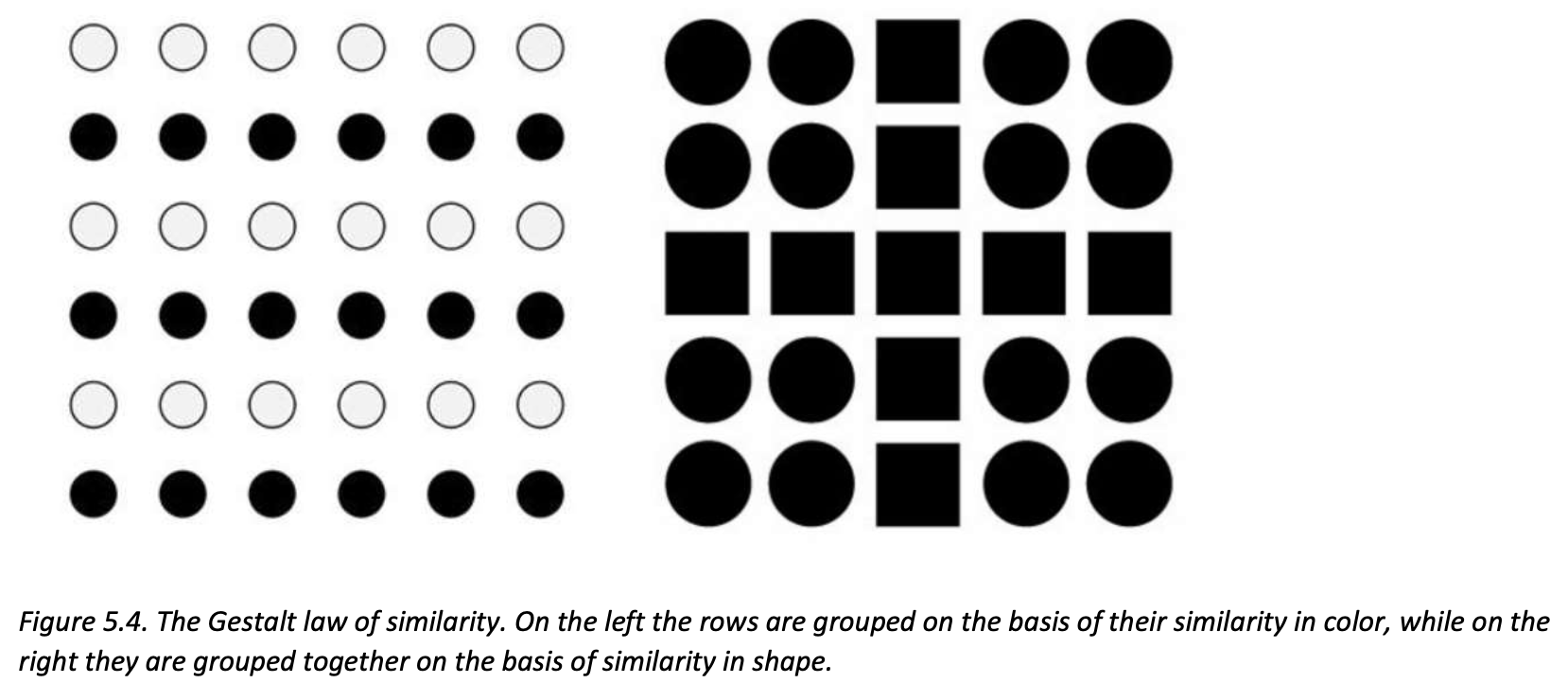
The law of similarity states that elements sharing similar characteristics tend to be perceived as belonging to the same group or object.
Grouping can be based on similarity in:
Colour.
Shape.
Orientation.
Movement.
Why is it useful?
- Different parts of the same object often share physical characteristics.
Example: Elements of the same colour may be perceived as belonging to the same row, even when all elements are equally spaced.
Connection to top-down processing — Waves by Wilma Hurskainen:
Similarity in colour and edge alignment causes parts of a woman's clothing to blend into the environment.
Previous knowledge of human bodies and clothing nevertheless helps us recognize the woman.
Key principle: Similar visual characteristics encourage grouping, but knowledge-based interpretation can influence the resulting perception.
What is the Gestalt law of proximity, and why is spatial closeness useful for perceptual organization?
The law of proximity states that elements positioned close together tend to be perceived as belonging to the same group or object.
Why is it useful?
Different components of the same object are usually located close to one another.
Spatial closeness therefore provides a cue that elements may belong together.
Example:
Columns of dots separated by alternating small and large distances.
Columns with smaller distances between them are perceived as pairs.
Key principle: Grouping depends on the relative spatial distances between elements.

What is the Gestalt law of good continuation, and how does it help the visual system organize overlapping objects?
The law of good continuation states that elements are grouped according to the smooth continuation of contours, lines and edges.
The visual system favours:
Smooth, continuous trajectories.
Contours that continue in a consistent direction.
Interpretations that avoid unnecessary, abrupt changes in direction.
Why is it useful?
Edges belonging to the same object are likely to follow continuous trajectories.
Helps maintain coherent object representations when objects overlap or partially obscure one another.
Example: Two intersecting lines are usually perceived as two continuous lines rather than separate lines that abruptly change direction at the intersection.
Key principle: Smoothly aligned contours are likely to belong together.

What is the Gestalt law of closure, and how does it allow us to perceive incomplete objects?
The law of closure states that elements forming a closed area tend to be perceived as belonging together.
Mechanism:
The perceptual system mentally completes incomplete contours.
Missing parts of a boundary can be perceptually filled in.
This produces the experience of a coherent, closed shape.
Why is it useful?
Objects normally have boundaries enclosing an area.
Parts of these boundaries may be hidden behind other objects.
Closure allows object perception despite incomplete sensory information.
Key principle: An object can be perceived as complete even when its entire boundary is not directly visible.

What is the Gestalt law of common fate, and how does movement influence perceptual grouping?
The law of common fate states that elements moving in the same direction and at the same speed tend to be perceived as belonging to the same object or group.
Characteristics:
Grouping is based on shared movement.
Elements can be grouped together despite differences in their spatial positions.
Can be considered a particular form of similarity involving motion.
Why is it useful?
Different parts of a moving object often move together.
Shared movement therefore provides information about which elements belong together.
Key principle: Common movement encourages perception of a common object or group.

How can similarity and proximity conflict, and what does this reveal about Gestalt laws?
Gestalt laws usually support the same interpretation because parts of an object often share characteristics and are positioned close together.
However, different laws can produce competing perceptual interpretations.
Example — Red circles and green triangles:
- Similarity:
Encourages grouping according to shared shape and colour.
Red circles belong together; green triangles belong together.
- Proximity:
Encourages grouping according to spatial closeness.
Nearby circles and triangles may be grouped together despite their differences.
Result: Perceptual organization becomes less straightforward because the two principles favour different arrangements.
Conclusion: Gestalt laws are heuristics rather than absolute rules because they do not always produce a single, unambiguous interpretation.

What does the Kanizsa triangle demonstrate about Gestalt organization, illusory contours and the constructive nature of perception?
The Kanizsa triangle is a visual illusion in which a white triangle is perceived despite the absence of physically drawn triangle edges.
Two possible interpretations:
Three incomplete black circles resembling Pac-Man shapes.
Three complete black circles partially obscured by a white triangle.
The perceptual system strongly favours the second interpretation.
Gestalt laws involved:
- Closure:
Missing boundaries are perceptually completed to form a closed triangle.
- Good continuation:
The aligned edges of the gaps support the perception of continuous triangle boundaries.
Illusory contours:
- Perceived boundaries that do not correspond to actual physical lines in the stimulus.
Conclusion: The visual system constructs perceptual properties that are not directly present in sensory stimulation.

What is the inverse projection problem, and why does it occur in visual perception?
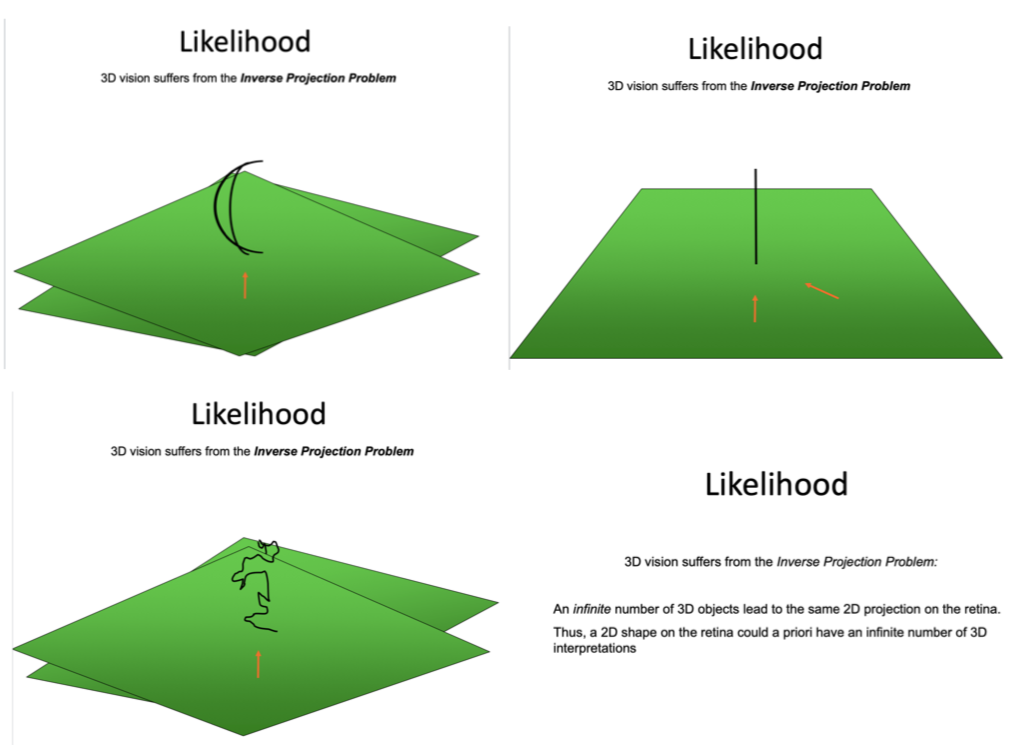
The inverse projection problem is the difficulty of determining which three-dimensional object or arrangement produced a particular two-dimensional retinal image.
Why does it occur?
The external world is three-dimensional (3D).
The image projected onto the retina is two-dimensional (2D).
An infinite number of different 3D objects could theoretically produce the same 2D retinal projection.
Consequently:
The retinal image does not uniquely specify the physical object that produced it.
The brain must infer the most likely three-dimensional arrangement.
Key principle: The visual system cannot simply reverse the retinal projection to recover a single guaranteed interpretation of reality.

How does a square-shaped retinal projection illustrate the inverse projection problem?
A single square-shaped retinal image could be produced by several different physical objects:
An actual square surface.
An irregularly shaped surface viewed from a particular angle.
A three-dimensional object whose projection happens to form a square.
Although these objects differ physically, they can produce identical two-dimensional retinal images.
Significance:
Identical sensory information can have multiple physical causes.
The retinal image alone does not uniquely determine an object's actual shape.
The brain must select the most likely interpretation.
Key principle: There is no unique correspondence between a 2D retinal image and its 3D physical source.

How does the visual system deal with the inverse projection problem, and what role does binocular information play?
The visual system must construct the most likely representation of the three-dimensional world using incomplete and ambiguous sensory information.
1. Binocular information
The two eyes receive slightly different images of the environment.
These differences provide additional depth information.
Helps reduce ambiguity about the three-dimensional arrangement of objects.
2. Interpretation without binocular information
Photographs and paintings can still produce three-dimensional perceptual experiences.
This demonstrates that binocular information is helpful but not necessary for constructing depth interpretations.
Important distinction:
The inverse projection problem is not the problem of combining images from the two eyes.
It concerns inferring the three-dimensional world from two-dimensional retinal projections.
Key conclusion: Perception involves constructing a probable interpretation rather than directly recovering physical reality from sensory stimulation.
What is Helmholtz's theory of unconscious inference, and how does it explain perception?
Hermann von Helmholtz proposed that perception involves unconscious inferences about the causes of sensory stimulation.
Unconscious inference is the process through which the perceptual system automatically infers what is happening in the environment based on available sensory information.
Characteristics:
Automatic.
Rapid.
Effortless.
Largely outside conscious awareness.
Functional significance:
Helps the brain interpret ambiguous sensory information.
Allows us to experience a meaningful percept without consciously reasoning through its possible causes.
Key principle: We experience the outcome of perceptual inference without necessarily being aware of the processes that produced it.
What is Helmholtz's likelihood principle, and how does it help resolve the inverse projection problem?
The likelihood principle states that the perceptual system selects the interpretation that most likely produced the observed pattern of sensory stimulation.
How it works:
Sensory information allows multiple physically possible interpretations.
The perceptual system considers regularities in the external world.
Interpretations requiring unusual coincidences are less likely to be selected.
The most probable interpretation becomes our perceptual experience.
Examples:
Lines that appear connected probably are connected.
Lines that appear straight probably are straight.
Symmetrical outlines probably belong to symmetrical objects.
Significance: The likelihood principle helps resolve perceptual ambiguity and the inverse projection problem.
Key principle: The brain favours the most probable interpretation, not every physically possible interpretation equally.
What is the relationship between unconscious inference and the likelihood principle?
Both concepts explain how the perceptual system constructs meaningful interpretations of ambiguous sensory information.
Concept | Function |
|---|---|
Unconscious inference | The automatic process through which the brain infers the causes of sensory stimulation. |
Likelihood principle | The principle guiding which interpretation is selected. |
Relationship:
Unconscious inference describes how perceptual interpretations are produced.
The likelihood principle describes which interpretation is favoured.
Key conclusion: Through unconscious inference, the perceptual system selects the interpretation that most likely explains the available sensory information.
How does the chair illusion demonstrate the likelihood principle and the limitations of unconscious inference?
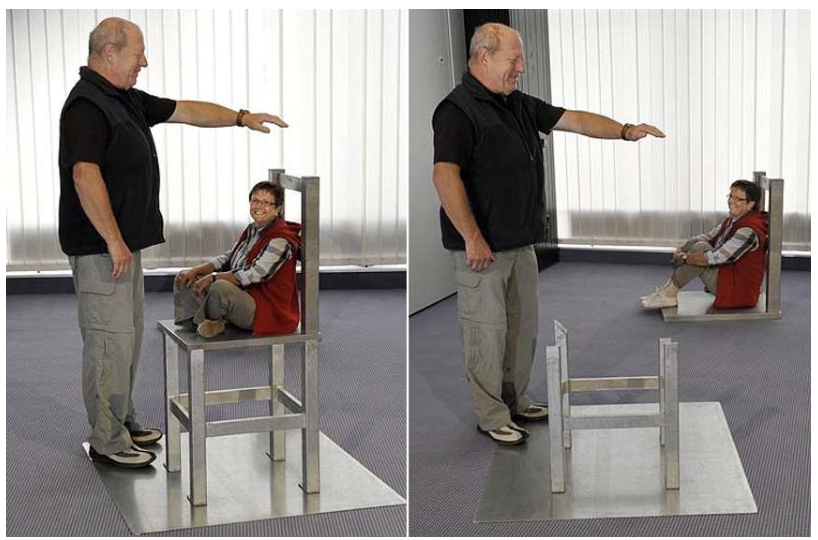
The chair illusion demonstrates how an unusual physical arrangement can produce a misleading perceptual interpretation.
Two viewpoints:
- First viewpoint:
A woman appears unusually small while sitting on a chair beside a man.
The chair appears to be one continuous object.
- Alternative viewpoint:
The chair consists of separate components positioned at different distances.
Why the illusion works:
Separate chair components are carefully aligned from a particular viewpoint.
Under ordinary circumstances, such precise alignment between unrelated objects would be unlikely.
The brain selects the more probable interpretation of a single continuous chair.
This produces an incorrect perception of the woman's relative size.
Key principle: The most likely interpretation is not necessarily the physically correct interpretation.
How do Felice Varini's viewpoint-dependent geometric illusions demonstrate the likelihood principle?
Felice Varini creates geometric patterns by painting separate elements across different surfaces within a room.
From a specific viewpoint:
Separate elements appear to form a coherent geometric shape.
Examples include a rectangle or square with diagonal lines and an annulus (a ring bounded by two concentric circles).
From other viewpoints:
The coherent geometric pattern disappears.
The separate painted surfaces become apparent.
Explanation:
It would normally be unlikely for unrelated lines across different surfaces to align so precisely.
The perceptual system therefore interprets them as belonging to a coherent geometric pattern.
Significance: Deliberately constructed, unlikely arrangements can mislead unconscious inference by producing sensory information normally associated with more probable arrangements.

How does the likelihood principle explain why the six Gestalt laws are effective perceptual heuristics?
The likelihood principle explains why Gestalt laws generally produce useful interpretations: they reflect regularities in the external world.
Gestalt law | Explanation based on likelihood |
|---|---|
Symmetry | Objects are more likely to be symmetrical than accidental gaps between objects. |
Similarity | Parts of the same object often share visual characteristics. |
Proximity | Parts of the same object tend to be spatially close together. |
Good continuation | Continuous edges are more likely than unrelated edges that coincidentally align. |
Closure | Objects generally occupy bounded areas, even when parts are hidden. |
Common fate | Elements moving together are likely to belong to the same object. |
Example — Kanizsa triangle:
Three independent Pac-Man shapes could theoretically have perfectly aligned gaps.
However, this would require an unlikely coincidence.
A white triangle partially covering three black circles provides a more probable interpretation.
Important distinction: The likelihood principle is not itself a Gestalt law. It explains why Gestalt laws are generally useful.


How does the likelihood principle explain figure-ground organization and contour ownership in the Rubin vase?
The likelihood principle explains why a shared contour is normally perceived as belonging to one figure rather than two separate figures simultaneously.
If the contour belonged to both the vase and the faces:
Separate objects would need to have exactly matching contours.
They would need to be viewed from precisely the correct position.
Their boundaries would need to align perfectly.
Such an arrangement would require an unlikely coincidence.
More probable interpretations:
The contour belongs to the vase, while the faces form the background.
The contour belongs to the faces, while the vase forms the background.
Conclusion: The perceptual system typically assigns contour ownership to one figure because this provides a more likely interpretation of the sensory information.

How does familiarity influence perceptual organization, and why is previous experience important for perception?
Familiarity influences perception because previously acquired knowledge helps the brain determine which interpretation of sensory information is most likely.
Through experience, we learn:
Statistical regularities of the environment.
Typical shapes of objects.
Normal appearances of familiar stimuli, such as people and clothing.
How different object properties tend to occur together.
Relationship to Gestalt psychology:
The original Gestalt psychologists believed that perceptual grouping rules were inborn.
Experience is now also understood to contribute to perceptual organization.
Key principle: Perceptual organization depends not only on general grouping principles but also on learned knowledge about the environment.
How can familiarity change our perception of a stimulus even when the physical stimulus remains unchanged?
Previously acquired knowledge can change how the brain organizes and interprets ambiguous sensory information.
Lecture demonstration:
An unfamiliar image is presented.
The observer initially struggles to recognize a meaningful pattern.
The observer discovers what the image represents.
New knowledge about the stimulus is acquired.
The same image is presented again.
Recognizing the meaningful pattern becomes considerably easier.
Explanation:
The bottom-up sensory information remains unchanged.
The observer's top-down knowledge has changed.
This knowledge influences how the sensory elements are organized and interpreted.
Conclusion: Identical sensory stimulation can produce different perceptual experiences depending on the observer's knowledge and familiarity.

How do bottom-up and top-down processing differ, and how do they interact to produce perception?
Perception involves the interaction between incoming sensory information and existing knowledge.
1. Bottom-up processing (stimulus-driven)
Begins with incoming sensory information.
Driven by the physical characteristics of a stimulus.
Provides sensory evidence about the environment.
2. Top-down processing (knowledge-driven)
Begins with existing knowledge, expectations and assumptions.
Influenced by previous experience and familiarity.
Influences how incoming sensory information is interpreted.
Interaction:
Bottom-up processing provides information about the stimulus.
Top-down processing helps determine its meaning.
Together, they contribute to the resulting perceptual experience.
Key principle: Perception is not a purely bottom-up process but an interaction between sensory evidence and existing knowledge.

How does the assumption that light comes from above demonstrate the influence of top-down processing on depth perception?
The perceptual system generally assumes that illumination comes from above.
This assumption influences how patterns of light and shadow are interpreted.
Mechanism:
1. Bottom-up information
The eyes receive a particular pattern of light and dark shading.
2. Top-down assumption
The brain interprets the shading based on the assumption that the light source is above the object.
3. Perceptual interpretation
The surface may be perceived as either protruding or indented, depending on the orientation of the shading.
4. Changing stimulus orientation
Rotating the stimulus can reverse the perceived depth, even though the underlying shading pattern remains equivalent.
Significance: Depth perception depends not only on sensory information but also on assumptions about regularities in the environment.

What is perceptual constancy, and what are the three main types of perceptual constancy?
Perceptual constancy is the ability to perceive stable properties of objects despite changes in the sensory information reaching our receptors.
Type | Source of variability | What remains constant |
|---|---|---|
Object constancy | Viewing angle | Object identity |
Size constancy | Viewing distance | Object size |
Colour and brightness constancy | Lighting conditions | Surface colour and brightness |
General mechanism:
The perceptual system identifies stable properties of objects.
It compensates for variability caused by contextual factors.
Key principle: Changes in retinal stimulation do not necessarily produce changes in perceived object properties.
What is object constancy, and how does the visual system achieve it despite changes in viewing angle?
Object constancy is the ability to recognize an object as the same object despite changes in its appearance from different viewpoints.
Example — A chair:
Viewing a chair from the front, side or above produces different retinal images.
Nevertheless, we recognize it as the same object.
Two important contributing factors:
1. Familiarity
Previous knowledge helps identify objects from different perspectives.
2. Non-accidental properties (NAPs)
Relatively stable structural characteristics provide information about object identity across different viewpoints.
Key principle: Object recognition does not depend on an object producing an identical retinal image every time it is viewed.

What are non-accidental properties (NAPs), and what are the four main examples?
Non-accidental properties (NAPs) are visual properties of objects that remain relatively stable across different viewing angles.
They are also referred to as viewpoint-invariant properties.
Four important NAPs:
1. Parallelism
Edges running parallel to one another.
2. Cotermination
Two or more lines sharing a common endpoint.
3. Symmetry
Correspondence between different parts of a shape.
4. Straightness
Edges being straight rather than curved.
Functional significance: NAPs provide relatively reliable information about an object's underlying structure despite changes in its retinal projection.


Why are non-accidental properties called non-accidental, and how do they relate to Helmholtz's likelihood principle?
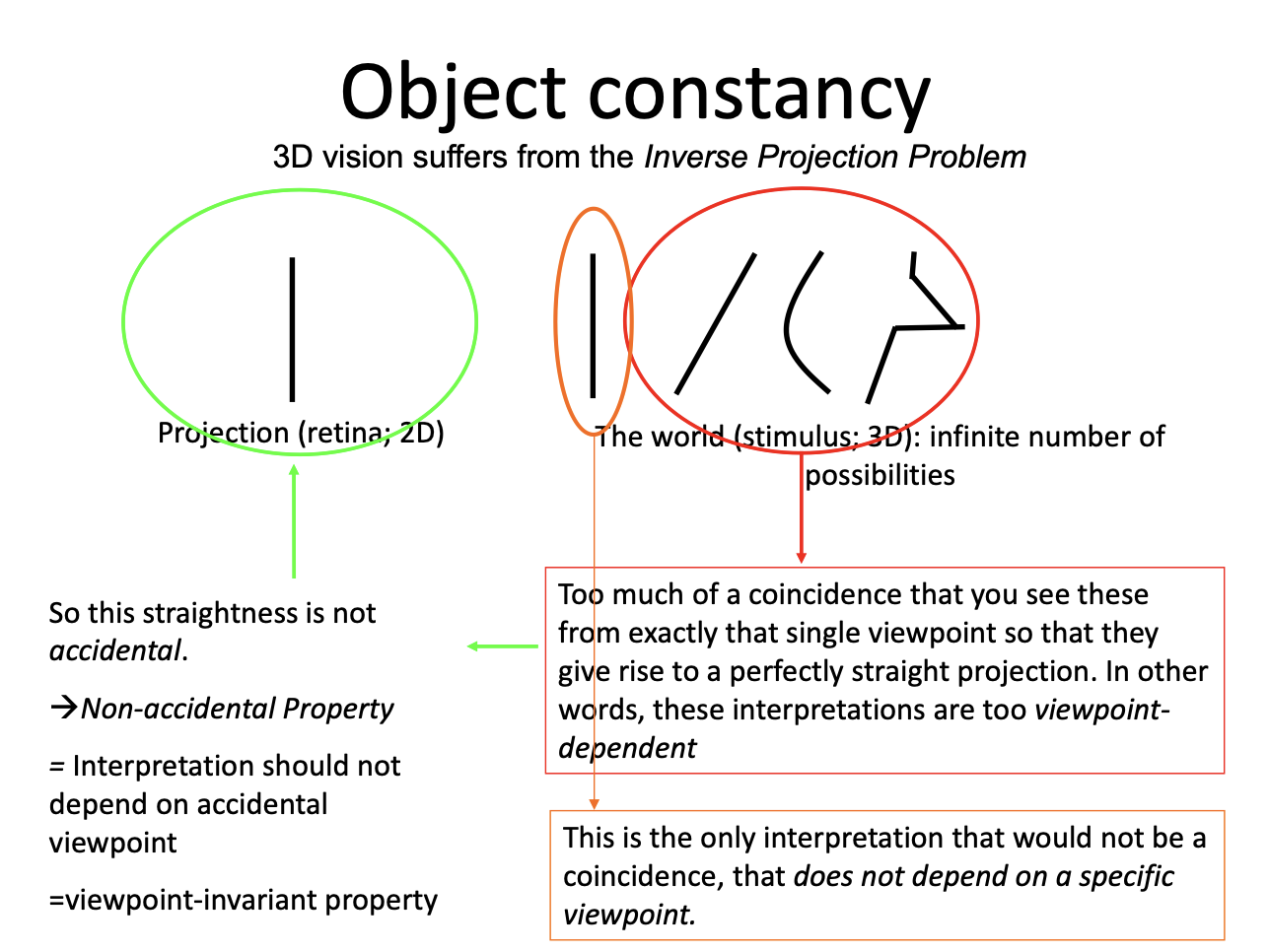
Non-accidental properties are considered reliable cues because their presence in a retinal image is unlikely to result from an accidental viewing angle.
Example — A straight line:
There are two possible interpretations:
The physical line is genuinely straight.
The physical line is not straight but is viewed from a highly specific angle that produces a straight retinal projection.
According to the likelihood principle:
The first interpretation is generally more probable.
The second requires an unusual coincidence involving the viewing angle.
The same reasoning applies to other NAPs, including parallelism, cotermination and symmetry.
Key principle: NAPs provide reliable information about the actual structure of objects because they are unlikely to arise purely by chance.
How do non-accidental properties contribute to object constancy and recognition across different viewpoints?
NAPs allow the visual system to identify relatively stable structural characteristics of objects despite changes in their retinal projections.
Example — Recognizing a cube:
A cube contains:
Straight edges.
Parallel edges.
Edges sharing common endpoints (cotermination).
Symmetrical properties.
When the cube is rotated:
Its two-dimensional retinal projection changes.
Many of its underlying structural properties remain recognizable.
The visual system uses these properties to identify the object across viewpoints.
Conclusion: NAPs help overcome the variability of retinal projections, contributing to stable object recognition.
Important: Not every NAP remains visible from every viewing angle.

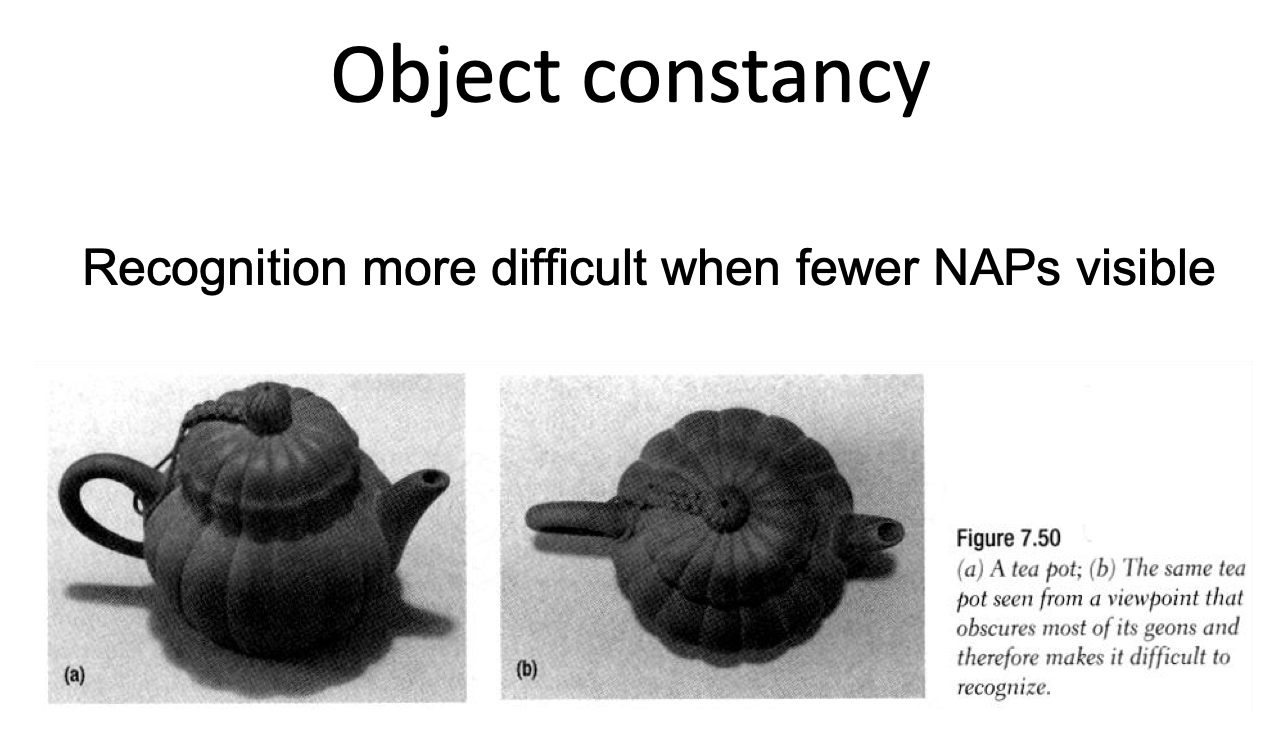
What evidence demonstrates that non-accidental properties are important for object recognition?
Object recognition becomes more difficult when fewer non-accidental properties are visible.
This can occur when:
An object is viewed from an unusual angle.
Important structural characteristics are occluded.
The viewing angle prevents certain properties from being distinguished.
Lecture example — Teapot:
- Typical viewpoint:
More distinctive structural properties are visible.
The teapot is relatively easy to recognize.
- View from above:
Fewer distinctive structural properties are visible.
Recognizing the teapot becomes more difficult.
Conclusion:
Object recognition depends partly on the availability of non-accidental properties.
Object constancy is not equally successful across all possible viewpoints.
Key principle: Fewer visible NAPs → Less structural information → Greater difficulty recognizing an object.
What is size constancy, and why does accurate size perception depend on accurate distance perception?
Size constancy is the ability to perceive an object's size as relatively constant despite changes in viewing distance and the size of its retinal projection.
Mechanism:
An object moves further away.
Its retinal projection becomes smaller.
The perceptual system estimates the object's distance.
It compensates for the change in retinal image size.
The perceived physical size remains relatively constant.
The perceptual problem:
A small retinal image could represent a genuinely small object nearby.
Alternatively, it could represent a large object further away.
Key principle: Accurate size perception depends on accurate distance perception.
What are the two main sources of depth information, and how do they differ?
The visual system uses two sources of information to estimate depth and distance.
1. Binocular depth information
Based on differences between the images received by the two eyes.
Binocular disparity provides information about depth.
2. Pictorial depth cues
Characteristics of a visual image that provide information about distance.
Can be used without binocular information.
Explain why depth can be perceived in two-dimensional photographs and paintings.
Eight pictorial depth cues:
Occlusion.
Relative height.
Relative size.
Shading.
Knowledge.
Atmospheric perspective.
Linear perspective.
Texture gradient.
Key principle: Binocular information is useful for depth perception but is not necessary for constructing a three-dimensional interpretation.
What is occlusion, and how does it provide information about depth?
Occlusion occurs when one object partially blocks another object from view.
Perceptual interpretation:
The object blocking another is perceived as closer.
The partially hidden object is perceived as further away.
Example: A tree partially blocking a house is interpreted as being in front of the house.
Important distinction: Occlusion provides information about the relative depth of objects rather than their exact distances.
