Anatomy Exam 2
 Call Kai
 Learn
Learn Practice Test
 Spaced Repetition
 Match
Match Flashcards
 Knowt Play
1/121

There's no tags or description
Looks like no tags are added yet.
Name | Mastery | Learn | Test | Matching | Spaced | Call with Kai | Chat |
|---|
No analytics yet
Send a link to your students to track their progress
122 Terms
Skull
22 bones total
8 cranial, 14 facial
Vertebral column
vertebrae, sacrum, coccyx
Thoracic column
ribs & sternum
Pectoral girdle
clavicle & scapula
Upper limb
arm, forearm, wrist/hand
Pelvic girdle
pelvic bones & sacrum
functions to support the upper limb, attachment site for many muscles
Lower limb
thigh, leg, ankle/foot
Sternal end of clavicle
articulates with manubrium at the sternum
forms sternoclavicular joint
Acromial end of clavicle
articulates with the acromion
forms acromioclavicular join
Three edges of scapula
medial, lateral, superior
Three points of scapula
superior, inferior, lateral
Three pelvic bones
Ilium, ischium, and pubis
fused during childhood
Pelvis
pelvic bones, sacrum, and coccyx
Pelvic inlet
defines the boundary between the greater and lesser pelvis
Femur
largest and strongest bone in body
head articulates with the acetabulum, and this forms the hip joint
Fovea capitis
pit in the center of the head where a ligament from the acetabulum attaches to stabilize the joint
What is the weakest part of the femur which is fracture prone?
the neck
What does the patella articulate with?
patellar surface
Where do the tibia and fibula articulate?
distal and proximal tibiofibular joint
united by interosseous membrane
What is more commonly fractured in ankle injuries?
the fibula because it is thinner and therefore weaker
stabilizes the ankle joint
What are the three arches of the foot?
transverse, medial longitudinal, and lateral longitudinal
Functions of bone
protection, mineral storage, acid-base homeostasis, movement, and support
What occurs in yellow bone marrow?
fat storage
What occurs in red bone marrow?
hematopoiesis
blood cell formation
Long bones
longer than they are wide, surface covered in periosteum
ex: humerus
What composes short, flat, irregular, and sesamoid bones?
two layers of compact bone surrounding a layer of spongy bone
periosteum is above compact
What does bone (osseous) tissue consist of?
mainly ECM with cells scattered throughout
Extracellular matrix
65% inorganic matrix
calcium salts + phosphorus salts = hydroxyapatite crystals
35% organic matrix (osteoid)
Mainly collagen
Hydroxyapatite crystals
make bones able to resist compression
Dipole
spongy bone
Periosteum
composed of dense irregular collagenous CT richly supplied with blood vessels and nerves
attached to underlying bone by perforating fibers
Short bones
about as long as they are wide, cube shaped
ex: carpals
Flat
thin and broad
ex: sternum
Sesamoid bones
small relatively flat, oval-shaped bones in tendons
ex: patella
Irregular bones
outside of all other categories
ex: vertebrae
Osteoblasts
build bone and carry out bone deposition
derived from osteogenic cells → osteocytes
in inner periosteum and endosteum
Osteocytes
maintains bone
located in lacuna
Osteoclasts
break down bone and participates in bone reposition
in shallow depressions on the internal and external surface of bone
Compact bone
contains osteons, lacunae, and central canal
covered in periosteum
Central canal
surrounds blood vessels and nerves that supply the osteon
Lacunae
small cavities located between lamellae that house osteocytes
connected via canaliculi
Spongy bone
a non-weight bearing bone which means it is not a dense structure
forms protective framework for bone marrow
located in inner portions of bone
Trabeculae
branching structure of bone
contains concentric lamellae
Process of ossification
primary bone (immature) -> reabsorbed by osteoclasts -> replaced by secondary bone (mature)
Intramembranous ossification
occurs during fetal development
inner spongy bone forms before the outer compact bone
many flat bones, skull, clavicle
Endochondral ossification
most occurs during development, some finishes in childhood
built on a hyaline cartilage model
all bones below the head excluding clavicles
Longitudinal growth
growth in length
long bones
Appositional growth
growth in width
all bones
Testosterone (in relation to bone growth)
increases appositional bone growth and mitosis at epiphyseal plate
why males are taller
Estrogen (in relation to bone growth)
increases longitudinal bone growth, inhibits osteoclasts, and accelerates closure of epiphyseal plate
Vitamin D
aids in calcium ion absorption
Calcium
bone deposition
Parathyroid hormone
increases blood calcium concentration when it gets low
Calcitonin
decreases blood calcium level when concentration gets high
Functions of connective tissue
connecting (connect structures in body), binding (tissue layers together), support (bone and cartilage support weight of body), protection (bone tissue protects internal organs), and transport (blood)
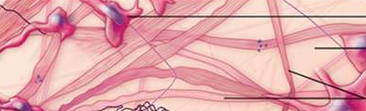
Loose connective tissue
support, protection, and houses blood vessels supply for epidermis
located deep in the epidermis, walls of hollow organs, and membranes lining body cavities

Dense irregular connective tissue
strength and resistance to stress in all three planes
found in deepest layer of skin and around joints/organs

Dense regular collagenous connective tissue
strength and resistance to stress in one plane (parallel collagen fibers)
found in tendons and ligaments

Dense regular elastic connective tissue
allows tissue to stretch and recoil
found in large blood vessels and certain ligaments

Reticular connective tissue
forms internal structure of many organs and supports smaller vessels/nerves
found in lymph nodes, spleen, bone marrow, liver, basement membrane, and around vessels/nerves

Adipose connective tissue
warmth, insulation, shock absorption, protection, and major energy reserve in body
deep to the skin and surrounds heart/abdominal organs

hyaline cartilage

fibrocartilage

elastic cartilage

Osseous (bone) tissue

Blood tissue

skeletal
striated, voluntary, multinucleated, with nuclei near the outer edges
attached to skeleton

smooth muscle tissue
no striations, involuntary, flattened cells, with single ovoid nucleus in center of cells

cardiac muscle
striations, involuntary, with intercalated discs
in heart

nervous tissue
neurons and neuroglial cells
in brain, spinal cord, and nerves
Neuroglial cells
anchors neurons and blood vessels in place, monitors extracellular composition, increases rate of impulse transmission, and circulates surrounding fluid of brain and spinal cord
Neurons
generate, conduct, and receive information in the form of nerve impulses
Epithelial tissue
protection for underlying tissue, immune defense against pathogens, secretion, transport into other tissues, and sensation
Components of epithelial tissue
consist of closely packed cells joined by tight junctions and desmosomes
basement membrane holds basal lamina, reticular lamina, and ECM
Simple epithelium
often found lining hollow organs and surfaces where substances must be diffused or transported
Paracellular transport
substance passing through narrow space between the cells
Transcellular transport
substance entering and diffusing through one cell through cytosol
Simple squamous epithelium
barrier that gases and fluid exchange, produces serous fluid
lines lungs, ventral cavities, blood vessels, and kidney
Simple cuboidal epithelium
absorption and secretion
lines kidney, lower respiratory, thyroid, salivary, and mammary glands
Pseudostratified columnar epithelium
secretes mucus and propels it with ciliary motion
lines trachea, nasal cavity, parts of urethra
Simple columnar epithelium
absorption, secretion, and propulsion of egg through uterine tube
lines pancreatic duct
Nonkeratinized stratified squamous epithelium
protection from mechanical stress and microorganisms
found in vagina, anal canal, mouth, pharynx, larynx, and esophagus
very flat cells
Keratinized stratified squamous epithelium
protection from mechanical stresses and microorganisms, as well as prevent water loss through skin
found in epidermis
apical cells dead and flaky
Stratified cuboidal epithelium
absorption and secretion
found in ducts of sweat glands
Stratified columnar epithelium
protection as well as secretion and absorption
found in ducts of certain glands, conjunctiva, and parts of male urethra
Transitional epithelium
protection and gives tissues distensibility
found in ureter, urethra, and urinary bladder
Exocrine glands
release secretions to apical surface via ducts
Unicellular exocrine gland
single cell, most common is a goblet cell which secretes mucus
Multicellular exocrine gland
composed of clusters of secretory cells
can be either tibular, acinar, or tubuloacinar
simple: don’t branch
compound: branch
Endocrine glands
secrete products directly into bloodstream and which facilitates longer-action and communicates further
Merocrine secretion
package products into secretory vesicles for release by exocytosis
salivary and sweat glands
Holocrine secretion
cells accumulate their product in cytosol and product is not released until cell ruptures and dies
sebaceous glands
Apocrine secretion
portions of cytoplasm pinched off with product being secreted
lipid droplet secretion in lactating mammary glands
Regeneration
damaged tissue is replaced with same tissue during healing, function of tissue is completely restored
epithelial, connective tissue (except cartilage), and smooth muscle tissue
Fibrosis
damaged tissue is replaced with fibrous connective tissue during healing, function is not regained and results in formation of scar tissue
cardiac muscle, skeletal, and cartilage CT
How does nervous tissue repair?
undergoes mitosis and divides, replaced by neuroglial cells to produce scar if neurons damaged, if cell body damaged it may undergo regeneration
Cutaneous membrane
epidermis (keratinized stratified squamous) and dermis (loose connective/dense irregular)
Loose connective tissue below cutaneous
hypodermis, superficial fascia, and subcutaneous tissue
anchor skin to muscle and bone
Functions of integumentary system
protection, sensation, thermoregulation, excretion, and vitamin D synthesis
Superficial layer of dermis
papillary layer composed of loose connective tissue