Ethers, Epoxides, and Sulfur Compounds
 Call Kai
 Learn
 Practice Test
 Spaced Repetition
 Match
 Flashcards
 Knowt Play
1/14

There's no tags or description
Looks like no tags are added yet.
15 Terms

Modified acid catalyzed hydration
R=alkyl group
Carbocation tendency to rearrange.
Markovinikov.

Modified Oxymercuratio/ Demercuration
markovinikov
Features alcohol instead of water
This will not do a carbocation rearangement

Epoxidation via halohydrin
X can be Br or Cl
Stereochemistry is syn

Acid-catalyzed ether formation
SN2
Happens at low temperature to encourage substitution
only forms symmetrical ethers
Only from primary alcohols

Williamson Ether synthesis
NaH strong base
SN2 reaction
non-symmetrical
step 2 needs a primary alkyl halide not a secondary or tertiary.

tertiary ether cleavage with HX
needs heat because the ether is unreactive without heat.
SN2
connect the halogen where it is cut.

primary ether cleavage with HX
It is like adding the X where you cut it off.

Acid-catalyzed Epoxide (SN2-ish)
opens in an anti. Inversion where we attack.
If it is tertiary, the epoxide will slightly disconnect itself to where the chloride ion will take the chance to attack.
If the highest substitution is secondary, the nucleophile will attack the less substituted side.
If the highest substitution is tertiary, the nucleophile will add to the more substituted side.

Another acid-catalyzed Epoxide
It is dissolved in methanol which makes it an acidic solution. It makes the two reagents react instantly together. You will use the protonated and neutral version of methanol instead of using HCl.

base-catalyzed epoxide
There will be two steps.
If we are in basic conditions. Nucleophile will attack the most accessible side
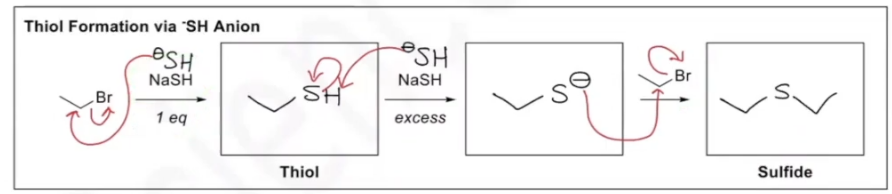
thiol formation via SH anion
this pathway only works in high yields if 1 equivalent of hydrosulfide is used

Disulfide bond formation
two eq of a thiol can be oxidized into a disulfide using either Br2 or I2 in aq hydroxide. Can be reverse by zinc and acid.

sulfide formation (from thiol)
thiolate is not as strong of a base as the alkoxide. secondary alkyl halides can be used successfully as well.

sulfoxide and sulfone formation
peroxide is a stronger oxidizing agent, and if excess is present it will continue to oxidize the sulfoxide to the sulfone.

Sulfonum ion formation
SN2.
sulfide will react with alkyl halides to generate sulfonium ions. These ions can act as leaving groups in future substitution reactions