lecture 1 dna packaging & the nucleus
 Call Kai
 Learn
 Practice Test
 Spaced Repetition
 Match
 Flashcards
 Knowt Play
1/36

There's no tags or description
Looks like no tags are added yet.
37 Terms
Most prokaryotic cells have a ______ ________ ___ molecule with an
average size of __ ________ _____?
single circular DNA, 20 kilobase pair
bacterial chromosome is referred to as the what?
nucleoid
what’s negatively supercoiled, extensively folded, and complexed to a few proteins?
The bacterial chromosome (nucleoid)
The human genome contains ________ base pairs in __ different
molecules _ copies of each = _ chromosomes?
3.2 billion, 23, 2, 46
the length of all the DNA in one cell’s nucleus if you stretched it out end to end?
3.5 meters
The cell is __-__ across. The _______, which sits inside the cell and holds the DNA, is about __ across?
30–50 μm, nucleus, 10 μm
DNA is wrapped around what kind of protien to form chromatin?
histone protiens
what are the 5 different histone protiens?
H1, H2A, H2B, H3, & H4
2 copies each of H2A, H2B, H3, H4 form what?
the histone octamer

how is a nucleosome core particle produced? (appears as beads on a string)
dna wraps twice around a histone octamer
what separates nucleosome core particles, and how much DNA is in one nucleosome repeat?
linker dna separates neighboring core particles (≥50 base pairs).
one core particle plus its linker dna makes up a nucleosome repeat of ~200 base pairs.
whhat composes the nucleosome “bead”?
see image


why does partial nuclease digestion of chromatin produce gel bands at ~200, 400, 600, and 800 bp?
nuclease mainly cuts linker dna because histones protect the DNA wrapped around them. partial digestion leaves some linkers intact, so the gel shows fragments containing 1, 2, 3, or 4 nucleosome repeats, each adding about 200 bp.
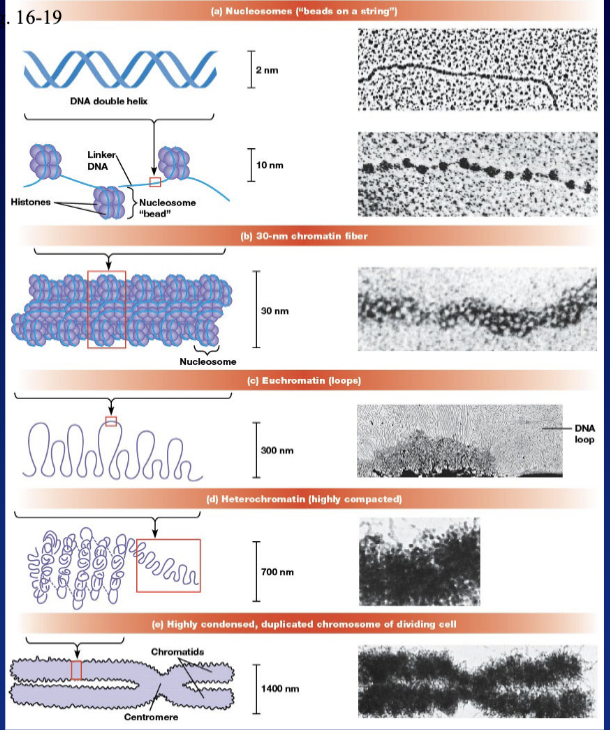
how do euchromatin and heterochromatin differ in condensation and availability for transcription?
euchromatin = decondensed chromatin → available for transcription
heterochromatin = condensed chromatin → not available for transcription
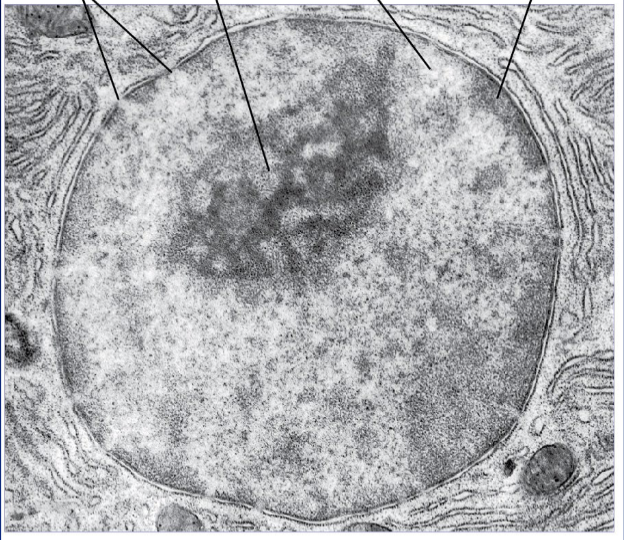
how can you tell euchromatin from heterochromatin in this electron micrograph?
euchromatin appears lighter because it is decondensed.
heterochromatin appears darker because it is condensed. It often clusters along the inner edge of the nucleus.
how is chromatin “packing” regulated
by modifying specific lysine residues
histone ______ leads to tighter packing? and what histones are used in this process?
histone methylation, uses histones methyltransferase and demethylase
histone ______ leads to looser packing? and what histones are used in this process?
histone acetylation, uses histones acetyletransferase and deacetylase

why would other chromatin remodeling proteins reposition nucleosomes?
to make dna more accessible
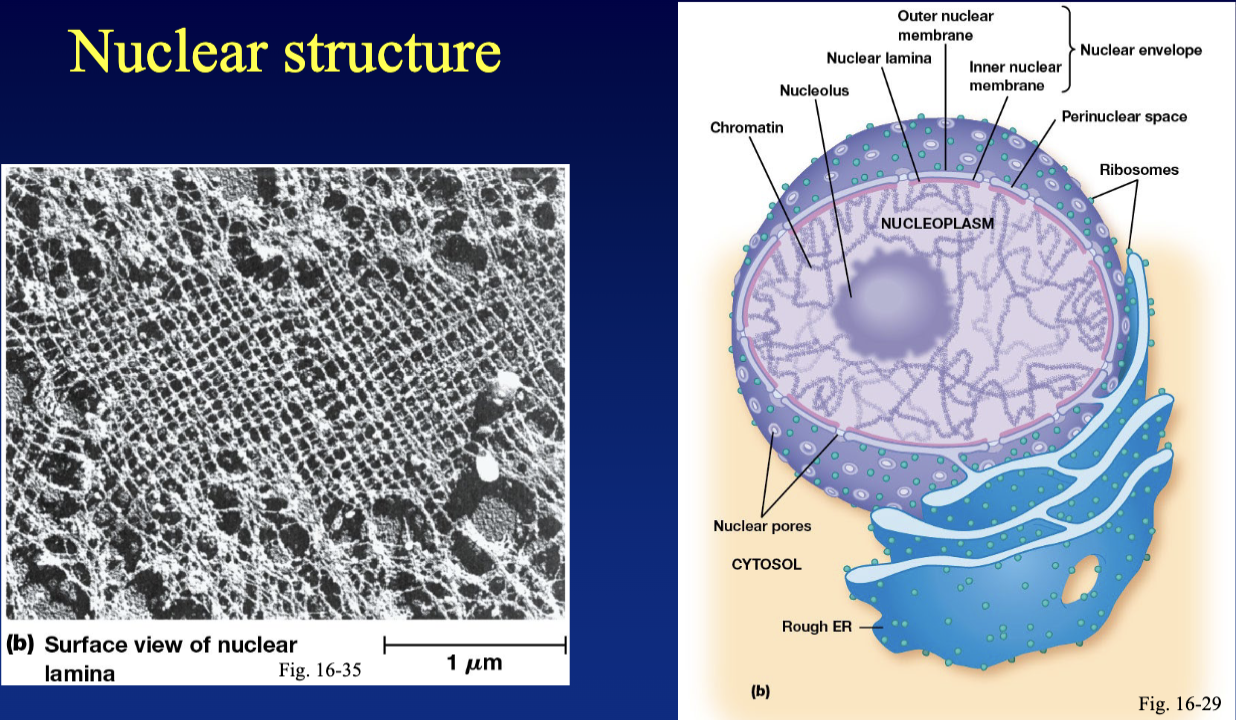
the nucleus has a complex structure. what is the nuclear lamina, and what does it do?
the nuclear lamina is a meshwork of intermediate filaments (different proteins) called lamins that lines the inner nuclear membrane.
they play a role in support and cellular structural integrity.
movement of molecules in and out of the nucleus occurs through what? and how many are in each nucleus?
nuclear pores, 3000-4000 per nucleus

most molecules that must cross the nuclear membrane via pores are actively transported. they’re typically larger than?
larger than 40 kD (kiloDaltons)
the proteins that line the pore are called what? and portions of this extend into the pore and have many what that are common in intrinsically disordered proteins?
nucleoporins, many FG repeats (a recurring pair of amino acids)
protiens larger than 40kD need to possess what to pass thru the nuclear pores?
a nuclear localization signal (NLS)
a series of lysine and or arginine residues bound by the protein importin which is able to navigate through the FG repeats and transport the cargo into the nucleus
nuclear localization signal (NLS)
what does a nuclear localization signal (nls) tell importin?
it tells importin which protein to carry into the nucleus. if the signal is disrupted, the protein stays in the cytosol.
what is the sequence of events in nuclear import, and how are importin and ran recycled?
1. in the cytosol, importin binds the cargo’s nuclear localization signal (nls). they enter the nucleus through a nuclear pore.
2. in the nucleus, ran-gtp binds importin, causing it to release the cargo.
3. importin and ran-gtp return to the cytosol together.
4. in the cytosol, ran-gap stimulates gtp hydrolysis. ran becomes ran-gdp and releases importin.
5. ran-gdp returns to the nucleus via diffusion, where ran-gef helps it exchange gdp for gtp.

most mrna diffuses from the nucleus into the cytosol without exportin or ran. export of other rna (rrna, mirna) from the nucleus requires proteins in the nucleus that possess what to bind to the rna?
a nuclear export signal (NES)
what is the sequence of events in nuclear export, and how are exportin and ran recycled?
in the nucleus, exportin binds cargo with a nuclear export signal (nes) and binds ran-gtp.
the complex exits the nucleus through a nuclear pore.
in the cytosol, ran-gap stimulates gtp hydrolysis. ran-gtp becomes ran-gdp, the complex comes apart, and the cargo is released.
exportin and ran-gdp return to the nucleus separately via diffusion.
ran-gef helps ran exchange gdp for gtp.
where are ran-gtp and ran-gdp most concentrated, and why?
ran-gtp is high in the nucleus because ran-gef promotes the exchange of gdp for gtp.
ran-gdp is high in the cytosol because ran-gap stimulates gtp hydrolysis.
how does the ran-gtp gradient drive nuclear import and export against cargo concentration gradients?
export: ran-gtp helps exportin bind cargo in the nucleus. in the cytosol, gtp hydrolysis causes cargo release.
import: ran-gtp binds importin in the nucleus, causing cargo release. importin returns to the cytosol, where it can pick up more cargo.
what sequence dictates an RNA sequence, which dictates what sequence? this is known as the central dogma of molecular biology.
a dna sequence, an amino acid sequence (a protein)

whats the definition of dna and whats it’s functional unit?
dna: the encoded hereditary information
functional unit of dna is known as a gene
gene
The sequence of DNA that directs the synthesis of a polypeptide
rna has many roles in protein synthesis. describe the roles of mrna, trna, and rrna.
mrna carries the instructions that the ribosome reads to make a polypeptide.
trna matches its anticodon to an mrna codon and delivers the corresponding amino acid.
rrna combines with proteins to form ribosomes and catalyzes peptide bond formation.

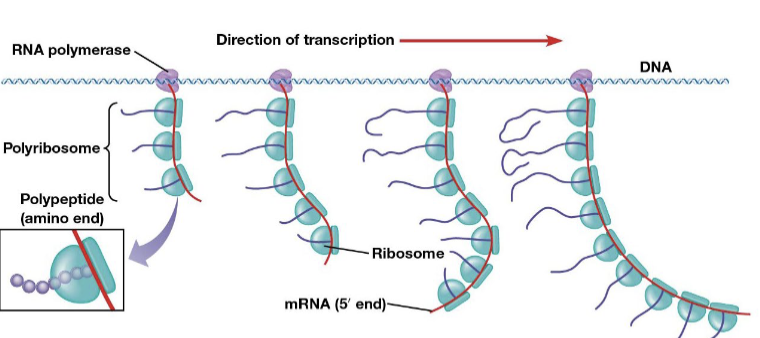
how do prokaryotes and eukaryotes differ in where and when transcription and translation occur?
prokaryotes: both occur in the cytoplasm. ribosomes can start translating mrna while it’s still being transcribed.
eukaryotes: transcription produces pre-mrna in the nucleus. the pre-mrna is processed into mature mrna, which exits the nucleus and is translated in the cytoplasm.

what does it mean that transcription and translation are coupled in bacteria?
ribosomes can start translating the 5′ end of an mrna while rna polymerase is still making the rest. multiple ribosomes can translate that same mrna at once, forming a polyribosome.