Art History fall 2026 | Lori Neuenfeldt TCU Exam 3
 Call Kai
 Learn
 Practice Test
 Spaced Repetition
 Match
 Flashcards
 Knowt Play
1/119

There's no tags or description
Looks like no tags are added yet.
120 Terms
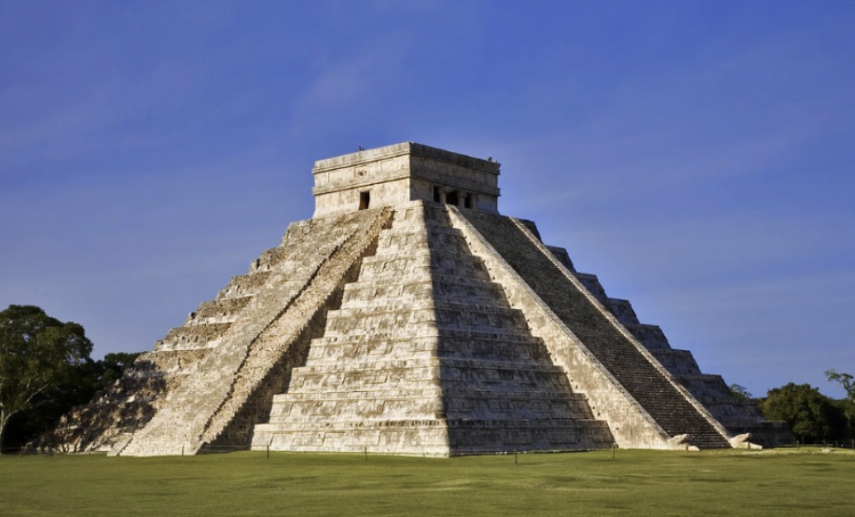
What is this
El Castillo
Maya
in Chichén Itzá

What does the meaning and form refer to?
The underworld
The sun
The feathered serpent

Culture, place and date
Mesoamerica, Maya
Chichén Itzá
ca, 800 CE

What is this
Purse cover
from Sutton Hoo ship burial
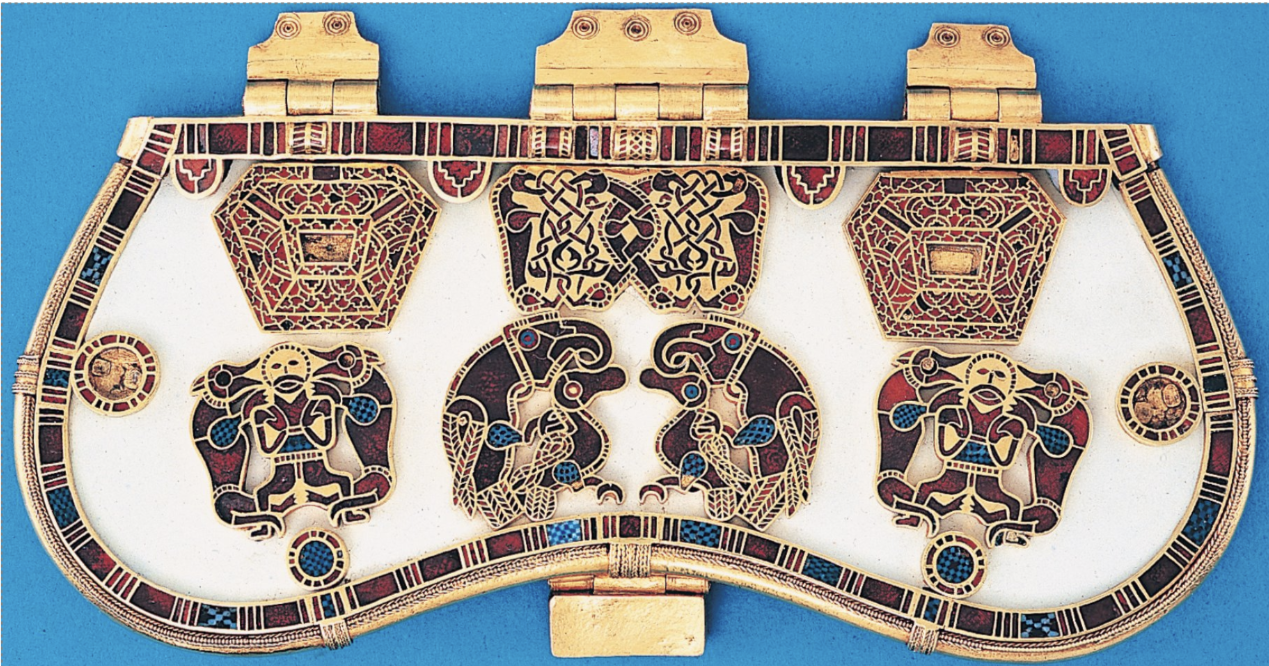
Culture/time period
Early Medieval, Anglo Saxon
C. 625

Details
Gold, glass, and enamel cloisonne with garnets and emeralds
4 birds in profile, birds of prey attacking the 2 smaller ones
Composition is very organized, symmetrical, balanced
2 men are frontally facing, each surrounded by 2 k-nines
Represents status and the power the owner would have had

What is this
Chi Rho Iota (XPI) page, Book of Kells
X Chi
P Rho
I Lota
XPI = three Greek letters that represent the name of Christ

Culture/time period
Early Medieval/Hiberno Saxon, 9th century

Details
Tempera on Vellum
Intertwining elements (relate to Anglo-Saxon)
Figures and Symbols
1. Chi Rho Iota (XPI) – The enormous Greek letters representing Christ's name.
2. Christ's head – A small human head is hidden within the decorative letter P (Rho)
3. Angels – Tiny angel figures are hidden among the intricate patterns, representing the divine and heavenly presence.
4. Cats and mice – Near the bottom of the page, cats are shown catching mice that are nibbling at a Communion wafer (the Eucharist). This might symbolize the Eucharist and the consequences of receiving it unworthily.
5. Moths – Hidden near the upper part of the X. They can symbolize transformation, rebirth, and resurrection.
6. Otter holding a fish – A tiny otter appears near the bottom. It reflects Christian and Irish monastic imagery and may have symbolic associations with Christ and creation.

What is the name of this peice?
Virgin and Child (Morgan Madonna)

Culture/time period
Romanesque, C.1200, France

Material and size
Walnut, Gesso, paint and traces of linen. 27” tall

Details
Frontal
Not realistic drapery, but it helps move our eye around it
Emphasises that she is seated on the throne, but she is also a throne, seating the Christ Child
Virgin mary
Mother of God
Queen of Heaven

What is this
Bayeux Tapestry

Culture/Time period
Romanesque, C. 1070

Is this a tapestry or embroidery?
Embroidery!

Height and fabric
1’8” High, 230ft long. Embroidered wool on linen
Tapestry is woven; you use warp and weft
Bayeux Tapestry is wool thread on a linen backing
Dyed in organic pigments
Medieval ages
C. 475-1400
Era between the fall of the Roman Empire c. 476 (classical antiquity) and the Renaissance c. 1400 (modern Europe)
Byzantine art is actually medieval
Beowulf
An Old English epic poem about a heroic warrior named Beowulf who battles monsters.
Reflects Anglo-Saxon culture, including warriors, bravery, treasure, burial traditions, and loyalty.
Important for understanding the early medieval culture that influenced artwork such as the Sutton Hoo treasures.
Cloisonné:
metalwork technique, fine threads of gold used for outlines, glass and stone laid in to create decorations

Romanesque
In the manner of the Romans
Reliquaries
sculptures to store relics
Throne of Wisdom
An artistic representation of the Virgin Mary seated with baby Jesus on her lap.
Mary acts as a throne for Jesus, who represents divine wisdom.
Common in Romanesque sculpture.
Example: The Morgan Madonna.
Remember: Mary is the throne; Jesus is the wisdom
Embroidery
The art of decorating fabric using a needle and thread.
Designs are stitched directly into fabric, sometimes incorporating gold thread, decorative patterns, or other materials.
Example: The Bayeux Tapestry, which depicts the Norman conquest of England.
Rounded arch. Culture and detail
An architectural arch with a curved, semicircular top.
A defining feature of Romanesque architecture.
Helps support the weight of the structure above it.
Contrasts with the pointed arches of Gothic architecture
Scriptorium
A room or designated space in a monastery where monks copied and produced manuscripts.

Barrel Vault
An architectural ceiling formed by extending a rounded arch continuously along a space.
Looks like a long, curved tunnel.
Commonly used in Romanesque churches.
Creates a strong stone ceiling but places significant outward pressure on the supporting walls.
Pilgrim and Pilgrimage
Pilgrim: A person who travels to a religiously significant location.
Pilgrimage: The journey itself, usually undertaken for religious devotion.
During the Middle Ages, Christians traveled to churches and shrines to visit sacred relics.
Pilgrimages brought donations, visitors, and wealth to monasteries and churches.
Gardner's Art through the Ages_ A Concise Global History.pdf
Zoomorphic
Art or design that incorporates animal shapes, figures, or characteristics.
Animals can be represented realistically, stylized, or intertwined with decorative patterns.
Especially common in early medieval metalwork and ornamentation.

What is this called
Abbey church of Saint-Denis, France
Birthplace of Gothic architecture

Culture/Time period
Gothic, Paris France 1140

What is this called
Virgin Jeanne D'Evreux, French

Culture/Time Period
Gothic, Rhineland Germany c.1300

What is the size/maeteial
Painted wood. 2’10.5” Tall

What is this called
Röttgen Pieta (pity or suffering) 14th century

Detail’s
German
Suffering/emotional
Christ is distorted, stiff from death
Humanizing biblical figures
14th cent war, plagues, famine, suffering
“What is your suffering compared to this”
Abbot Surger
Abbot (head monk) of the Abbey Church of Saint-Denis in France.
Credited with helping develop Gothic architecture in the 12th century.
Believed that light, beauty, and precious materials could bring people closer to God.
His renovations at Saint-Denis helped establish the Gothic style.
Remember: Suger = beginning of Gothic architecture and the importance of light.
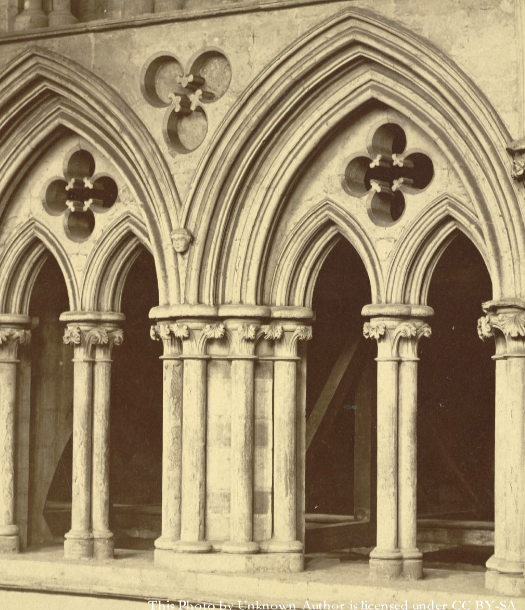
Pointed arches
An arch that comes to a sharp point at the top rather than forming a rounded semicircle.
A major characteristic of Gothic architecture.
Distributes weight more efficiently than a rounded arch and allows for taller structures.
Remember: Romanesque = rounded; Gothic = pointed.
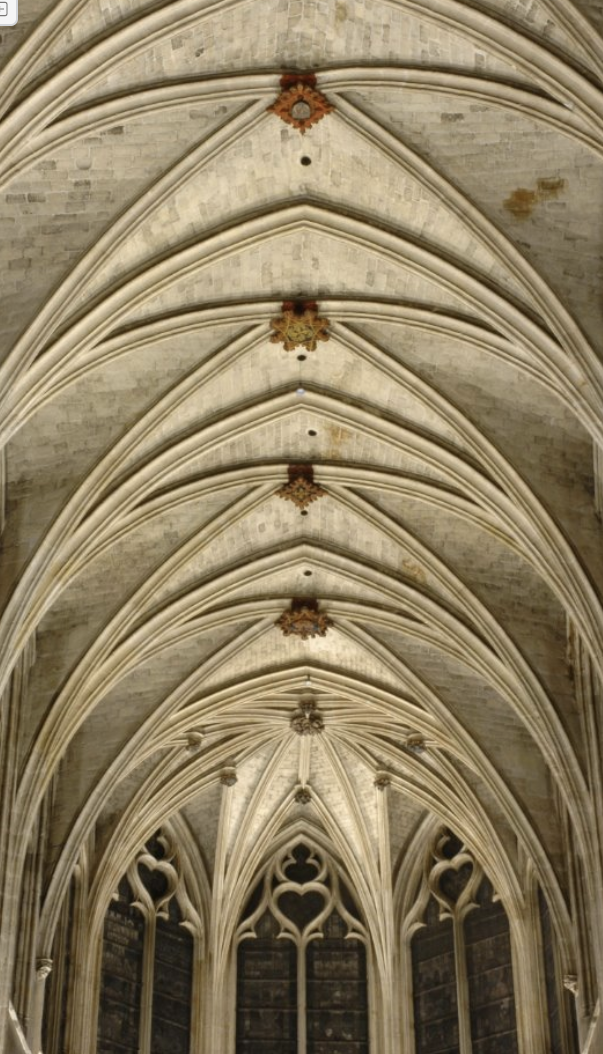
Rib Vault
A ceiling structure made of intersecting stone arches (ribs).
The ribs support the weight of the ceiling and help distribute it toward supporting columns.
Common in Gothic cathedrals.
Allows for taller, more open interiors.
Remember: Ribs = intersecting structural arches across the ceiling.

Fleur-de-lis
A stylized flower resembling a lily or iris.
Became a symbol of French royalty and monarchy.
Also associated with the Virgin Mary and Christian purity.
Frequently appears in medieval art, decoration, and royal heraldry.
Remember: Fleur-de-lis = French royal flower symbol.
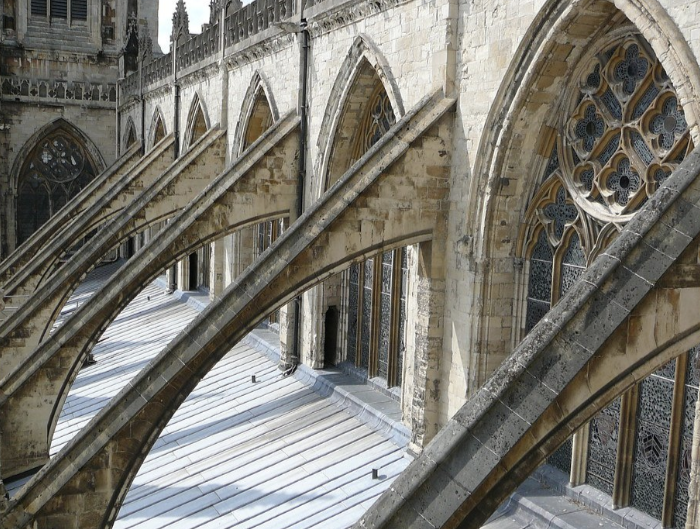
Flying Buttress
An exterior architectural support that transfers the outward pressure of a cathedral's walls and roof to a separate supporting structure.
Allows Gothic churches to have taller walls and larger stained-glass windows.
One of the most recognizable features of Gothic architecture.
Remember: Flying buttresses support the building from the outside.

Stained Glass
Stained glass: Colored glass pieces arranged into images or patterns, often depicting biblical stories and religious figures.
Used in Gothic churches to communicate religious teachings and fill interiors with colored light.
Rose window: A large circular stained-glass window, usually featuring elaborate symmetrical designs.
Remember: Rose window = large circular stained-glass window.
Tracery
Decorative stone framework that divides and supports sections of a Gothic window.
Creates intricate geometric patterns within windows.
Often surrounds and organizes stained-glass panels.
Remember: Tracery = the decorative stone framework around the glass.
Intricate stained glass window of Sainte-Chapelle in Paris, Gothic architecture, exterior
Lux Nova
Latin for "new light."
A concept associated with Abbot Suger and Gothic architecture.
Refers to the belief that light could communicate God's divine presence.
Gothic architecture used large stained-glass windows to fill churches with colorful light.
Remember: Lux Nova = divine light entering through Gothic stained glass.
Luxury Art
Artwork made using expensive, precious, or high-quality materials.
Often included gold, silver, gemstones, ivory, and elaborate decoration.
During the Middle Ages, luxury objects demonstrated wealth, power, religious devotion, and status.
Examples include jeweled reliquaries, illuminated manuscripts, and precious religious objects.
Remember: Luxury art = expensive materials used to communicate wealth, status, or devotion.
Pietà
An artwork depicting the Virgin Mary holding or mourning the dead body of Jesus after his crucifixion.
Fresco
Painting on wet plaster

What is this
Gates of Paradise, east doors, by Lorenzo Ghiberti

culture/time period and material
Early Italian ren, 1425 (took 27 years to complete) gilded bronze

What is this?
David by Donatello
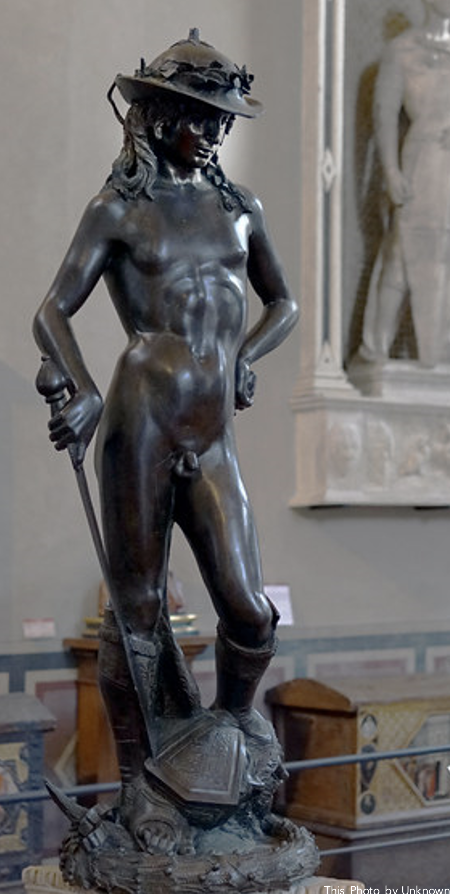
Who was this commissioned by
Plazzo Medici
Culture/Time period
Early Italian Ren, 1440

Height and Material
Bronze, 5’2”

Details
1st known free standing nude since ancient times
all’antica - “in the manner of the antique”
Nude adolescent
Contrapposto
Crowned with Laurels
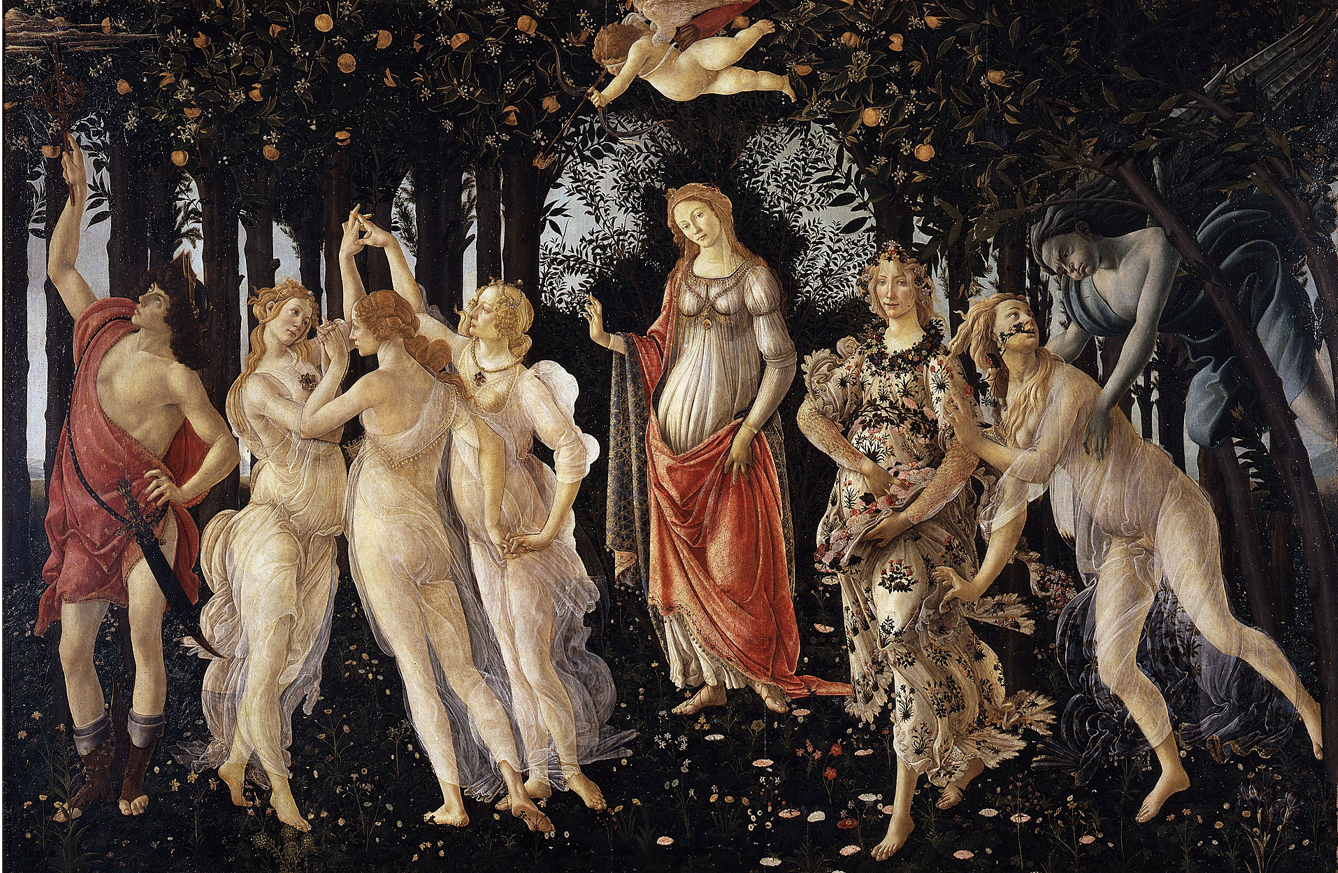
What is this
La Primavera (spring) by Sandro Botticelli

Culture/Time period
Ealy Italian ren, 1480
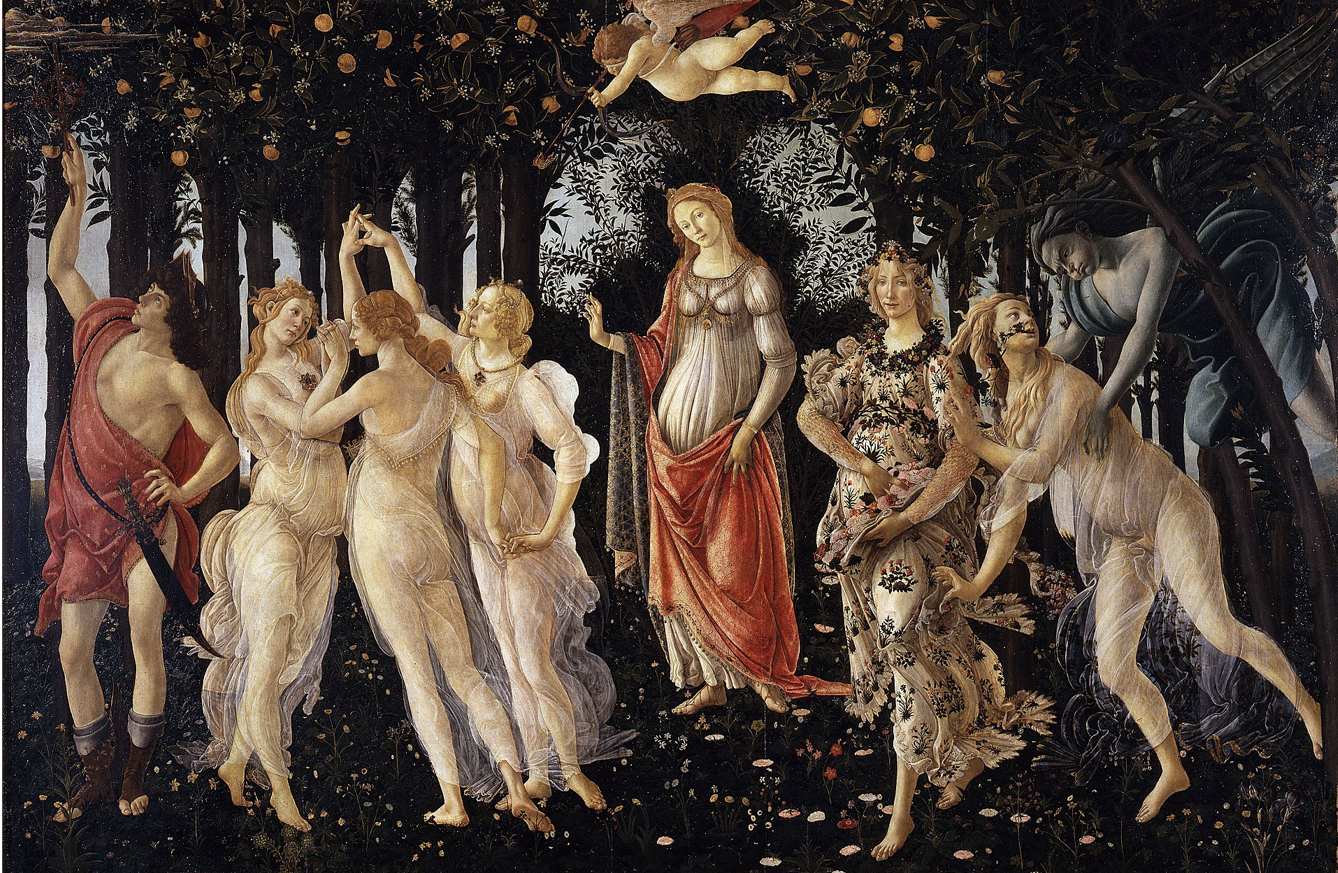
Matieral
Tempera on Pannel

Details
Elongated figures
Mercury – Roman messenger god; stands on the far left, holding a staff and reaching toward the clouds.
Three Graces – Three women dancing together; represent beauty, charm, and grace.
Venus – Roman goddess of love and beauty; stands in the center.
Cupid – Flying above Venus, aiming his arrow.
Flora – Woman scattering flowers; represents spring and fertility.
Chloris – Nymph being pursued by Zephyrus; transforms into Flora.
Zephyrus – God of the west wind; appears on the far right, blowing toward Chloris.
Fresco
A painting technique where pigment (color) is applied directly to wet plaster on a wall or ceiling.
Often used for large wall and ceiling paintings.
The paint bonds with the plaster as it dries.
Common in Renaissance churches and buildings.
Linear Perspective
A technique artists use to create the illusion of three-dimensional depth on a flat, two-dimensional surface using lines that converge at a vanishing point.
Atmospheric Perspective
A technique that creates depth by making distant objects appear lighter, less detailed, and often bluer or hazier than objects in the foreground.
Humanism
A Renaissance intellectual movement that emphasized human potential, achievement, education, and the study of classical Greek and Roman ideas.
Medici Family
A wealthy and influential banking family in Florence, Italy, who supported Renaissance artists, architects, and scholars through patronage.
Tempera
A painting medium made by mixing pigment with a binding agent, traditionally egg yolk.
Often called egg tempera.
Dries quickly.
Creates thin, smooth layers and precise details.
Commonly used before oil painting became dominant during the Renaissance.
Fresco vs Tempera
Fresco = Fresh plaster (paint while plaster is wet).
Tempera = Tempered/mixed paint (pigment mixed with egg yolk).
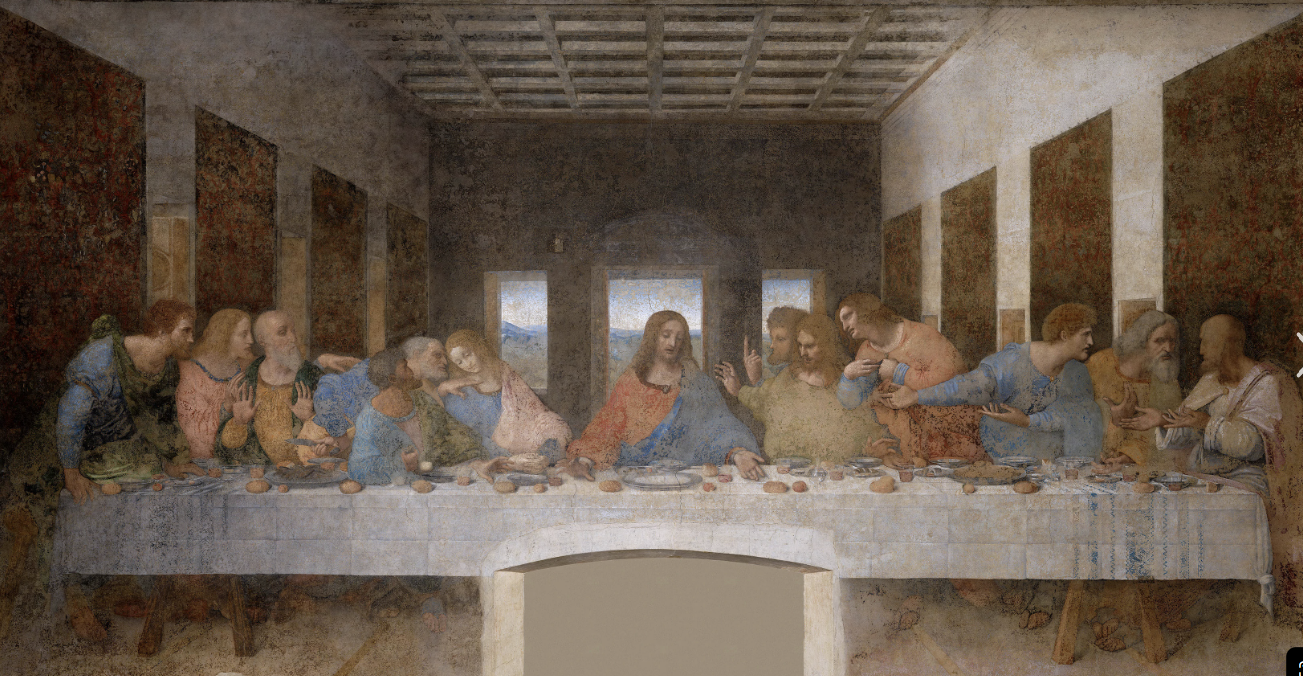
What is this
The Last Super by Leonardo Da Vinci

Culture/Time period
High Italian Ren, 1495

Tecnique
fresco a secco (paint applied to dry plaster)(experinemntal)
Very unstable painting
Deterioration: 18 years after completion
Percentage of the surface painted by Leonardo: 42.5%
Percentage of the surface that is lost: 17.5%

Details
It is a very unstable painting
Jesus in the middle
To the right, in orange, is Philip pointing to himself
Judas to the left in green, leaning away. His hand is reaching to the same object that Christ is reaching towards. Judas is holding his money bag
John in blue near Judas
To the left of John is Peter. Holding a knife
Apostles
Groups of 3
Real world - no grandeur, no halo
“Motions of the soul” emotional - fear, doubt, rage, love
Attributes
Geometry = perfection = heaven on earth
Arch curve door halo
Body is a triangle
Lines angle pint to him
Fresco a secco
Dry plaster
Paint is applied to dry plaster.
Allows artists more time and flexibility to add details.
Paint does not bond as securely to the wall, so it is more likely to deteriorate.
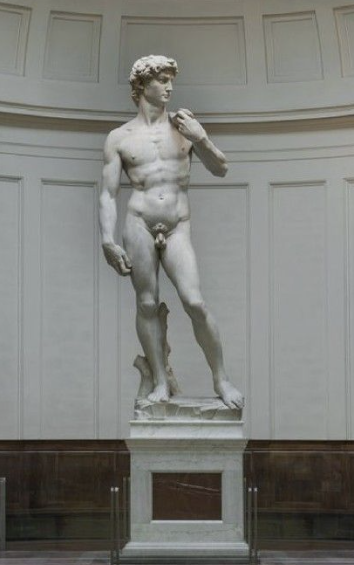
What is this
Michelangelo Buonarroti, David
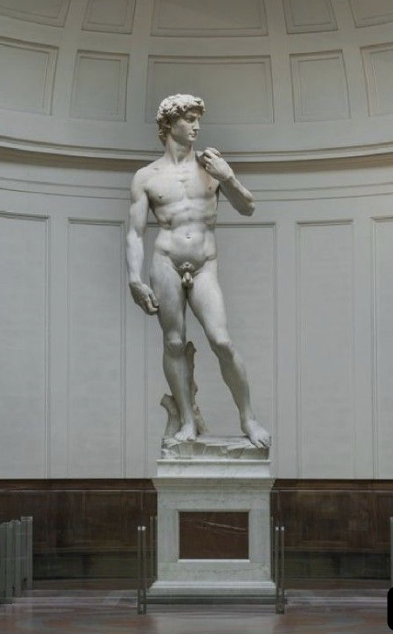
Culture/Time period
High Italian Ren, 1501

Material and Height
Marble, 17ft high. “The Giant”

Details
David = symbol of Florence
Overthrown enemies ( ex., Medici)
Moments before battle
Tension
Flexing shifting
Contropasto
Juxtaposing limbs
Asymmetrical
Psycological
Turning head towards adversary
Emotionally connected to events outside himself
Chiaroscuro
An artistic technique that uses strong contrasts between light and dark to create the illusion of three-dimensional form, depth, and volume.
Humanism
A Renaissance movement that emphasized human potential, individual achievement, education, and the study of ancient Greek and Roman ideas.
A secco
A painting technique in which pigment is applied to dry plaster, rather than wet plaster.
Sfumato
An Italian painting technique that creates soft, gradual transitions between colors and tones, blending edges without sharp outlines.
ex: Mona Lisa
Soft, smoky or hazy transitions.
No harsh outlines between light and shadow.
Makes faces and figures look more natural and realistic.
Especially associated with Leonardo da Vinci.

What is this?
Melencolia I, by Albrecht Dürer

Culture/Time period
Norther ren, 1514

Material
Engraving (printmaking)

Details
Humanism!
Winged woman: Represents Melancholy — sadness, deep thought, and intellectual struggle.
Compass: Represents geometry, measurement, and mathematical knowledge.
Geometric shapes: Represent mathematics and the intellectual work involved in artistic creation.
Hourglass: Represents the passage of time.
Magic square: A numerical grid associated with mathematics and mystery. Its rows and columns add up to 34.
Sleeping dog: Often interpreted as representing melancholy or inactivity.
Putto (small winged child): Represents creative or intellectual activity.
The exact meaning of every symbol is debated, so focus on the larger theme ra
Oil paint
A painting medium made by mixing pigment with oil, traditionally linseed oil.
Takes longer to dry than tempera.
Allows artists to blend colors and create smooth transitions.
Can be applied in thin or thick layers.
Creates rich colors, depth, and realistic details.
Became especially popular during the Renaissance.
An artwork created by transferring an image from a prepared surface (such as wood or metal) onto paper or another material.
Can produce multiple copies of the same image.
Made using techniques such as woodcut and engraving.
Helped spread artwork, information, and Renaissance ideas throughout Europe.
Wood cut
A printmaking technique in which an artist carves away areas of a wooden block, leaving the raised areas to receive ink.
The raised surfaces hold the ink.
Carved-away areas remain white (unprinted).
Often has bold lines and strong contrasts.
Usually produces a more graphic, simplified appearance.
Engraving
A printmaking technique in which an artist cuts lines directly into a metal plate using a sharp tool called a burin.
Lines are carved INTO the metal.
Ink fills the carved grooves.
The plate is pressed onto paper to transfer the image.
Allows extremely fine details, shading, and precise lines.
Mesoamerica
c. 2000 BC - 1521 CE (Pre-Columbian)
Mexico, Guatemala, Belize, Honduras, El Salvador
Mesoamerican cultures
Olmec
Maya
Aztec
Shared features of Mesoamerican groups
Water (underground springs)
Corn
Solar Calendar
Human sacrifice, bloodletting, piercings
Ball games
Architecture linked to nature
Cerimonal central designs
Tenochtitlan
Mexican Capital (beneath Mexico city)
Prophecy - eagle on cactus with serpent in its mouth
Mesoamerican Religions
Pantheon of deities
Priests and priestesses
Human sacrifice
Blood = fertility
Sacrifice conquered enemies
Tears of children bring rain

Coatlicue
Earth goddess
Mother of 400+ kids, including the god of the sun and the god of war
Kids consider it sacrilege to sacrifice her
Beheaded goddess = sacrificial death
Medieval ages
C. 476 -1400
Era between the fall of the roman empire and renaissance
Byzantine art is actually Medieval
Medieval Politics and Religion
Feudal systems, kingdoms - kings, nobles, knights, serfs
Spread of Christianity, latin church
Styles
Exaugurated
Not natural/abstracted with exaggerated features
Idealism
Geometric
Naturalism
Dramatic Naturalism
Elongated

Compare Greco-Roman “classical” to Medieval
Medieval one (on the right) is frontal and symmetrical; one on the left is contrapposto
Nudity is no longer a way to celebrate the body in medieval art
Contrapposto is the natural way the body stands, so it is naturalism. She could also be idealism. The guy on the right has a scared or spiritual feeling, an orant pose (two hands open, as early Christians pray). He is very flat, with not a lot of shadow. It is intentional not to look naturalistic. They did not want to create pictures in a way that only God creates people. They thought art should not lie to you and create temptation to worship it. Becoming Christian is what is encouraged in the arts in Medieval times.

Medieval sub periods
Early Medieval 480 - 1050
(Anglo and Hiberno saxon)
Carolingian Art 780 - 900
Ottonian Art 900 - 1000
Romanesque 1000 - 1200
Gothic art 1200 - 1400
Luxury arts
Jewelry
Manuscripts
Textiles
Small sculptures/reliqaries
Ivories
Serving vessels
Sutton Hoo - England
Greatest Anglo-Saxon burial
Found a rich warrior with status symbols
Weapons, jewels
Burial at sea
Scriptora
Monastic writing studios