L11: The "Other" Senses: Audition, body senses and chemical senses
 Call Kai
 Learn
 Practice Test
 Spaced Repetition
 Match
 Flashcards
 Knowt Play
1/143

There's no tags or description
Looks like no tags are added yet.
144 Terms
What are some examples of sense stimuli?
- Sound waves
- Pitch
- Loudness
-Timbre
Define Soundwaves
vibrations of an object cause air particles to vibrate (oscillations of compressed and rarefied air).

Define pitch
frequency of vibration (Hz).
Define loudness
intensity (more vigorous vibrations = more intense stimuli).
Define timbre
The complexity of sound (mixture of vibrations).
Explain the anatomy of the ear

What area of the ear is sound funneled through ear canal to ear drum?
tympanic membrane

What are of the ear uses bones set to vibrate by ear drum?
middle ear

What areas of the ear make up the middle ear bones?
1) Malleus
2) Incus
3) Stapes

What area of the ear is also called the hammer?
malleus

What area of the ear is also called the anvil?
Incus

What area of the ear is also called the stirrup?
stapes

What area of the ear does the energy transmission from middle ear to inner ear (from air to liquid).
cochlea

What is the auditory pathways of the ear called?
cochlear nerve (branch of vestibulo-cochlear).

What % of auditory synapses are found within inner hair cells?
95%

outer hair cells are called what type of cells?
effector cells

What is the role of effector cells?
alter effects of vibrations on inner cells.

****T/F The primary auditory pathway projects both Contralateraly and Ipsilaterally
T: information from the cochlear goes to both hemispheres.

Define contralateral
crosses to the opposite side
******

Define ipsilateral
stays on the same side
How is The primary auditory pathway organized ?
tonotopic organization
Define tonotopic organization
means that cells responsive to different frequencies are found in different places at each level of the central auditory system, and that there is a standard (logarithmic) relationship between this position and frequency.
Note: Each cell has a characteristic frequency (CF).
Define Place coding
different parts of basilar membrane flex in to respond to different frequencies

different parts of basilar membrane flex in to respond to different frequencies. What is this a definition of?
Place coding

In place coding the point of maximum vibration is tightly coupled to_______________
frequency

How is loudness transmitted to CNS ?
by rate of firing

When loudness is being transmitted to the CNS louder sounds=_______________?
higher firing rate

loudness of low frequencies signaled by_______________.
number of neurons firing
Why is the loudness of low frequencies signaled by number of firing neurons?
because rate changes pitch in these neurons.
Explain the perception of Timbre:
timbre gives the different qualities for the same note on different instruments.

****Perception of Timbre

The perception of spatial location can be attributed to these two features:
1) Phase difference
2) Location by intensity
Define Phase difference
the difference in arrival times of sound waves at each of the eardrums. Left/right judgments are more accurate than front/back.

Define location by intensity (for perception of spatial location):
intensities are absorbed by the head creating a "sonic shadow".

****Association cortex and pattern recognition
What vs Where. Brain activity in response to judgments of category (red) and location (blue) of sounds.
IFG = inferior frontal gyrus, IPL = inferior parietal lobule, MFG = middle frontal gyrus, SFG = superior frontal gyrus, SPL = superior parietal lobule.

What components make up the Vestibular system?
1) semicircular canals
2)Vestibular sacs
(Utricle and saccule)
3)Vestibular nerve
4) Cochlea

****
Angular acceleration (rotation of the head)
What do vestibular sacs respond to?
Gravity
What are the functions of the Vestibular system?
1) balance
2) head position
3)eye / head compensation
(vestibulo ocular reflex)
____________________________of the vestibular sacs can cause nausea.
Low frequency stimulation
stimulation of what part of the Vestibular system can cause dizziness.
canals
Define nystagmus
Involuntary rolling or trailing of the eyes in one direction and then rapid movement in the opposite direction.

What causes nystagmus?
caloric stimulation (cold water in the ear)
What are the associated head planes for the canals?
sagittal, transverse and horizontal
In the vestibular system where do axons synapse?
1) MOST on vestibular nuclei in medulla.
2) some direct synapses with cerebellum.
****Axon cortical connections result in:
dizziness
**** Axon connection to lower brain stem result in:
nausea & vomiting.
Why do some areas have over-representation in the moto and somatosensory strips?
B/c Regions requiring more fine motor control (or with greater density of tactile receptors) need to have larger representations in the cortex to do everything that is required of them

What are the cutaneous senses ?
touch (skin receptors).
Define kinesthesia
body position and movements (joints, muscles, tendons).
What make up the organic senses?
receptors in and around internal organs (butterflies in the stomach).
What 3 stimuli make up Touch senses?
1) pressure
2) vibration
3) pain
Define pressure
deformation of the skin
Define vibration
Sensory surface texture
Define pain
tissue damage
What 3 stimuli make up Kinaesthesia?
1) stretch receptors in muscles
2) stretch receptors in tendons
3) joint receptors provide info
What do stretch receptors in muscles provide information on?
Muscle length
What do stretch receptors in tendons provide information on?
Force
What do joint receptors provide information on?
Magnitude and direction
What is our largest organ?
skin
What is the role of skin?
1) protection
2) thermoregulation (sweat or restriction of circulation)
**** Skin
1) Indentation (Ruffini)
2) Vibration (pacinian)

Define Glabrous skin
hairless, more complex mixture of free nerve endings and axons

Define Pacinian corpuscle
The sensitivity to vibration.
What is the role of large diameter myelinated axons?
- fast-conducting, localization of touch.
What is the role of small diameter unmyelinated axons?
- temperature
- pain.
Why is temperature perception relative?
B/c Dependent on prior experience
T/F coolness receptors closer to the surface of the skin; warmth receptors are deeper.
TRUE
What are the 3 different layers of the skin?
1) epidermis
2) dermis
3) Hypodermis

What are the 4 main sense receptors of the skin?
1) Thermo-receptor
(Senses heat or cold )
2) Meissner's corpuscle
(Senses "touch")
3) Nociceptor
(Senses pain)
4) Pacinian corpuscle
(Senses pressure)

What receptor senses heat and cold?
Thermo-receptor

*** Moving stimuli
dynamic interaction with kinesthetic information and motor control systems to determine, texture, density and in some instances identity.
What causes Tactile agnosia?
damage to angular gyrus.
What Corpuscle receptor senses touch?
Meissners corpuscle

**** Tactile agnosia
apperceptive and associative distinctions apply.
What receptor senses pain?
Noicceptor

*** Somatosensory pathways

*** Somatosensory pathways

Define tactile agnosia
an inability to recognize common objects by touch not due to a loss of sensitivity (discrimination still possible).
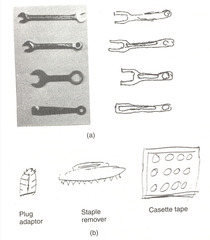
What is normally co morbid with visual neglect?
tactile neglect/extinction
What corpuscle receptor senses pressure?
Pacinian

*** cross-modal attention.
Define Allochiria
mislocalization of touch, usually from lateral to medial within one limb but can be across limbs.
Define Autotopagnosia
inability to identify body parts that have been touched, finger agnosia most common.
Receptors of noxious stimuli are called
Nociceptors
What are some examples of noxious stimuli?
- intense pressure (e.g striking)
- heat, acid ( e.g capsaicin in hot peppers )
******

****

Where is sensory pain registered?
primary somatosensory pathway

Define sensory pain
The intensity of a painful stimulus
Define Emotional Pain
The evaluation of the sensory component ( influenced by past experience)
Where is Emotional Pain registered?
anterior cingulate AND insular cortex

What are the long term implication of pain?
Threat to future comfort
Where is the sensory component of pain registered?
Somatosensory cortex

Where is the emotional component of pain registered?
Anterior cingulate

Where are long term implications of pain registered?
prefrontal cortex (stimulus-response associations and long-term memory)

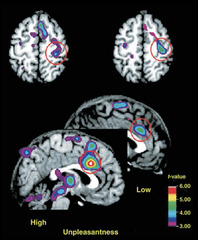
What were the findings of the hypnotism study?
-somatosensory cortex not affected not affected by hypnotism.
-anterior cingulate shows less activation during hypnosis.
Define olfaction
sense of smell
What stimulates the olfactory senses?
volatile substances that rapidly vaporizes