Resilience to Violence
 Call Kai
 Learn
 Practice Test
 Spaced Repetition
 Match
 Flashcards
 Knowt Play
1/25

There's no tags or description
Looks like no tags are added yet.
26 Terms
Positive Manifold
The positive manifold refers to the observation that various cognitive abilities are positively correlated, meaning that proficiency in one area, such as reading, often indicates higher performance in others, like mathematics and general cognitive tasks.

Competence Begets Competence
This concept suggests that early competence leads to cumulative advantages in skills and abilities, increasing the likelihood of future success and resilience.
Bijvoorbeeld:
goede ontwikkeling in de kindertijd → grotere kans op goede ontwikkeling tijdens adolescentie.
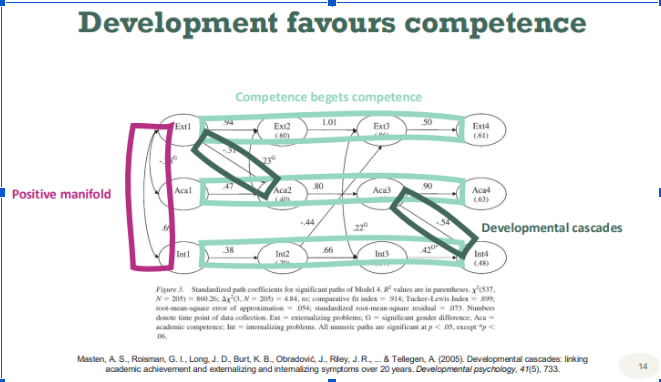
Developmental cascades
This concept refers to the process where early experiences in one developmental domain can have a cascading effect, positively influencing progress in other areas over time.
Bijvoorbeeld:
goede opvoeding → betere sociaal-emotionele ontwikkeling → positiever zelfbeeld → betere relaties → betere verdere ontwikkeling.

Effectance
De motivatie om actief met de omgeving bezig te zijn om deze te begrijpen, beheersen en ervan te leren.
Self-efficacy
Self-efficacy beliefs zijn overtuigingen over je eigen vermogen om iets succesvol te kunnen uitvoeren.
Stress inoculation
Stress inoculation betekent dat beperkte hoeveelheden stress iemand juist kunnen helpen om later met grotere stress om te gaan.
Vergelijk het met een vaccin:
een kleine hoeveelheid stress → leren omgaan met stress → grotere weerbaarheid tegen toekomstige stress.
Sensitization
Een eerdere negatieve ervaring kan iemand gevoeliger maken voor nieuwe stressoren.
Bijvoorbeeld:
eerdere adversity → verhoogde kwetsbaarheid → nieuwe stress heeft grotere impact.
Scarring
Een negatieve ervaring kan als het ware blijvende sporen achterlaten, waardoor iemand later kwetsbaarder wordt. Hierdoor kan dezelfde stressor bij twee kinderen verschillende effecten hebben, afhankelijk van hun eerdere ervaringen.
HPA-axis
Bij aanhoudende stress wordt ook de HPA-axis geactiveerd.
De HPA-axis leidt uiteindelijk tot de afgifte van Cortisol
Allostatic load
De lichamelijke "kosten" van langdurige aanpassing aan stress. Het lichaam probeert voortdurend een balans te bewaren. Bij langdurige of extreme stress kan deze regulatie overbelast raken.
Chronic stress → accumulated physiological burden → allostatic load
Wanneer het stresssysteem langdurig wordt belast, neemt de kans op maladaptief functioneren toe.
Sensitive period
Een periode waarin een bepaalde ervaring maximale invloed kan hebben.
Critical period
Een periode waarin een bepaalde ervaring essentieel/noodzakelijk is voor normale ontwikkeling. Denk aan spreken, dit moet je vóór een bepaalde leeftijd leren.
Social referencing
Social referencing is het proces waarbij kinderen naar anderen kijken om te bepalen hoe ze op een situatie moeten reageren.
Attachement Theory
Serves as a lifelong blueprint for interpersonal relationships.
Secure bonds foster greater resilience.
Applies to all key caregivers and figures, not solely mothers.
Support via Scaffold
Temporary, adaptive guidance where parents provide a stable framework without taking full control, allowing children to learn to balance independently.
Proactive guidance: Fosters problem-solving and age-appropriate autonomy.
Risk calibration: Reduces risk without eliminating necessary learning experiences.
Socialization: Introduces the child to varied social contexts.
Core pillars: Safety, emotional security, and opportunities to learn.
Walsh's family resilience framework
Communication: respite, empathy, humour and positivity
Beliefs: meaning-making, sense of coherence, hope and goals
Organization: connection to the community, mobilizing social and economic resources
Parenting is not the only resource,
Acculturation stress
Difficulties in dealing with cultural differences.
Immigrant paradox
First-generation immigrant youth are often more successful or healthier than later-born generations.
Family stress model
Income loss → parental stress → harsher or less responsive parenting → worse child outcomes. This explains why cash benefits reduce maltreatment risk.
The five essential elements of mass trauma intervention (Hobfoll et al.)
Safety, calming, self- and collective efficacy, connectedness, hope. The principle behind them: most people recover naturally if the environment is restored, so don't over-pathologize
Developmental systems theory
A person's development is shaped by complex interactions between several systems outside the individual, embedded in multiple ecological layers.
What are the two influential concepts to understand the nature and effects of social, economic and political factors on health.
Social determinants of health
f.e. property, social connections, health care system, stigma
Structural violence
Johan Galtung and Paul Farmer: certain structures, also cause disease.
Galtung’s triad of violence
Galtung’s triad van violence
The three components:
Direct violence: Visible, overt behaviour that cause physical, verbal or psychological harm.
Structural Violence: Systematic, indirect inequalities built in social, economic and political systems (f.e. poverty, racism and wealth gaps) that prevent people from meeting their basic human needs.
Cultural Violence: The prevailling attitudes, beliefs, ideologies, religion, art or language that are used to legitimize, justify or normalize direct and structural violence.
What are the 5 steps of Structural Competency
Describe the role of social structures in producing and maintaining health inequities globally
Identify the ways that structural inequalities are naturalised within the field of global health
Discuss the impact of structures on the practice of global health
Recognise structural interventions for addressing global health inequities, and
Apply the concept of structural humility in the context of global health
The Six Dimensions of food security
Availability: Having the quantity and quality of food sufficient to satisfy dietary needs
Access (economic, social and physical): Having financial means to acquire food that is available for everyone
Utilization: having the adequate diet, clean water, sanitation and health care to reach nutritional wellbeing
Stability: Having the ability to ensure food security in the event of sudden shocks.
Agency: Individuals or groups to be able to act independently to make choices about the food they eat, produce, how that food is produced, processed and distributed.
Sustainability: Food system practices that contribute to long term regeneration of natural, social and economic systems, ensuring the food needs of present generations are met without compromising the needs of future generations.
Waarom zijn mensenrechten relevant?
Mensenrechten is een relatie tussen de staat en de individu. De individu is de rights-holder met specifieke “rights entitlements" en de staat is de duty bearer, met de taak om deze rechten te respecteren, volbrengen en beveiligen.