Lecture 3: Fungal symbioses with plants
 Call Kai
 Learn
Learn Practice Test
 Spaced Repetition
 Match
Match Flashcards
 Knowt Play
1/29

There's no tags or description
Looks like no tags are added yet.
Name | Mastery | Learn | Test | Matching | Spaced | Call with Kai | Chat |
|---|
No analytics yet
Send a link to your students to track their progress
30 Terms
Important symbioses
prokaryotes: involved in N fixing, important for all life
Fungi: involved in nitrogen extraction, and form colonies with cyanobacteria to form Lichens
Taxonomy
The theory and practice of grouping individuals into species, arranging species into larger groups, and giving these groups names, thus producing a classification.
Systematics
The science of organismal diversity, establishing relationships between species.
Why base classification on evolution?
Knowing the identity of something is potentially informative of what it does, where it lives, as well as what it looks like.
The Linnaean hierarchy
Domain
Kingdom
Phylum
Class
Order
Family
Genus
Species
Dear Katy Perry came over for good spaghetti
Plural of genus
genera
Plural of phylum
Phyla
Derived trait
a new trait different from an ancestral trait is the derived trait
looking at derived trait that species have in common
ingoring all shared ancestral traits every species might have to help narrow it down
Monophyletic
the group contains
its own most recent common ancestor
all descendants of that common ancestor
every taxon (names group) should be monophyletic

Paraphyletic
a group has its own most recent common ancestor
BUT not all of the descendants share the same common ancestor

Polyphyletic
a group that doesn't not have its own most recent common ancestor
all the descendants do not share that common ancestor

Synapomorphy
a derived trait shared by other taxonomic groups because of a common ancestor that helps it from other groups
example: flowers differentiate angiosperms from gymnosperms
Symplesiomorphy
a trait shared by taxonomic groups because of a common ancestor that does not help differentiate it from other groups
Convergence
the independent evolution of similar trails (often because of similar selection pressure)
Homology
shared or similar trait because of shared ancestry (could be derived or ancestral)
Homoplasy
shared or similar trait because of convergence
Symbioses - photosynthesis
plants have chloroplasts because of symbioses with bacteria
cyanobacteria are the likely ancestor of green chloroplasts
still exist, large organisms
Symbioses - nitrogen fixing
converting nitrogen in are to usable form costs a lot of energy
78% of atmosphere contains nitrogen that most of life cannot access
only prokaryotes can fix it for it then to be used by other life
some fixing done by free living bacteria in the soil, or in cyanobacteria
other fixing
Phylum proteobacteria and leghemoglobin
Rhizobium in N2 fixing association (nodule) with legumes from family Fabaceae
leghemoglobin in root nodules help protect the oxygen-sensitive nitrogenase enzymes from oxygen
root nodules have evolved three times in Fabaceae, not all species in the family have them
Symbiosis - mycorrhizae
Myco = fungus
rhiza = roots
usually mutualistic symbiosis between fungi and roots or other under ground organs of plants
help with extraction of nutrients/water
may help protect roots against parasites
*Term refers to association of structure, not to the fungus or plant
Types of Mycorrhizae
Arbuscular or end-
intracellular
Glomeromycota
ecto- (ECM)
Extracelluar
Basidyomycota and Ascomycota
Phylum Glomeromycota
form arbuscular mycorrhizal (endomycorrhizae) associations with most land plants (liverworts to agiosperms)
Phylum ascomycota
a few associate with roots of selected vascular plants to form ectomycorrhizae, this is the largest phylum
Phylum Basidiomycota
many species associate with the roots of selected vascular plants to form ectomycorrhizae
Which fungi form ectomycorrhizae
phylum ascomycota
phylum basidiomycota
which fungi form arbuscular mycorrhizae
Phylum Glomeromycota
endomycorrhizae
another term for arbuscular mycorrhizae
almost all grasses form this
formed by Glomeromycota in association with a great diversity of green plants, predominantly herbaceous, or tropical woody plants
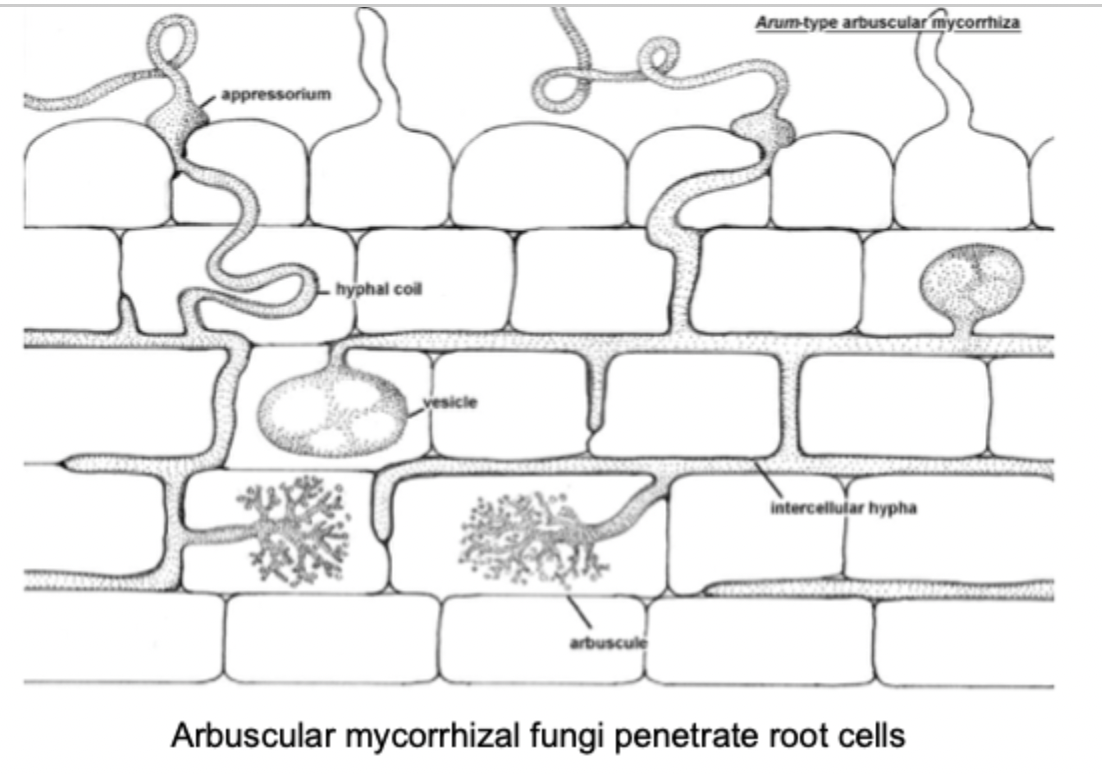
fungal hyphae penetrate cell walls but not the plasmalemma of root cortex
within root cells, form shrubby arbuscules for nutrient transfer or sometimes oily vesicles for storage/survival
form spores in soil or dead roots - no fruiting bodies
particularly important in delivery of phosphorus
T/F: plant evolution depended on mycorrhizae
true
early plants lacked any roots, fungi may have provided access to water and nutrients
mycorrhizae show up in fossil records up to 407 million years ago
Ectomycorrhizae
formed by various groups of Basidiomycota (90% are in agaricomycetes)
a few Ascomycota
in association with predominantly temperate woody plants
Hyphae do not (usually) penetrate cell walls of plant roots, but form a mantle over the root then a network of hyphae between cortex cells called Hartig net
form large sexual fruiting bodies, above or below ground
Ecological significance of mycorrhizae
many plants would not thrive in harsh conditions without them
mitigate drought, nutrient limitation, root pathogens
shown to impact composition of the plant community
many organisms feed on mycelium or fruiting bodies of mycorrhizal fungi