Gothic art
 Call Kai
 Learn
 Practice Test
 Spaced Repetition
 Match
 Flashcards
1/26

There's no tags or description
Looks like no tags are added yet.
27 Terms
When did the Gothic Age develop, and what major change does it mark in art?
From the middle of the 13th century to about the end of the 14th century (last offshoots in the 15th). Transition from the medieval conception of art to a new faith in culture and man: classical-Byzantine abstractness is abandoned for a more real and earthly representation of man and life.

Who is this painter, and when is he documented?
Cimabue (Cenni di Pepo), documented from 1272 to 1302. Italian Gothic painter who started from late Byzantine models.

Name this work, its artist and where it is kept.
Crucifix by Cimabue (before 1271), Florence, Museum of the Work of Santa Croce.

Name this fresco, its artist, date and place.
Crucifixion by Cimabue, 1277-79, Upper Basilica of San Francesco, Assisi.

Name this work, its artist, date and where it is kept.
The Majesty (Maestà, Madonna of Santa Trinita) by Cimabue, 1280, Uffizi Museum, Florence.
How did Cimabue renew the late Byzantine models he started from?
He gave his figures (very often crucifixes) greater expressive vitality and developed a more conscious use of space and form.

Who is this painter, and what are his life dates?
Giotto (1267-1337), founder of a new pictorial language in Italy.
Why is Giotto considered a revolutionary?
He stopped placing symbolic actions inside abstract spaces and instead showed concrete actions developing in real environments. The background of his scenes becomes a space articulated in depth.
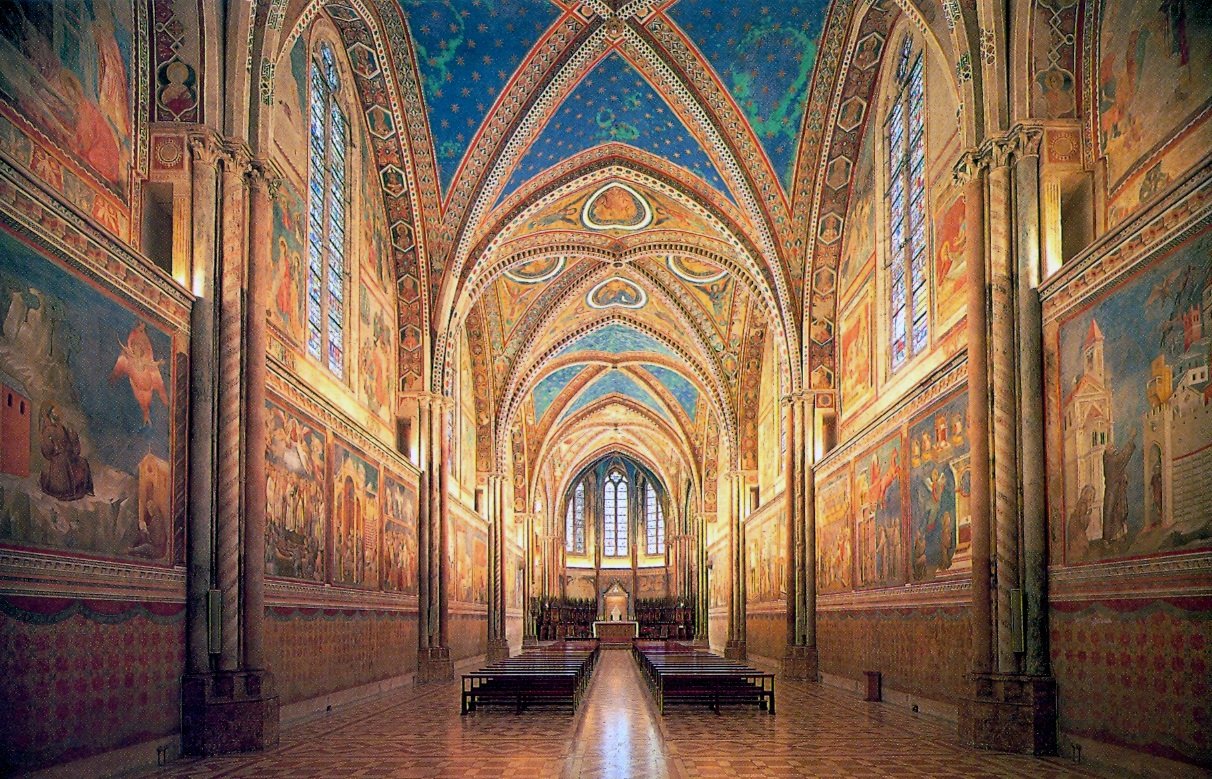
Which frescoes are in this church, and who painted them?
The frescoes of the Legend of Saint Francis by Giotto (1296-1300), Upper Church of San Francesco, Assisi.

Name this place, its decoration and its date.
Scrovegni Chapel (Cappella degli Scrovegni), Padua, frescoed by Giotto in 1304-06.

Which fresco cycle is this wall part of, and who painted it?
The Scrovegni Chapel (Padua, 1304-06) by Giotto.

Who is this painter, and what are his dates and school?
Duccio di Buoninsegna (ca. 1255-1318), a major Sienese painter.
How did Duccio renew Byzantine art?
He softened the lines into a previously unknown fluidity and exploited the full potential of oriental color.

Name this work, its date and where it is kept.
Rucellai Madonna, attributed to Duccio, dated 1285, now in the Uffizi Museum, Florence.

Name this work, its date and where it is kept.
Double-sided altarpiece (Maestà) for the high altar of Siena Cathedral by Duccio, 1308-1311, now in the Museo dell'Opera, Siena.
Who is Benedetto Antelami?
Sculptor and architect (c. 1150-1230), active mainly in Parma (Baptistery).
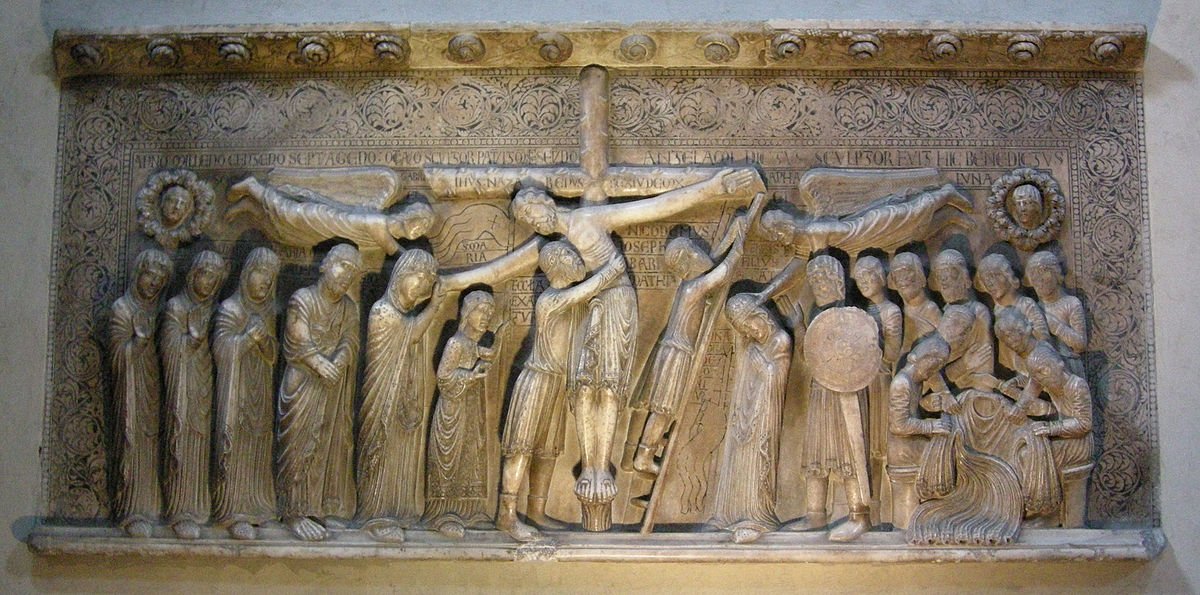
Name this relief and its sculptor.
Deposition from the Cross (La Deposizione dalla croce) by Benedetto Antelami.

Who is this sculptor, and what are his dates?
Nicola Pisano (ca. 1215-1280).
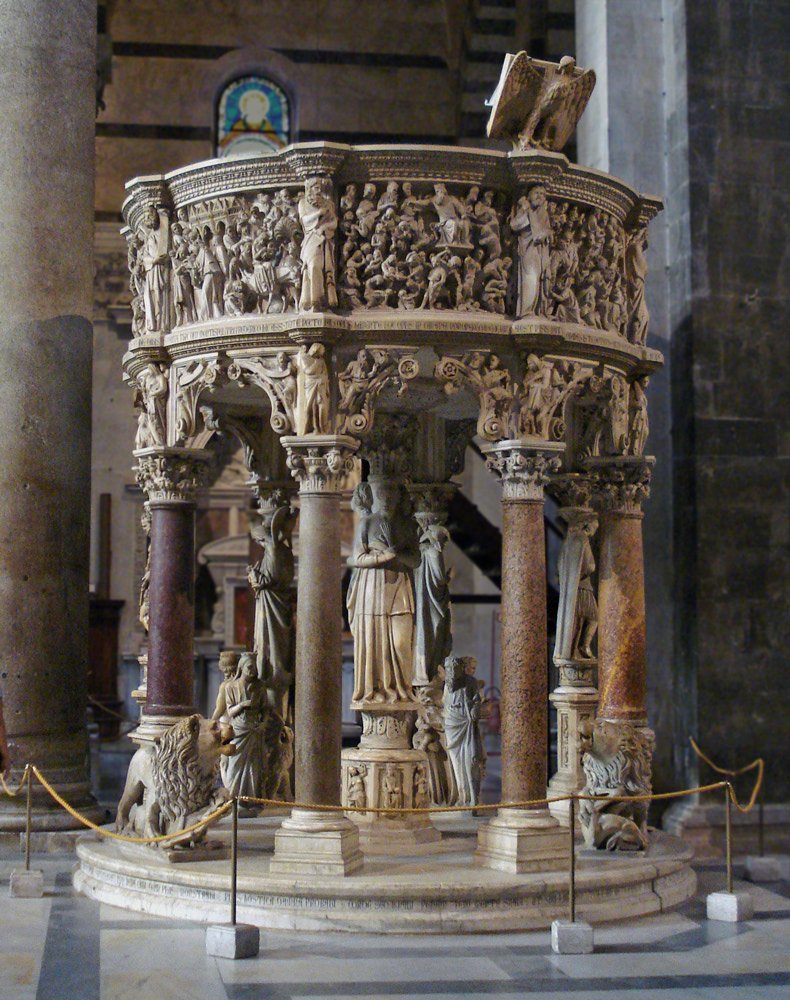
Name this work, its sculptor and its date.
Pulpit of the Baptistery of Pisa, Nicola Pisano, 1260.

Name this work, its sculptor and its date.
Pulpit of Siena Cathedral, Nicola Pisano, 1268.
Who is Giovanni Pisano, and what are his main works?
Giovanni Pisano (1248 - ca. 1315), son and collaborator of Nicola. With Nicola he completed the Fonte Maggiore of Perugia (1278); he made the pulpit of Pisa Cathedral (1310).

Name this monument, its date and city.
Fonte Maggiore, Perugia, 1278, by Nicola and Giovanni Pisano.

Who is this sculptor and architect, and where did he mainly work?
Arnolfo di Cambio (1245 - ca. 1302), formed in the school of the Pisano, mainly active in Florence as sculptor and architect.

Name this statue and its sculptor.
Bonifacio VIII benedicente (Boniface VIII Blessing) by Arnolfo di Cambio.
Who is Wiligelmo and what is he known for?
Sculptor active in Modena from 1099 to ca. 1110, author of the sculptures of Modena Cathedral.

Which cathedral's sculptures are these, and who is the sculptor?
Modena Cathedral, sculptures by Wiligelmo (the cathedral's architect was Lanfranco).
Who was the architect of Modena Cathedral?
Lanfranco