Physics waves
 Call Kai
 Learn
Learn Practice Test
 Spaced Repetition
 Match
Match Flashcards
 Knowt Play
1/69

There's no tags or description
Looks like no tags are added yet.
Name | Mastery | Learn | Test | Matching | Spaced | Call with Kai | Chat |
|---|
No analytics yet
Send a link to your students to track their progress
70 Terms
Definition of a wave
something that transfers energy without transferring matter
What is the difference between mechanical and electromagnetic waves?
Mechanical waves need a medium to travel through whereas electromagnetic waves don’t
Name some examples of mechanical waves
sound, water, seismic
What is a transverse wave?
A wave where the oscillations are perpendicular to the direction of energy transfer
Give examples of transverse waves
water, EM waves, vibrations on a string, seismic s-wave
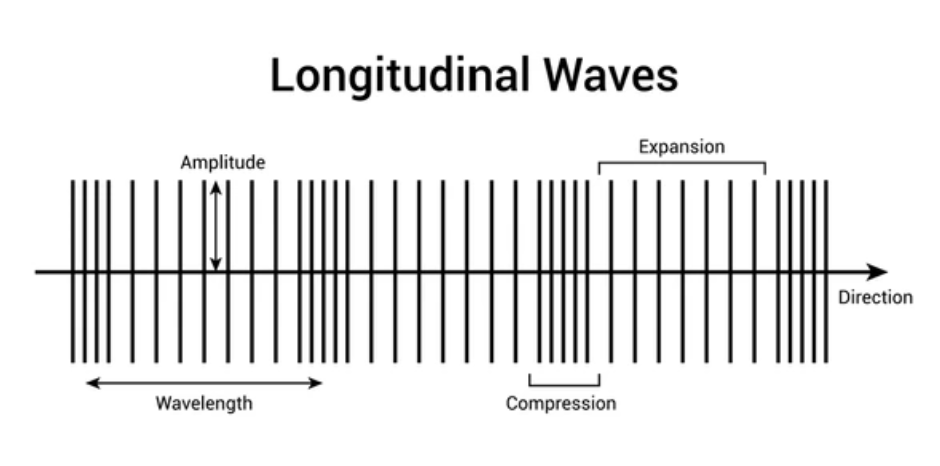
What is a longitudinal wave?
A wave where the oscillations are parallel to the direction of energy transfer. The oscillations alternate between compressions and rarefactions.
Give examples of longitudinal waves
sound, seismic p-waves
Draw a labelled transverse wave

Draw a labelled longitudinal wave
What is the line through the middle of a transverse wave called?
The undisturbed position
Are mechanical waves transverse, longitudinal or both?
both
Are electromagnetic waves transverse, longitudinal or both?
transverse
Amplitude
the maximum displacement of a point on a wave from its undisturbed position.
The bigger the amplitude the more / less energy the wave carries?
more
Wavelength
The distance from a point on the wave to the equivalent point on the adjacent wave.
Frequency (f)
The number of waves passing a point per second
What is the unit for frequency?
Hertz, Hz
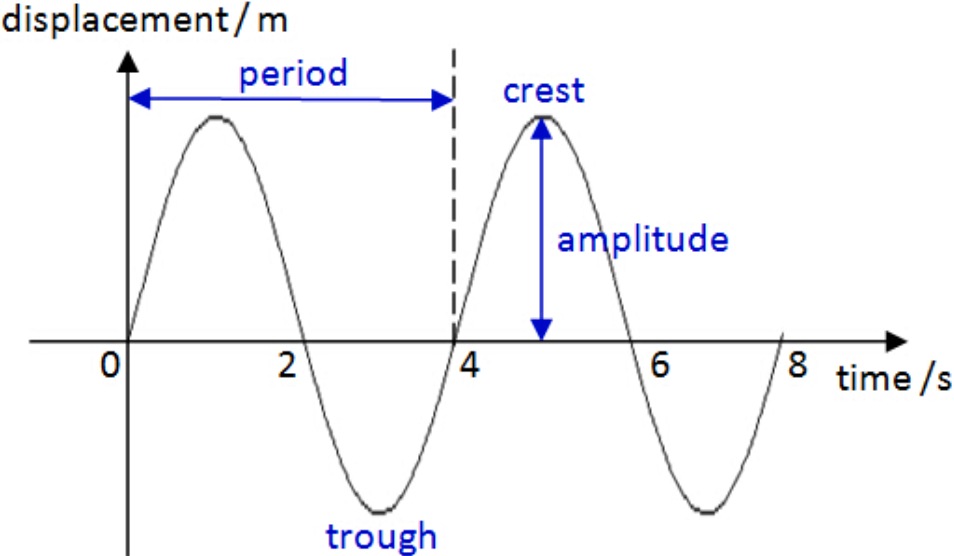
Period (T)
The time taken for a wave to pass a point
What is the equation that links frequency and time period?
T=1/f or f=1/T
Draw a labelled displacement-time graph
Wave speed
Distance travelled by the wave per second. Measured in m/s.
What is the equation linking frequency, wave speed and wave length?
wave speed = frequency x wave length
What are the symbols for wave speed frequency and wave length?

How do you measure wave speed using a ripple tank? (PAG)
Increase strobe frequency until the waves appear to ‘freeze’ in place
Frequency of the wave = frequency of the strobe
Measure the wavelength (between two adjacent ripples) with a ruler
Use the equation wave speed = wave length x frequency
How do you measure the wave speed of sound?
Stand far away from a wall and clap
Measure the time taken for you to hear the echo of a sharp clap
Measure the distance between you and the wall and then multiply it by 2
Wave speed = 2 x distance travelled / time heard between clap and echo
What is the speed of sound in air?
Ranges from 330 - 340 m/s
What is the speed of sound in a vacuum and why?
0 m/s because sound is a mechanical wave meaning it needs to travel through a medium therefore it can’t travel in a vacuum because there is no medium.
How do you measure a wave speed in water?
Measure out a known distance using a metre ruler
Time how long it takes for a wave to travel that distance using a stopwatch
Use the equation speed = distance / time
What type of waves are sound waves?
Longitudinal and mechanical
What do the amplitude and frequency link to in soundwaves?
Amplitude = loudness
Frequency = pitch
Does sound travel faster in solids liquids or gases? Why?
Solids because their particles are closer together allowing the mechanical vibrations to transfer energy more efficiently.
What changes / stays the same when sound waves travel through different mediums?
The wave length and wave speed change.
The frequency stays the same
What can reflecting sound be used for?
Echo ranging (mapping sea bed from a boat), ultrasound
What frequency is infrared?
0-20Hz
What frequency can humans hear?
20-20000Hz
What frequency is ultrasound?
20000< Hz
How do humans hear things?
Sound waves cause the eardrum to vibrate
This causes small bones in the ear to vibrate which amplifies the vibrations
The vibrations are transmitted into the inner ear which is filled with fluid
Vibrations of the fluid are detected by cilia (small hairs)
Different hairs detect different frequencies and pass signals to the brain
What type of wave is ultrasound?
mechanical and longitudinal
How can ultrasound waves be used to build up an image?
A transducer produces and detects pulses of ultrasound waves
Each ultrasound wave pulse from the transducer is partially reflected and they return to the transducer at different times
The further away from the boundary the transducer is, the longer a wave takes to return
These returning waves can be used to build up an image on the screen
What are some uses and advantages of ultrasound?
Used in medicine for prenatal scans of a fetus - non ionising
Used to image organs, ligaments or muscles - non ionising
Used in industry to investigate flaws in objects - non destructive
Used in echo sounding to work out distance between ocean surface and sea floor
What are the layers of the earth?
crust - solid layer of rock around the earth (about 50km thick)
mantle - solid layer of rock
outer core - molten due to high temps (only liquid layer) - slightly less pressure
inner core - solid due to high pressure
Seismic waves
Waves produced by an earthquake
Seismology
study of earthquakes
What are earthquakes recorded by?
seismometer
Where do earthquakes happen?
inside the crust
Focus
The point where the earthquake originates from
Epicentre
The point on the surface nearest to the focus
What is a primary / P-wave?
The initial tremors which last about 1 minute - longitudinal waves
They are faster than S-waves
What is a secondary / S-wave?
Second tremors a few minutes later - transverse waves
They travel slower than P-waves and can’t travel through liquid
What do you need to remember for drawing an S-wave shadow zone?
S-waves can’t travel through the liquid outer core as they are transverse waves?
How do you draw a shadow zone for P-waves?
P-waves are strongly refracted at each boundary, creating a shadow region due to difference in path between passing through the core and not passing through thr core.
What are the uses of radiowaves and why are they useful?
Used for communication, radio and TV.
They are useful because they travel through earth’s atmosphere
What are the uses and dangers of microwaves?
Used or satellite communication and microwave ovens
They are dangerous because they heat water molecules easily.
What are the uses and dangers of infrared?
Used for thermal imaging, short range communication and heating.
Excessive exposure can damage your skin/ eyes.
What are the uses and dangers of visible light?
Used for illumination and fibre optic communication
Can damage eyes
What are the uses and dangers of ultraviolet?
Used for sterilisation, forensics and tanning beds
It can cause sun burn, skin cancer and eye damage
What are the uses and dangers of x-ray?
Used for medical x-rays, airport security and dentistry
It can cause DNA mutations which lead to cancer
What are the uses and dangers of Gamma rays?
Used to kill cancer cells, as a medical tracer or for sterilisation
Can cause DNA mutations which lead to cancer
Which of the EM waves are ionising?
UV, X-ray, Gamma
Gamma has the shortest/longest wavelength and the lowest/highest frequency.
shortest wavelength highest frequency
What are X-rays used for in a medical setting?
diagnosis and therapy
How does an x-ray work?
x rays pass through soft tissues such as skin/muscle/organs but they are absorbed by hard tissue (bones/teeth)
x rays detected at the photographic plate are used to build up an image
How do radiographers protect themselves from the ionising rays?
wearing a lead apron/vest
leaving the room to increase distance
having a lead lining around the x-ray tube
How can you use x-rays to see soft tissues?
Patients can be given a contrast medium e.g. barium meal. The barium compound is a good absorber of x-rays.
How does x-ray therapy work?
X-rays are ionising therefore they can be used to target cancerous cells in the aims of destroying them
we can use a very narrow beam to try and target only cancerous cells and thick plates of lead between x-ray tube and healthy tissue
x-rays for therapy are shorter in wave length and higher in energy (more energy) than x-rays used for imaging
Dose
the amount of ionising radiation a patient is exposed to - measured in Sv
What things does the doctor need to consider when doing x-rays?
benefits vs. risk
the smallest dose while still getting the procedure done effectively
What does the radiation dose depend on?
the type of radiation used
how long the body is exposed to it
the energy per second absorbed by the body from radiation