PMCOL 306 - Lecture 4
 Call Kai
 Learn
Learn Practice Test
 Spaced Repetition
 Match
Match Flashcards
 Knowt Play
1/46

There's no tags or description
Looks like no tags are added yet.
Name | Mastery | Learn | Test | Matching | Spaced | Call with Kai | Chat |
|---|
No analytics yet
Send a link to your students to track their progress
47 Terms
Drug Distribution - Terminology
Cp: Plasma concentration of a drug.
D or D0: Dose of drug administered.
AVD or Vd: Apparent volume of distribution.
ka: First-order rate constant of absorption.
Drug Distribution - Rate Constants
ke: First-order rate constant of excretion.
km: First-order rate constant of metabolism.
k or kel: Elimination rate constant, equal to km + ke.
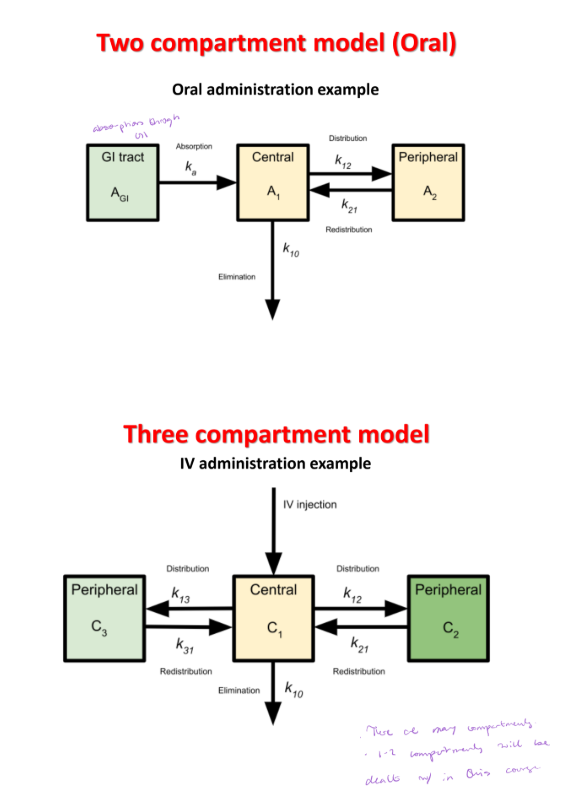
K10: Elimination from the central compartment.
Drug Distribution - Compartment Rate Constants
K12: Rate constant for distribution from the central compartment to the peripheral compartment.
K21: Rate constant for distribution from the peripheral compartment to the central compartment.
The two rate constants are not equal.
t1/2: Drug half-life.
Pharmacokinetic Models - One-Compartment Model
The simplest model involves a rapid intravenous injection of the entire dose, called an IV bolus.
Drug moves very quickly between the blood (central) and tissue (peripheral) compartments.
Distribution is complete by the time the first plasma sample is taken.
A plot of the natural log of plasma concentration against time is linear.
Pharmacokinetic Models - Two-Compartment Model
Drug moves more slowly between the central and tissue compartments.
Distribution is incomplete by the time the first plasma sample is taken.
A plot of log drug concentration against time is not linear, with an initial steep portion followed by a shallower portion.
The central compartment exchanges drug with the peripheral compartment through K12 and K21, while K10 represents elimination from the central compartment.
Apparent Volume of Distribution
The theoretical volume that would contain the total amount of drug in the body at a concentration equal to the measured plasma concentration.
AVD = D / C, where D is the amount of drug in the body and C is the plasma concentration.
Expressed in litres.
It is a major pharmacokinetic property and determinant of drug half-life and dosing frequency.
Apparent Volume of Distribution - Measurement Timing
AVD depends on when plasma concentration is measured.
Different distribution phases produce different apparent volumes of distribution.
Vc represents the central compartment volume immediately following an IV bolus.
Vss represents the apparent volume of distribution at steady state.
Apparent Volume of Distribution - Vc
Vc is the volume of the central compartment immediately following an intravenous bolus dose.
It is often represented as V or Vd.
It is widely used to calculate loading doses when steady state needs to be reached quickly.
Vc = Dose / C0.
Apparent Volume of Distribution - Vss
Vss is the volume of distribution at steady state.
It represents the apparent distribution volume associated with the steady-state dosing paradigm under which most drugs are developed.
Vss is the preferred measure when comparing Vd between patient groups.
It is independent of elimination processes.
Apparent Volume of Distribution - Vbeta
Vbeta is derived from the terminal elimination-phase half-life.
It is not often used because it is difficult to measure.
It is affected by changes in drug clearance.
It represents the apparent volume of distribution associated with the terminal beta phase.
Apparent Volume of Distribution - Pharmacokinetic Parameters
AUC: Area under the concentration-time curve.
AUMC: Area under the moment curve, or distribution equilibrium curve.
MRT: Mean residence time, the average time a drug molecule stays in the body; derived for drugs administered intravenously.
CL: Clearance rate.
Apparent Volume of Distribution - Vc Equation
Vc = Dose / C0.
C0 is the plasma concentration immediately following an IV bolus.
This equation is used to calculate the apparent volume of the central compartment.
Memorize this equation.
Apparent Volume of Distribution - Total Body Water
Vc indicates the degree of drug distribution in body water.
Total body water is approximately 0.6 L/kg in men and 0.5 L/kg in women.
If a drug is evenly distributed throughout the body, its calculated Vc will approximate total body water.
The human body is approximately 50 to 70 percent water.
Apparent Volume of Distribution - Total Body Water Examples
For a 70 kg man, total body water is approximately 42 L.
For a 60 kg woman, total body water is approximately 30 L.
A drug evenly distributed throughout body water will have an apparent volume of distribution near the corresponding total body water value.
Apparent Volume of Distribution - Vc Below 3 L
A Vc below 3 L indicates that the drug is mainly confined to plasma.
Such a drug has limited distribution outside the bloodstream.
Heparin is an example.
Apparent Volume of Distribution - Vc Around 17 L
A Vc around 17 L indicates distribution mainly into extracellular water.
The drug is relatively hydrophilic and does not readily cross biological membranes into intracellular space.
Mannitol is an example.
Apparent Volume of Distribution - Vc Around 40 L
A Vc around 40 L indicates distribution throughout total body water.
The drug is sufficiently lipophilic to partition into cells but sufficiently hydrophilic to remain soluble in aqueous spaces.
Ethanol is an example.
Apparent Volume of Distribution - Vc Above 40 L
A Vc above 40 L can indicate that tissue binding exceeds plasma protein binding.
A large volume of distribution means that substantial drug has partitioned into tissues outside the plasma.
Chloroquine and propofol are examples.
Propofol has an AVD of approximately 560 L.
Apparent Volume of Distribution - Membrane Permeability
If a drug cannot cross membranes, its Vc cannot exceed the extracellular space.
Such a drug remains outside cells.
Its distribution is therefore restricted by membrane permeability.
Apparent Volume of Distribution - Plasma vs. Tissue Binding
If plasma binding is stronger than tissue binding, Vc will generally be below 40 L.
More drug remains in the circulation rather than penetrating into tissue.
If tissue binding exceeds plasma protein binding, Vc can be greater than 40 L.
Apparent Volume of Distribution - Body Water
A 100 mg dose is administered to a 100 kg woman with an estimated total body water of 50 L.
Plasma drug concentration is 2 micrograms/mL.
Vc = 100 / 2 = 50 L.
This suggests distribution throughout total body water.
Apparent Volume of Distribution - Confined to Plasma
A 100 mg dose is administered intravenously.
Plasma drug concentration is 33.3 micrograms/mL.
Vc = 100 / 33.3 = approximately 3 L.
This suggests that the drug is confined mainly to plasma.
Apparent Volume of Distribution - Body Water Calculation
A 100 mg dose is administered to a 100 kg woman with an estimated total body water of 50 L.
Plasma drug concentration is 0.5 micrograms/mL.
Vc = 100 / 0.5 = 200 L.
This exceeds total body water, suggesting that substantial drug is stored in another compartment, such as fat.
Apparent Volume of Distribution - Kidney and Liver Dysfunction
Drugs strongly bound to plasma constituents, such as phenytoin and diazepam, can have increased AVD when plasma protein binding is reduced in liver or kidney disease.
Reduced AVD is a general phenomenon associated with renal failure.
Pronounced changes are most likely for drugs eliminated through renal excretion, such as digoxin.
Apparent Volume of Distribution - Dehydration
Dehydration decreases body water.
Decreased body water can decrease AVD.
Apparent Volume of Distribution - Age
With age, body fat generally increases while total body water decreases.
Increased fat can increase the volume of distribution of highly lipophilic drugs.
Diazepam and chlordiazepoxide are examples.
Increased distribution into fat may meaningfully increase elimination half-life.
Apparent Volume of Distribution - Obesity
Lipophilicity is a principal correlate of in-vivo AVD and the increased AVD of drugs in obese patients.
Increased AVD can prolong drug half-life.
Prolonged half-life can delay drug accumulation and washout during and after chronic dosing.
The magnitude depends on the degree of obesity and the lipid solubility of the drug.
Apparent Volume of Distribution - Summary
AVD is the theoretical volume required to dilute the total administered drug to the measured plasma concentration.
It does not represent the actual volume of the body or its fluid compartments.
Highly tissue-bound drugs have low plasma concentrations and high AVD.
Drugs that remain mainly in circulation have higher plasma concentrations and low AVD.
Apparent Volume of Distribution - Limitations
AVD provides a reference for the expected plasma concentration for a given dose.
It provides limited information about the specific pattern of drug distribution.
Drugs may distribute primarily into fat, remain in extracellular fluid, or bind extensively to particular tissues.
Each drug has its own distribution pattern.
Pharmacokinetic Constants - Models Studied
One-compartment model with IV bolus administration.
One-compartment model with IV infusion.
Loading dose followed by IV infusion.
Oral administration and the two-compartment model with IV bolus administration.
Drug Elimination Kinetics - Zero Order
Zero-order kinetics involve elimination of a constant amount of drug per unit time.
The amount eliminated per unit time does not depend on the drug concentration.
Ethanol is an example of a drug that follows zero-order kinetics.
Drug Elimination Kinetics - First Order
First-order kinetics involve elimination of a constant fraction of drug per unit time.
The amount eliminated per unit time depends on the amount of drug present.
First-order kinetics are the most common type in pharmacokinetics.
Drug Elimination - Logarithmic Transformation
Drug elimination is typically a first-order process described by an exponential decay curve.
Pharmacokinetic data can be converted into a linear relationship to make rate constants easier to calculate.
A logarithmic concentration-time plot is linear for first-order elimination in a one-compartment model.
Logarithmic Conversion - Natural Log and Base-10 Log
The base-10 logarithm is commonly written as log, while the natural logarithm is written as ln.
The value of e is approximately 2.71828.
The natural logarithm of 10 is approximately 2.303.
Multiply ln by approximately 2.303 to convert to log; divide log by approximately 2.303 to convert to ln.
One-Compartment Model - IV Bolus
The amount of drug in the body is not measured directly; blood samples are collected at intervals and plasma drug concentrations are analyzed.
The relationship between drug amount and plasma concentration is DB = Vd x Cp.
DB is the amount of drug in the body at time t.
D0B is the amount of drug in the body at time zero, corresponding to the administered dose.
One-Compartment Model - Calculating Vd
Sampling blood soon after administration provides a reasonable estimate of the initial plasma concentration, C0p.
The dose and initial plasma concentration can be used to calculate Vd.
Vd = Dose / C0p.
Vd = D0B / C0p.
One-Compartment Model - Drug Amount Over Time
DB = D0B x e^(-kt).
DB is the total amount of drug in the body at time t.
D0B is the initial amount of drug in the body.
k is the elimination rate constant, and t is elapsed time.
One-Compartment Model - Plasma Concentration Over Time
C = C0 x e(-kt).
C is the plasma concentration at time t.
C0 is the initial plasma concentration.
k is the elimination rate constant, and t is elapsed time.
One-Compartment Model - Logarithmic Equations
log DB = (-kt / 2.3) + log D0B.
ln DB = -kt + ln D0B.
These equations express first-order elimination as a linear relationship after logarithmic transformation.
Drug Half-Life - Equation
t1/2 = 0.693 / k.
t1/2 is the time required for drug concentration to decrease to half its initial value.
k is the elimination rate constant.
IV Bolus - Calculating Concentration
Initial concentration C0 = 100 mg/L, k = 0.10 h^-1, and elapsed time t = 6 h.
Use C = C0 x e^(-kt).
The concentration after 6 hours is approximately 54.9 mg/L.
Elimination Rate Constant and Half-Life - Clinical Importance
Help estimate the time required to reach steady state.
Help estimate the time required to eliminate all or part of a drug from the body.
Help estimate the amount of drug accumulated in the body and the degree of peak-trough fluctuation.
Help determine the appropriate dosing interval.
Drug Elimination - Five Half-Lives
Approximately five half-lives are required to reach steady state.
Approximately five half-lives are also required to eliminate nearly all of a drug from the body.
Five half-lives represent near-complete elimination, rather than literal removal of every drug molecule.