EQ - Bonding Exam Questions
 Call Kai
 Learn
 Practice Test
 Spaced Repetition
 Match
 Flashcards
 Knowt Play
1/15

There's no tags or description
Looks like no tags are added yet.
16 Terms

Iodine and hydrogen iodine are both simple molecular structures
thus the molecules are held together by intermolecular forces
the intermolecular forces are weak between the molecules so require little energy to overcome hence they are weak
Iodine has van der Waals forces between it’s molecules, hydrogen iodide has permanent dipole-dipole and weak van der Waals forces between its molecules
yet the van der Waals forces between iodine molecules are stronger than the combined permanent dipole-dipole forces and van der Waals forces in hydrogen iodide as it has more electrons so requires more energy to overcome

The melting point generally increases from Na - Si
The melting point generally decreases from Si - Ar
The melting point increases from P to S because sulfur has more electrons therefore a greater Mr
hence more and stronger van Der Waals forces between sulfur molecules

The higher the charge on the cation, the stronger the attraction between the ions
hence a greater amount of energy needed to separate the cation Mg2+ in MgF2 than the Li+ in LiF
the smaller the radius of the cation, the stronger the attraction between the ions
Li+ ion has a smaller radius and a higher amount of energy needed than Na+ ion

Silicon is a giant covalent lattice
hence has many strong covalent bonds
which require a large amount of energy to overcome so has a high melting point
Phosphorus is a simple molcular structure
hence has weak van Der Waals forces between molecules
that require a smaller amount of energy to overcome
Mg has a higher metling point than sodium because
Mg2+ ions are smaller and have a greater charge (Na+ions)
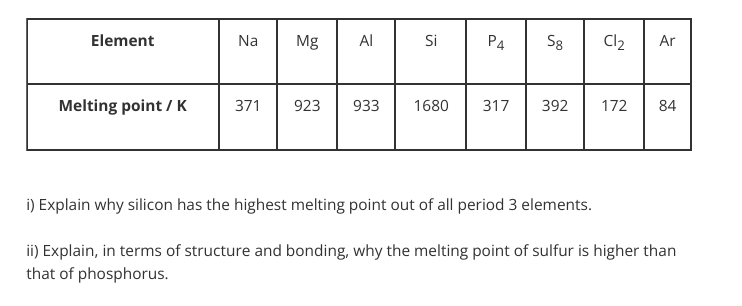
Silicon has the highest melting point because it is a giant covalent structure / macromolecular
hence has many strong covalent bonds
which require high amount of energy to overcome
Sulfur has a higher melting point than phosphorous because
both phosphorous and sulfur have van Der Waals forces between molecules
yet sulfur has more electrons than phosphorous
hence sulfur has more and stronger van Der Waals forces between molecules which require a larger amount of energy to overcome

bromine is a simple molecular structure whereas magnesium is a giant metallic sturcture
bromine has weak van der Waals forces between its molecules
magnesium has strong electrostatic forces of attraction between the positive Mg ions and the negative sea of delocalised electrons
forces of attraction in magnesium are stronger than the van der Waals forces between bromine molecules so requires more energy to overcome
Mg has a much greater liquid range because of strong forces of attraction in liquid
Describe the bonding in magnesium (2)
attraction is between Mg2+ and delocalised electrons

iodide ion is bigger so less attractionn to the Na+ ion
The boiling point of fluorine and hydrogen fluoride are -188oC and 19.5oC respectively. Explain, in terms of bonding, why the boiling point of fluorine is very low.
van der Waals forces between the molecules
intermolecular forces are weak so require little energy to overcome
Explain how the strongest type of intermolecular force arises between two molecules of ammonia (3)
large difference in electronegativity between N and H atoms
this results in N becoming delta negative and H becoming delta positive
lone pair on N atom from one molecule is attracted to the delta positive hydrogen of another molecule
BrF4 – ions are also formed when potassium fluoride dissolves in liquid BrF3 to form KBrF4.
Explain, in terms of bonding, why KBrF4 has a high melting point. (3)
there are forces of attraction between ions
there are electrostatic forces of attraction between oppositely charged ions
between K+ ions and BrF4 - ions

Na has metallic bonding within a giant metallic structure
whereby there are forces of attraction between the positive nucleus and the delocalised electrons in Na
NaBr and Nal have ionic bonding within their giant ionic structure
there are electrostatic forces of attraction between the + and - ions (between oppositely charged ions) in NaBr and Nal in all directions
the ionic bonds are stronger than the metallic bonds
there is stronger attraction between the + and - ions in NaBr than in Nal
since the Br- ions is smaller than the I- ion
Explain why a flouride ions is larger than a sodium ion (2)
flouride ions has two fewer protons hence a lower nuclear charge
therefore a weaker attraction between the nucleus and outer electron

SrCl2 has the highest melting point followed by ICI and then Br2 with the lowest boiling point
SrCI2 is a giant ionic lattice whereby there are strong ionic bonds i.e electrostatic forces of attraction between oppositely charged ions.
it is a lattice so there are many strong bonds to overcome
ICI has permanent dipole-dipole between molecules which are weaker than the ionic bonds in SrCI2
Br2 has van Der Waals forces between molecules which are weaker than the permanent dipole-dipole forces between ICI and much weaker than the ionic bonds in SrCI2
Explain why magnesium has a higher melting point than sodium (2)
Mg2+ ions has a higher charge than Na+ and so Mg2+ ions are smaller
therefore attract delocalised electrons more strongly, stronger electrostatic force of attraction between positive ions and delocalised electrons
Explain why stronium has a higher melting point than barium (2)
Sr2+ ions are smaller than Ba2+ ions
therefore a stonger attraction between the positive ions and the delocalised electrons in Sr than in Br