Tilly, Revolutions and Collective Violence
 Call Kai
 Learn
 Practice Test
 Spaced Repetition
 Match
 Flashcards
 Knowt Play
1/26

There's no tags or description
Looks like no tags are added yet.
27 Terms
why do groups engage in violence?
competing for resources/power
material/financial and normative (social ideas shared by others, institutional resources - support from state offices) and coercive
Why does Tilly reject relative deprivation as an explanation for revolution?
Tilly argues that deprivation is too common to explain revolution. Many people experience frustration and hardship without rebelling. Revolutions occur when organized groups mobilize resources, form coalitions, and challenge state authority.
Why is mobilization more important than discontent in Tilly's theory?
Discontent does not automatically produce action. Mobilization gives groups the resources necessary to act collectively. Without organization, leadership, communication, and resources, grievances alone do not create revolutions.
The process by which groups gain control over resources such as money, people, organizations, loyalty, and weapons for collective action.
Why are coalitions central to revolutionary success?
Revolutionary groups rarely possess enough power on their own. Successful revolutions usually occur when challengers gain support from existing members of the political system, intellectuals, military officers, or other influential groups.
What is multiple sovereignty and why is it important?
Multiple sovereignty exists when competing groups claim legitimate authority over government and significant numbers of people obey each claimant. Tilly argues that this is the defining feature of a revolutionary situation
Why do wars often increase the likelihood of revolution?
Wars weaken governments, increase demands on the population, damage legitimacy, and sometimes create divisions within the military. These conditions make it harder for governments to suppress challengers.
According to Tilly, what are the four conditions necessary for revolution?
1- contenders for state power making coalitions
advancing claims to sovereignty
2- significant portion of the population submits to those claims
3- defection of some members of the state to the revolutionary coalition
is not necessary but is a symptom
4- government unable to suppress revolutionary coalition
How does Tilly's theory differ from Gurr's?
Gurr explains revolution primarily through relative deprivation and frustration. Tilly argues that political organization, mobilization, coalition building, and struggles for power are far more important than individual feelings of deprivation
Why does Tilly discuss the Russian Revolution?
Tilly uses Russia as an example of multiple sovereignty. The Provisional Government and the Soviets both claimed authority, creating competing centers of power. Revolution occurred because rival groups successfully challenged state authority, not simply because people were angry.
example of revolution in Columbia
Columbia experienced revolution for decades, so using Tilly’s def they were experiencing revolution for decades
What is multiple sovereignty?
multiple groups claiming state power over the same area
A situation where two or more groups make competing claims to governmental authority and parts of the population obey more than one claimant.
dual power - taken from Trotsky
does not have to be just between two groups
What determines whether a revolution succeeds?
Mobilization, coalition-building, government weakness, and especially control over coercive resources such as the military.
how is civil war a special case
would be a revolution in which the blocs of contenders had distinct territorial bases - tilly

can a coup be a revolution
it can be but it has to be viable (compliance of the people)
March 1920 Germany there was a coup but there was a general strike and the coup failed = no support from the people = unviable coup
what does Tilly’s explanation do
1- tillys conception of revolution can accommodate multiple different forms (very broad)
2- conception does not say what the outcome might be
what is the risk of the fact that tillys def of revolution does not require any large change and that he does not refer to the outcome
risk is that claims can be biased if you look at cases with a certain outcome so Tilly looks at cases that had uncertain outcomes
tilly and gurr comparisons

what affects ability to compete for power? (conditional factors)
1- coercive capacity of the state (political environment) ex- dictator gov
2- resources available for competitive groups (organizations)
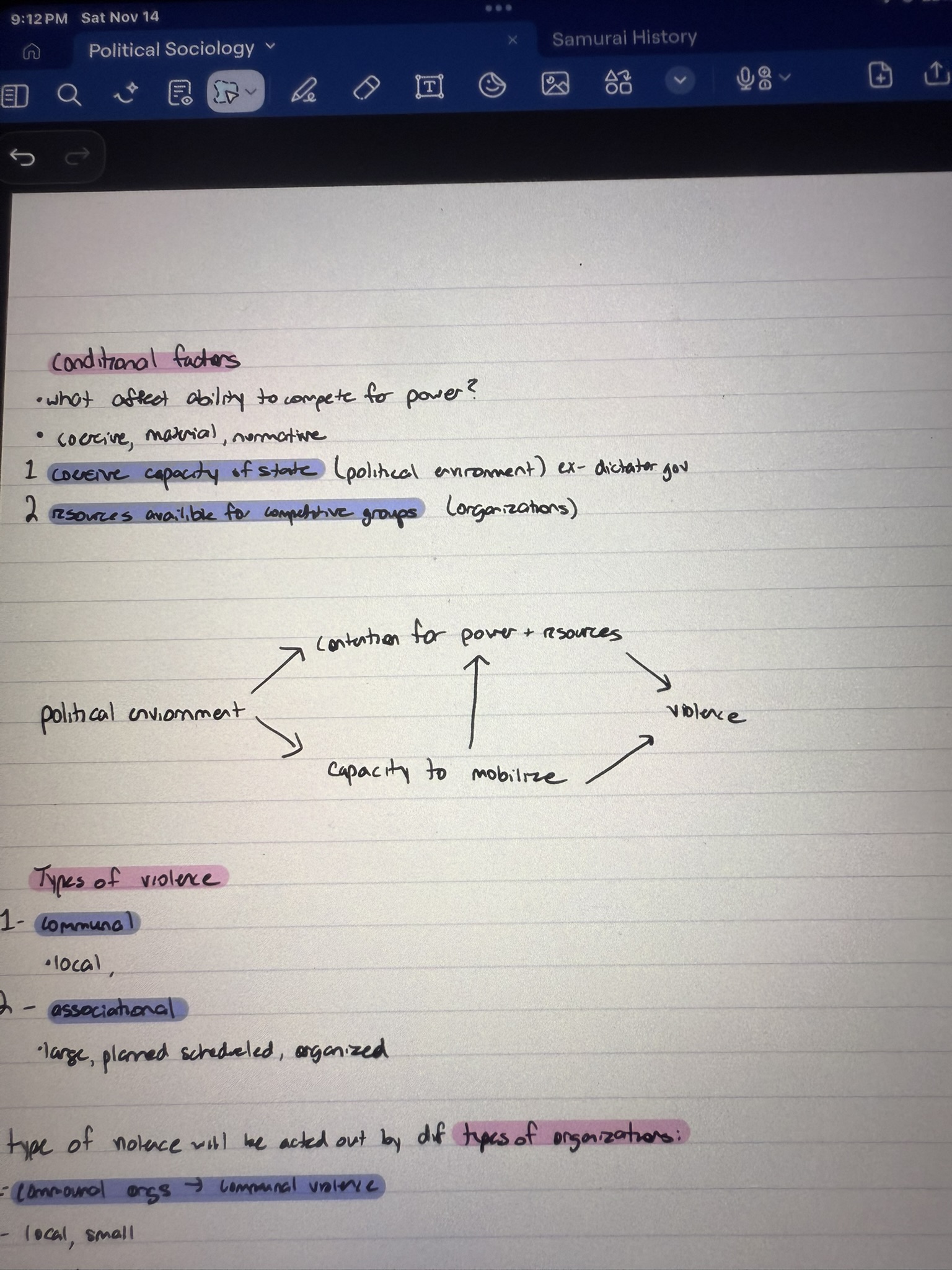
what are the two types of violence?
communal - local
associational - large, planned, scheduled, organized
the type of violence will be acted out by different organizations
1- communal orgs do communal violence (local, small, ex religous groups)
2- associational groups do associational violence (large, highly differentiated, ex parties, trade unions, firms)
what are the three categories of groups?
coercive organizations, contenders, and members/non-members of the polity
what are coercive organizations
government and state
gov - controls main means of coercion
state - is formal and centralized government
ex - police, armies
enforced decisions through coercion
That's why he repeatedly says military defections are so important in revolutions. A revolutionary movement becomes dangerous when coercive power shifts away from the state
what is a contender
groups that apply resources to influence development
Any group that applies resources to influence government decisions.
Examples:
Political parties
Labor unions
Business groups
Peasant organizations
Revolutionary movements
different from Gurr bc Gurr starts with individuals
Tilly starts with organized groups.
To Tilly, politics is basically a struggle among contenders competing to influence government.
what are members and non members of the polity
influence the gov
A member of the polity is a contender with routine access to government.
They can successfully make claims on the government and expect responses.
Ex-
Established political parties
Powerful economic elites
Major interest groups
Government insiders
These groups already have influence.
like in the US, dems and republicans are members bc they routinely influence, on the other hand, the green party would be a non-member bc they have no influence
also can be elected officials
how to know when multiple sovereignty happens
1- groups who operate as if they were the state (claims sovereignty of the state)
do taxation, law enforcement, enlist military, administer welfare
2- illicit compliance of a significant portion of the population
ex Colombia
groups controlling parts of Colombia (FARC, ELN)
started in 1960s still happening
The Colombian state was still the official government, but organizations like:
FARC (Revolutionary Armed Forces of Colombia)
ELN (National Liberation Army)
maintained control over certain territories.
In some regions, local populations often had to:
follow rules established by the guerrillas
pay taxes or fees demanded by guerrillas
seek dispute resolution through guerrilla authorities
cooperate with guerrilla forces rather than state officials
Why does Tilly focus on contenders and membership in the polity rather than deprivation?
Tilly argues that political conflict is produced by organized groups competing for power, not by individual frustration. The crucial distinction is between groups that already have access to government (members of the polity) and groups that are excluded from power (challengers). Revolutions occur when challengers mobilize resources, build coalitions with existing members, and create competing claims to authority.
what is the chain of events that leads to revolution
Coercive Organizations → Contenders → Members vs. Challengers → Coalitions → Multiple Sovereignty → Revolution
Tilly's argument is basically:
Organized groups compete for power.
Some groups are inside the polity and some are outside.
Challengers mobilize.
Challengers form coalitions with insiders.
Government coercive power weakens.
Multiple sovereignty emerges.
Revolution occurs.