Learn: Memory Types and Cognitive Load Theory in Learning
 Call Kai
 Learn
Learn Practice Test
 Spaced Repetition
 Match
Match Flashcards
 Knowt Play
1/27

There's no tags or description
Looks like no tags are added yet.
Name | Mastery | Learn | Test | Matching | Spaced | Call with Kai | Chat |
|---|
No analytics yet
Send a link to your students to track their progress
28 Terms
What are the three types of memory?
Sensory Memory, Working Memory, Long-Term Memory

What is the role of sensory memory?
Transforms stimuli into mental representations with a very large capacity, lasting about 3 seconds.
What percentage of incoming sensory information is typically discarded?
About 90%
Why is attention necessary for learning?
Attention acts as the gatekeeper to learning, determining what information is processed.
What factors influence what we pay attention to?
Relevance, prior knowledge, interest, effort required, emotional state, and multitasking.
What is the difference between maintenance rehearsal and elaborative rehearsal?
Maintenance rehearsal involves repeating information without adding meaning, while elaborative rehearsal involves making connections and meaning.
How does chunking help working memory?
Chunking groups information to reduce the cognitive load, making it easier to process.
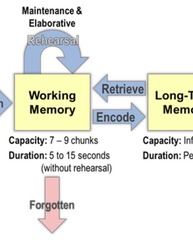
What is the capacity of working memory?
Limited; can typically handle 3-7 units of information.
What is long-term memory (LTM) characterized by?
Infinite storage capacity and permanent duration.

What supports the retrieval of long-term memories?
Retrieval practice strengthens memory recall.
What is the process of encoding in memory?
Transforming experiences into mental representations.
What role does consolidation play in memory?
It strengthens associated neural connections for better storage and retrieval.
What is cognitive load theory?
It describes how different types of cognitive load (intrinsic, extraneous, germane) affect learning.
What are the three types of cognitive load?
Intrinsic (built-in), Extraneous (unnecessary), Germane (relevant).

How can teachers help manage cognitive load?
By minimizing extraneous load, maximizing germane load, and focusing on intrinsic load.
What is task switching and how does it affect attention?
Task switching is a thief of time and accuracy, negatively impacting focus and learning.
What is the significance of attention-grabbing strategies in teaching?
They help engage students' attention and enhance learning by reducing distractions.
How can AI assist in reducing cognitive load?
By providing personalized learning experiences and automating repetitive tasks.
What is the role of schemas in long-term memory?
Schemas organize knowledge, making it easier to store and retrieve related information.
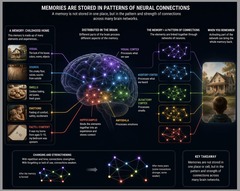
What are retrieval cues?
Prompts that help reconstruct memories during retrieval.
What is the importance of making learning relevant?
Relevance increases engagement and aids in the retention of information.
How does sleep affect memory consolidation?
Sleep strengthens neural connections formed during learning, aiding in memory consolidation.
What strategies can support working memory?
Rehearsal, chunking, and elaboration are effective strategies.
What is the initial processing of information called?
Sensory memory.
What is the role of attention in the learning process?
Attention filters information, allowing relevant stimuli to be processed further.
What is an example of elaborative rehearsal?
Explaining a concept in your own words or connecting new material to prior knowledge.
What is the metaphor used to describe long-term memory?
A giant library where books represent memories.

What is the relationship between experiences and learning?
Experiences are the foundation for encoding and processing information in memory.