BIO 201 Lecture Exam 1 Latest updated questions and answers + rationales - Grand Canyon University
 Call Kai
 Learn
 Practice Test
 Spaced Repetition
 Match
 Flashcards
 Knowt Play
1/216

There's no tags or description
Looks like no tags are added yet.
217 Terms
How are anatomy and physiology related?
Anatomy is the study of the internal and external parts of the body.
Physiology is how living organisms perform their vital functions.
List and describe the specialties of anatomy.
Gross anatomy/macroscopic anatomy examines large, visible structures:
-surface anatomy: exterior feat.
-regional anatomy: body areas
Systematic anatomy: groups of organs working together (skeletal system)
-Developmental anatomy:from egg to maturity
-clinical anatomy: medical specialties(surgical anatomy)
Microscopic anatomy examines cells and molecules:
-cytology: cells and their structures
-histology: tissues and their structures
List and describe the specialties of physiology
-Cell physiology: processes within and between cells
-Organ physiology: functions of specific
-Systemic physiology: functions of an organ system
-Pathological physiology: effects of diseases
Name the levels of structural organization that make up the human body and explain how they're related.
Chemical-cellular-tissue-organ-system-organism.
Define metabolism.
the chemical reactions occurring in the cells and tissues of the body
Compare and contrast catabolism with anabolism. Use examples to help understand the differences.
Catabolism: tearing down; decomposition of complex molecules within the body's cells or tissues(breaking down glucose)
Anabolism: building up; synthesis of new molecules within the body's cells or tissues
Define homeostasis and explain its importance
is the property of a system in which variables are regulated so that internal conditions remain stable and relatively constant.
Compare and contrast intrinsic and extrinsic regulation. Use examples to help understand the difference
Intrinsic regulation: autoregulation
-levels decrease at a tissue
Extrinsic regulation: more distant regulation
-during exercise
List and describe the three control systems involved in maintaining homeostasis
Receptor (sensor)
-respond to changes in the environment
-sends info to control center
Control Center (intergrator)
-determines set point
-analyzes info
-determines appropriate response
Effector
-provides a means for response to the stimulus
Compare and contrast negative and positive feedback. Use examples to help explain each.
Negative feedback:
-includes homeostatic control mechanisms
-shuts off the original stimulus, or reduces its intensity once balance in the body is reached
Positive feedback:
-increases the original stimulus to push the variable farther
-in the body this only occurs in blood clotting and birth of a baby
Describe a person in anatomical position
hands at sides
palms facing forward
feet together
on back
Define Anterior
the front side
Define posterior
the back side
Define lateral
farther away from body
Define medial
close to body
Define proximal
closer to body-in terms of arm would be shoulder
Define distal
farther from body-in terms of arm would be fingers
Define superficial
toward or at the body surface
Define deep
away from the body surface
Define intermediate
In between
Ventral is the same as _______ when describing a region on a human.
anterior/the front side
Dorsal is the same as ________ when describing a region on a human.
posterior/the back side
Cranial is the same as ________
skull area
Caudal is the same as ________
tail bone area
Describe a human in supine position
lying with the front or face and hands facing up
Describe a human in prone position
lying with the front or face down and hands facing upward
List the three anatomical planes/sections
sagittal
midsagittal
frontal
transverse
What are the 4 abdominopelvic quadrants?
right upper quadrant
right lower quadrant
left upper quadrant
left lower quadrant
What are the 9 abdominopelvic regions?
right hypochondriac region
right lumbar region
right inguinal region
left hypochondriac region
left lumbar region
left inguinal region
epigastric region
umbilical region
hypogastric region(pubic)
Identify the major organs located in each of the 4 abdominopelvic quadrants.
RUQ liver, gallbladder, large and small intestine.
RLQ appendix
LUQ stomach, spleen
LLQ urinary bladder
Identify the major organs located in each of the 9 abdominopelvic regions.
RHR none
RLR none
RIR none
LHR spleen
LLR none
LIR none
ER stomach liver
UR large and small intestine
HR appendix, bladder
what are the 2 major body cavities in a human?
Dorsal
Ventral
List the major organs in each cavity.
??
Draw and label the structure of a mitochondrion
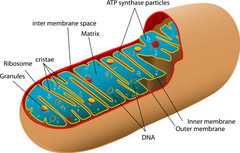
What is the structure of ATP?
Adenosine Triphosphate; organic molecule containing high-energy phosphate bonds
Why is a hydrolysis an important reaction type in regards to ATP?
Adding H2O; important because going from more complex to less complex, adding water
How do ATPase and ATP synthase differ?
ATPase breaks bond to create energy; ATP Synthase adds phosphate to ADP to make ATP
What ion is used to power ATP syntheses in order to regenerate ATP?
Hydrogen used to combine ADP and a free phosphate
About how many ATP are generated from one little molecule of glucose? The answer depends. Why?
36-38 ATP; it depends on the route the electrons take from NADH in cytosol
We are aerobic creatures. What does this mean?
Aerobic means that oxygen is needed to break down food and create energy
What exactly is the difference between oxidation and reduction?
Oxidation: removing electrons
Reduction: adding electrons
LEO says GER
NAD+ is reduced to ______ and FAD+ is reduced to___________.
NADH; FADH2
What does it mean that the breakdown of glucose is exergonic as well as catabolic?
Exergonic - high energy glucose broken down into CO2 and H2O; produces more ATP than uses
Catabolic - larger glucose breaks down into smaller molecules (CO2 and H2O)
Draw and label the regions of the mitochondria where the 3 different parts of cellular respiration occur

How many ATP are generated from the glycolytic pathway? How many ATP are used to get the process up and running? What is the significance of this? What then is the main purpose of the glycolytic pathway in aerobic creatures?
4 generated; 2 used to start reaction; makes 2 extra ATP, makes pyruvate which is used in the Kreb's Cycle. It helps to start ATP synthase and keep the cycle going to create the ATP
What is the fate of the pyruvate generated at the end of glycolysis? Where does it go next?
It is oxidized to Acetyl CoA, which goes into the Kreb's Cycle
What is the fate of the lactic acid generated at the end of glycolysis? Can it be used to generate any more energy?
It can be fermented to get out 2 ATP when Oxygen is not present
Is lactic acid fermentation or alcoholic fermentation efficient ways to generate energy? Explain.
Get 2 ATP out of each. Lactic acid turns into lactate and yeast turns into ethanol... Creates 2 ATP, but is used to try again with glycolysis to find an oxygen to keep the process moving
List the main products of the Krebs Cycle. So, is there really all that much energy ATP produced during the Krebs cycle? What then is the main point of it?
6 NADH-
2 FADH2
2 ATP
4 CO2
The 6+2 NADH and 2 FADH are used in the electron transport chain, which makes all of the ATP. Only 2 ATP are produced.
What is a transmembrane potential? How is this important in terms of energy production?
In inter membrane space, there are lots of protons; the other side is negative, which creates a pull, or potential - the proteins shuttle H+ from matrix to inter membrane space, H+ can go through ATP synthase back to matrix to make ATP
What is the fate of all of that NADH and FADH2 generated during glycolysis and the Krebs cycle. What is is used for?
Used to carry electrons to the electron transport chain and get electron removed - oxidation - to go down the chain
What step of cellular respiration is the majority of ATP generated? Draw a quick sketch of this process, making sure to include ATP synthase in your drawing.
Electron transport chain produces almost all ATP.

Where do all of the different processes of aerobic respiration occur (glycolysis, Krebs cycle, electron transport chain)? Be specific.
Glycolysis: In the cytoplasm
Krebs cycle: In the matrix of mitochondria
Electron transport chain: occurs over the cristae
Hypothesize how genetic mutations that code for proteins in the electron transport chain as well as various poisons could be fatal.
With poisons or mutations, you do not have oxygen or usable energy to keep the electron transport chain running. It block the last protein in the chain which stops the ATP synthase from doing its job
Describe the importance of selective permeability in regards to the cell membrane.
Proteins restrict and control what goes in and out of the cells based on size, electrical charge, molecular shape, and lipid solubility.
List the two major types of transport across the cell membrane and the subtypes for each.
Passive: simple diffusion, channel-mediated diffusion, carrier-mediated transport, facilitated diffusion
Active: vesicular (bulk) transport, receptor mediated endocytosis?
Compare and contrast simple diffusion with channel mediated diffusion.
Simple: flowing freely
Channel-mediated: have to go through a specific channel created by proteins that allow only certain things to pass
What are some factors that affect diffusion?
Size - big molecules take longer
Concentration gradient - they want to go where the least solute is
Charge - they want to be balanced - opposites attract
Distance - shorter distance is faster
Solubility - likes soluble materials because the membrane is lipid, so if it is lipid soluble it will go through
Sketch the difference between co-transport and counter-transport.

Compare and contrast facilitated diffusion and active transport.
Facilitated diffusion: molecules too large to fit through channel proteins, they bond to receptor site on a carrier protein which allows it to go through
Active transport: requires ATP, goes against the concentration gradient
Draw and label the process of receptor mediated endocytosis

Compare and contrast pinocytosis, phagocytosis, and exocytosis.
Pinocytosis: Cell drinking - endosomes drink extracellular fluid
Phagocytosis: Cell eating - engulf large bacteria and other objects in phagosomes
Exocytosis: reverse of endocytosis - out of cell
Explain in detail the difference between a solution with low vs. high osmolarity.
Low osmolarity: little solute, a lot of water
High osmolarity: a lot of solute, little water
Describe in detail the process of osmosis. Make sure you underwent what substance is moving and in which direction.
Osmosis: the diffusion of water across cell membrane, water is moving in to areas with high osmolarity and out of places with low osmolarity
How do osmotic pressure and hydrostatic pressure differ?
Osmotic pressure: Pressure within the capillaries due to proteins in the blood
Hydrostatic pressure: like holes in a hose
What is tonicity?
The osmotic effect of a solute on a cell - "toned" muscles or saggy muscles?
If it is hypo/hyper/isotonic. The status of the cell- if it is swollen, crenated, or normal.
Explain what will happen to a cell if it is placed in an isotonic solution, a hypotonic solution, or a hypertonic solution.
Isotonic: it will stay the same
Hypotonic: Have less solute, so causes water to flow into cell, causing cell to expand too much
Hypertonic: Have more solute, so causes water to flow out of cell into solution, causing it to shrivel
What is crenation? Hemolysis?
Crenation: cell shriveling or shrinking
Hemolysis: rupturing of red blood cells
Label the major structures found in a neuron and describe their functions.
Dendrite: Spikes off cell body, short, highly branched signal receptive regions - convey incoming messages toward cell body
Cell Body: Flat part that dendrites come off of, receives messages
Axon: Impulse generating and conducting region of the neuron
Schwann Cell: One single cell in the axon
Axon Terminal: The opposite end of the neuron, sends signal to body parts
Nodes of Ranvier: In between Schwann Cells
What are the differences between axons and dendrites?
The dendrites receive and transport information to the other parts of the cell and the axons transport it to the axon terminal that sends it to the next neuron.
What is myelin and what is its primary function?
Myelin is a whitish fatty protein layer that serves to protect and electrically insulate axons, increases the speed of transmission of the nerve impulses, and is only around axons
Along the axons of myelinated neurons there are gaps in the myelin where the axolemma (Cell membrane of the axon) is exposed. What is the name given to these gaps in myelin? What is the significance of these gaps in the myelin sheath?
They are called Nodes of Ranvier and are between the Schwann Cells
What is meant by the term "polarity" in regards to the cell membrane of a neuron?
It is positive outside the cell membrane and negative inside. They are opposites which creates a potential to do work
How do sodium and potassium leak channels play a role in the development of the negative membrane potential of the axolemma?
The leak channels make sure that the cell gets back to its resting membrane potential and regulate the amount of each substance
Compare and contrast the 3 types of ion channels.
Chemically gated: Opens as a response to ACh at binding site
Voltage gated: Responds to changes in transmembrane potential
Mechanically gated: Opens in response to distortion of the membrane by an applied pressure
What is meant by the term "propagation" in regards to an axon?
The advancement of the action potential moving through the axon... Moving along
Membrane potential
3 Na out, 2 K in exchange pump, resting membrane potential of -70mV
Action potential
"Nerve impulses" self-regenerating wave of electrochemical activity that allows neurons to carry signal over distance; pulse
Resting Period
-70mV the outside is positive and the inside is negative
Threshold
Causes voltage gated channels to open, exchange occurs at -60mV
Activation gates
Activated when the potential reaches a certain level
Inactivation gates
When potential gets to certain levels, the gates shut
Depolarization
Rising phase, activated by -60mV and Na+ gates open and Na+ flows into cell
Repolarization
Once it reaches +30mV, the Na+ gates close and the K+ gates open, flowing K+ out o the cell
Refractory period
Doors can't be stimulated again until they reset to original confirmation and do not allow the flow to go the opposite direction or re-stimulate the potential
What is a voltage gated channel?
A channel that responds to change in the transmembrane potential
Explain what is meant by, "An action potential is an all or none phenomenon".
Once the stimulus starts one axon to have action potential, it keeps moving all the way to the source and doesn't stop
What is the sodium-potassium pump, and why is it so important to nerve impulse transmission?
It helps take 3 Na+ out of the cell and puts 2 K+ back into cell. This helps get the cell back to -70mV at resting potential for the next impulse to come through
How many Na and K ions does the Na/K pump move and in what direction do these tow ions move?
3 Na+ out
2 K+ in
What is a salutatory conduction?
It is the jumping of the action potential from one node of Ranvier to the next because the refractory periods restrict them
Which neurological disease destroys the myelin sheath of neurons in the CNS(Central Nervous System)? What might be some symptoms early on in this disease?
Multiple Sclerosis - it attacks the myelin sheath, it forms scar tissue, nerve impulses are distorted or interrupted
Symptoms: blurred vision, double vision, lack of coordination, twitching, paralysis, weakness, losing function of nerves and functions
What is the significance of water in the human body?
Most cellular activities are performed in aqueous solutions
Where Na is, water follows
Changing is pH concentration either inside or outside the cell can affect excitability, function, or volume of fluid within the neuron
What are the major electrolytes found in the human body and what are the normal ranges of the concentrations of these electrolytes?
Na+, K+, Ca2+, Mg2+, Cl-
Extracellular fluid, also called ________.
The fluid outside of the cell; interstitial fluid
Intracellular fluid
The fluid inside the cell
Intravascular fluid
Fluid inside the capillaries; plasma
All the fluids and where they are found in a picture
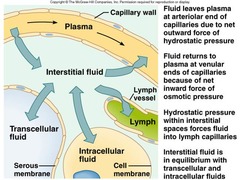
What portion of total body weight is represented by each of the 3 types of fluids?
40% intracellular
16% extracellular
4% plasma
Pure Covalent Bonds
In this type of bond electrons are shared equally. They have the same or similar electronegativity. The atoms charge is equal on both sides.
Polar Covalent Bonds
In this type of bond there is an unequal sharing of electrons. One atom has a stronger pull on the electron. Electrons spend more time with one atom.