2 Basic Principles of Health Care Ethics
 Call Kai
 Learn
 Practice Test
 Spaced Repetition
 Match
 Flashcards
 Knowt Play
1/37

There's no tags or description
Looks like no tags are added yet.
38 Terms
What is Applied Ethics?
Worldviews → societal morays & legal rights.
Reinterpreted in every generation.
Difference between morality and ethics.
Morality: belief of what is right & wrong.
Ethics: the critical reflection of morality & rational analysis of it.
Morality
belief of what is right & wrong
Ethics
the critical reflection of morality & rational analysis of it.
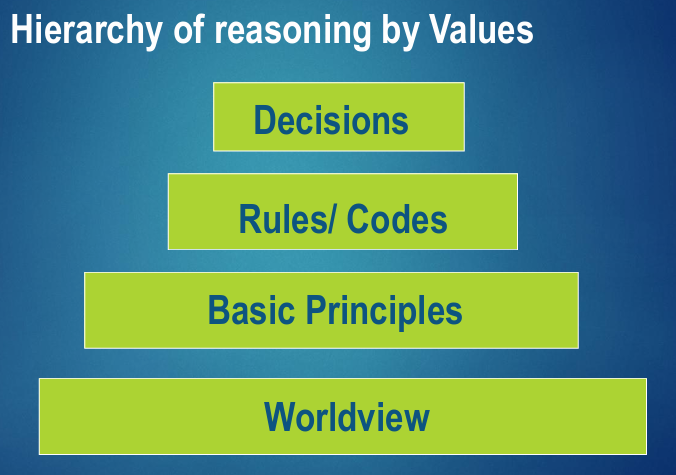
What is the Hierarchy of reasoning by Values in bioethics?
decisions
rules/codes
basic principles
worldview
What are the Universal Principles of Bioethics?
Autonomy
Beneficence
Nonmaleficence
Justice
What are the ethical rules?
Veracity
Confidentiality
Role Fidelity
What is autonomy?
Gr. autos (self) and nomos (governance)
Personal self-determination
What are the three basic elements of autonomy?
The ability to decide
The power to act upon your decisions
Respect for the autonomy of others
Autonomy develops what rule?
informed consent (test question)
What are the elements to informed consent?
Disclosure
Understanding
Voluntariness
Competence
Permission giving
Informed consent involves…
Therapeutic privilege – legal exception
Benevolent deception
Paternalism
What is Beneficence?
Seek the good for the patient.
Suggests mercy and charity.
Reflected in Hippocratic Oath.
…for the benefit of the sick according to my ability and judgment.
Duty to promote health & welfare
What is Nonmaleficence?
PRIMUM NON-NOCERE (do no harm)
Refrain from inflicting harm
Expressing beneficence in the negative
Intentional acts or omissions.
Involves the issue of side effects
Principle of double effect
What is the Principle of Double Effect?
Prescribe a treatment that may have harmful effects as long as that is never the intended outcome
What are the guiding elements to Principle of Double Effect?
Treatment is good or morally neutral
The good must not follow as a consequence of the secondary harmful effects.
Harm never intended, tolerated as causally connected with the good intended.
The good must outweigh the harm
What is justice?
Fairness, equity, fair treatment and entitlements.
Distributive justice.
Scarce health care resources.
Practitioner self –determination.
Mal-distribution of services.
Costs.
Comparative justice
What is Veracity?
Truth telling
Fiduciary relationship
Use of placebos?
Nondisclosure
Deception
Form of paternalism
What is Confidentiality?
Strict confidentially of information gathered in the course of treatment.
Relationship of trust.
Fiduciary responsibility of the practitioner.
HIPAA: Health Insurance Privacy and Portability Act of 1996.
What is Role Fidelity?
Member of the health care team.
Health care specialties shape individual practice.
Practicing faithfully within the constraints of practice roles.
Prescribed by the scope of practice in each state.
Profession Code of Ethics
Rules derived from _____ principles.
Shaped by the needs of the _______ profession.
Something can be socially correct, medically possible and legally permissible and yet be _______ reprehensible.
universal
specific
morally
Name the 4 Ethical Problems
Ethical Distress
Ethical Dilemma
Dilemma of Justice
Locus of Authority

What is this ethical problem?
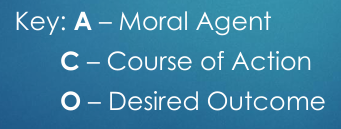
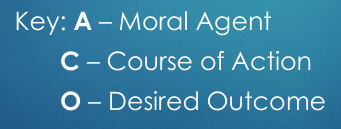
When the Moral Agent [A] faces a problem where he or she knows exactly the right Course of Action [C] but is faced with a barrier from reaching the Desired Outcome [O].
Ethical Distress
What is an example of ethical distress?
Your patient has reached the end of his insurance coverage but you know he requires more treatment to reach his full functional potential.
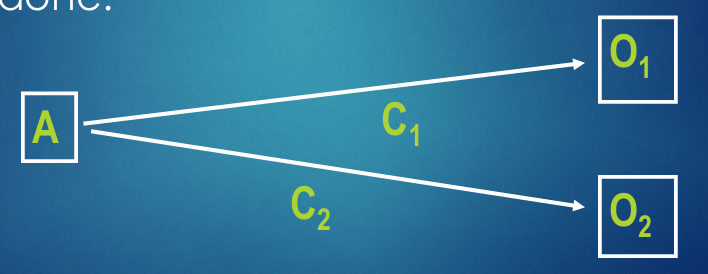
What is this ethical problem?
When faced with two or more morally correct Courses of Action that both can’t be done
Ethical Dilemma
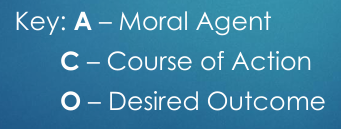
What is an example of ethical dilemma?
You need to decide whether or not to skip an important portion of one patient’s treatment in order to address the pressing needs of another patient.
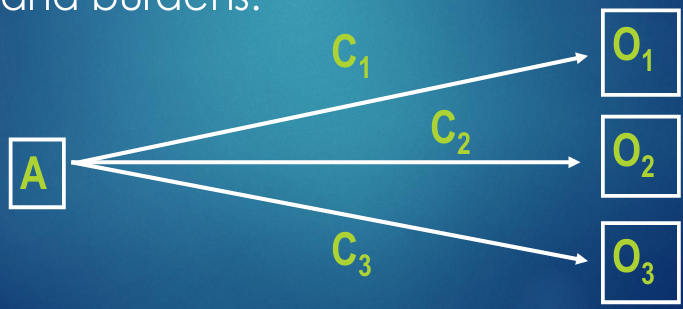
What is this ethical problem?
The dilemma that arises out of the competition of several groups for society’s benefits and burdens
Dilemma of Justice
What is an example of Dilemma of Justice?
You are not allowed to provide the same amount of care for similar patients because of unequal health care insurance coverage
What is this ethical problem?
Focus is not what should be done but on who should do it.
Problems that occur when roles, institutional policies or societal arrangements create confusion about who is in charge.
Locus of Authority
What is an example of Locus of Authority?
You are asked by the family of a cancer patient you are treating whether the patient’s condition is terminal.
What is this type of ethical problem?
Should the elderly be provided the same level of health care as provided for children?
dilemma of justice (who is benefitting more)
What is this type of ethical problem?
Should patients with DNR orders be treated in ICU?
ethical distress (want to treat but is a barrier)
What is this type of ethical problem?
Must a healthcare provider who is HIV positive relate this to patients?
ethical distress (barrier to treat a pt with honesty)
What is this type of ethical problem?
Who should live when there is not enough care or medicine for everyone?
dilemma of justice (capability but not the resources)
What is this type of ethical problem?
Who tells the patient, or family, the prognosis when terminal illness is suspected.
locus of authority
What is this type of ethical problem?
Can health care practitioner work for the patient and be socially responsible for cost containment at the same time?
dilemma of resources (resources, usually a single practice)
What is this type of ethical problem?
Is there a right to health care? If there is a right, what is the limit of that right?
ethical distress (barrier of income)
What is this type of ethical problem?
Is it in the patient’s best interest to be kept alive on artificial life support or have the life support removed?
ethical dilemma (can morally argue both outcomes)
What is the six step process to addressing ethical principles?
Identify the characteristic of the problem:
Gather the facts
Examine the options
Weigh and evaluate the potential options
Make a decision and act on it
Assess and evaluate the results