Drug Resistance
 Call Kai
 Learn
 Practice Test
 Spaced Repetition
 Match
 Flashcards
 Knowt Play
1/51

There's no tags or description
Looks like no tags are added yet.
52 Terms
Drug tolerance
A reduction in response following repeated or sustained drug exposure, such that a larger dose may be required to produce the original effect
Drug resistance
Described reduced response (or absence of response) to drug treatment. It usually means the drug’s biological targets, such as bacteria, viruses, or cancer cells, can survive or grow despite treatment
Tachyphylaxis
Example of drug tolerance, repeated ephedrine doses deplete norepinephrine, reducing blood pressure response
Chronic drug tolerance
Example of drug tolerance, repeated morphine use produces less analgesia
Not all treatment failures is resistance, all of the following listed can also cause treatment failure except
Mutation of drug
Antibiotics often act on bacterial structures that humans dont have, this can provide a relatively ______ therapeutic window
Wide
Tumor cells are human cells, anti cancer drugs must exploit tumor-specific vulnerabilities while limiting harm to normal tissues, this results in a ____ therapeutic window
Narrow

Resistance can shift the effective concentration _____
Upward
Intrinsic resistance
Resistance that exists naturally in a cell or organism before drug exposure
Intrinsic resistance key features
Pre-existing
Due to inherent biological characteristics
Does not require prior drug exposure
Gram-negative outer membrane limits
vancomycin entry
Intrinsic resistance example
A tumor lacks the drug target or harbors alternative pathways
Intrinsic resistance example
Acquired resistance
Resistance that develops in a previously drug-sensitive cell or organism.
Acquired resistance key features
Develops through genetic or adaptive
changes
Can involve mutations, gene transfer, or
altered gene expression
May arise before or during treatment
Bacterial beta-lactamase acquisition
Acquired resistance example
Target mutation in a tumor
Acquired resistance example
Major mechanism of drug resistance (Pharmacokinetic)
Drug does not reach the target - Reduced uptake, impaired delivery, or increased efflux
Drug is inactivated - Enzyme-mediated destruction or
chemical modification
Major mechanism of drug resistance (Pharmacodynamic)
Target changes - Mutation, reduced expression, or altered binding
Cell bypasses the blockade - Alternative metabolic or signaling pathway
Mechanisms of innate (intrinsic) resistance - Pharmacokinetic systemic factors (host)
1. Decreased drug absorption
2. Decreased metabolic activation of the drug
3. Increased metabolism and elimination
4. Decreased drug distribution due to structural or functional barriers (for example BBB)
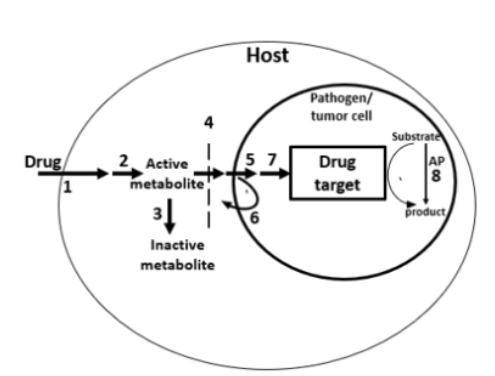
Mechanisms of innate (intrinsic) resistance - Pharmacodynamic factors
5. Reduced transport inside the pathogen
6. Elevated removal from the pathogen
7. Target is hardly reachable due to specific
cellular barriers or low affinity to the drug
8. Existence of an alternative pathway which can
complement the activity of the targeted pathway

Antibiotic-resistant germs caused more than 2.8 million infections and more than 35,000 deaths in the US every year
Why antibiotic resistance matters
Which of the following is not an approach to avoid innate resistance
Increase concentration of drug
Acquired resistance
Pathogens or tumor cells initially respond to a drug but
become less responsive or resistant over time
Resistance mechanisms (acquired)
Genetic changes (mutations or acquired genes) and, particularly in cancer, epigenetic or adaptive cell-state changes can produce resistant cells.
Selection (acquired)
During drug treatment, susceptible cells are eliminated while resistant cells survive and expand. Acquired resistance can arise through either selection of pre-existing resistant variants or treatment-induced adaptive mechanisms.
Examples of high-burden resistant bacterial threats
Methicillin-resistant Staphylococcus aureus (MRSA) and Carbapenem-resistant Acinetobacter (CRAB)
Gram positive
Purple, cocci (round, spherical), has the additional cell wall
Gram negative
Pink, bacilli (rod-shaped)
Amoxicillin, vancomycin (prevent cell wall synthesis)
Drugs used in gram positive bacteria
Amoxicillin (water soluble, able to cross the lipid membrane by the “watery” porin protein)
Drugs used in gram negative bacteria
Target mutations
Germs change the antibiotic’s target so the drug can no longer fit it and do its job
Antibiotic efflux pumps
Germs can rid of antibiotics using pumps
E.g. porin mutants with decreased affinity
Germs restrict access by changing the entry ways or limiting their numbers
E.g. beta-lactamase destroys beta-lactam antibiotics
Germs change or destroy the antibiotics
Use of alternative enzyme
Germs avoid use of antibiotic’s target
Which of the following is not an example of bacterial resistance mechanisms
Metabolize the drug
Vertical gene transfer
Mutated gene is passed through the bacterial replication to the descendants of this bacterial cell.

Horizontal gene transfer
The sharing of genetic material between organisms
that are not in a parent–offspring relationship.

Which of the following is not a horizontal transfer mechanism
Conformation
Conjugation
Direct cell-to-cell DNA transfer, often by plasmid, Common route for plasmid-borne resistance genes
Transformation
Uptake of free DNA from the environment, DNA released from other bacteria can be incorporated
Transduction
Bacteriophage transfers bacterial DNA, Virus carries DNA between bacteria
MDR1 / P-glycoprotein (P-gp) (ABCB1)
The major drug transporter (transports ~1/2 of all the drugs) in normal tissues and a key contributor to multidrug resistance in cancer
Common multidrug-resistant (MDR)
Cells selected for resistance to drugs with different structures and targets were found be cross-resistant to the other drugs: a ______ phenotype
Which of the following is not a reason why is P-gp inhibition not becoming a routine cancer therapy
P-gp is not expressed in normal protective barriers, including intestine, liver, kidney, and blood-brain barrier.
Target alternation
How Cancer Cells Resist Targeted Therapy - The target protein changes, so the drug binds less well.
Target amplification
How Cancer Cells Resist Targeted Therapy - The cancer produces much more of the target, overwhelming the drug.
Bypass signaling
How Cancer Cells Resist Targeted Therapy - A different receptor or pathway activates the same growth signal.
Downstream pathway reactivation
How Cancer Cells Resist Targeted Therapy - Signaling resumes below the blocked target.
Cell-state or lineage plasticity
How Cancer Cells Resist Targeted Therapy - Cells change phenotype and no longer depend on the targeted pathway.
Drug-tolerant cells and tumor heterogeneity
How Cancer Cells Resist Targeted Therapy - A pre-existing or reversible resistant subpopulation survives, then expands during treatment
Tumor microenvironment support
How Cancer Cells Resist Targeted Therapy - Surrounding stromal cells, hypoxia, or growth factors help cancer cells survive therapy.