M1: Cells and Tissues of Immune System + Week 1 F2 Lecture
 Call Kai
 Learn
Learn Practice Test
 Spaced Repetition
 Match
Match Flashcards
 Knowt Play
1/28

Earn XP
Description and Tags
This is week 1 of the lecture F2F and the online module
Name | Mastery | Learn | Test | Matching | Spaced | Call with Kai | Chat |
|---|
No analytics yet
Send a link to your students to track their progress
29 Terms
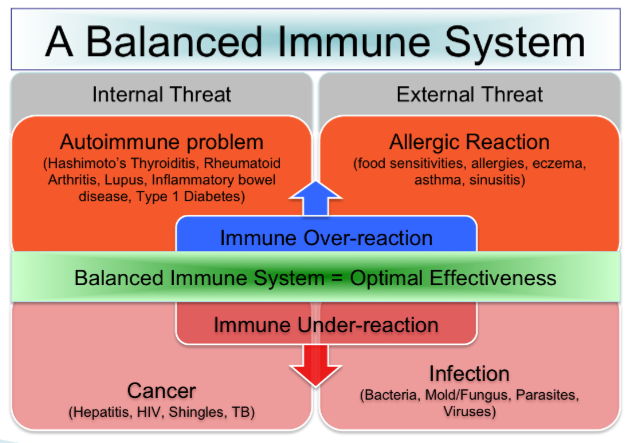
Q: What does immune system do? Here below four categories. Place which one is immune over reaction and under reaction AND which is considered a internal and external threat
Cancer
Allergic reaction
Infection
Autoimmune problem
Internal threat
Autoimmune problem
Cancer
External Threat
Allergic Reaction
Infection
Immune over reaction
Autoimmune response
allergic reaction
Immune under-reaction
Allergic reaction
infection
INNATE AND ADAPTIVE IMMUNITY
Q: What are the two defense systems that make up the immune defense?
Innate and adaptive immunity
Q: Which two systems is the first line of defense and what does the other system does after the response?
The first line of defense will be the innate immune system which will respond first when the barrier had been breached. It will work within hours of an encounter with invaders.
In contrast, adaptive immunity is contingent upon innate immunity and begins to work in a couple of days after infection. Adaptive immunity develops after infection and is tailored to recognize, eliminate a specific threat
ADAPTIVE IS ONLY PRESENT IN JAWED VERTEBRATES

TYPES OF ADAPTIVE IMMUNE RESPONSES\
Q: What are the two general types of adaptive immune responses?
Humoral and cell mediated
Q: What mediated to humoral and cell mediated immunity AND what type of antigens they recognize?
Humoral immunity is mediated by protein molecules called antibody made by B lymphocytes (B cells). Antibodies recognize extracellular antigens
Cell mediated immunity is mediated by T lymphocytes (T cells) and targets intracellular antigens. This is usually results in killing of target cells

CRDINAL FEATURES OF ADAPTIVE IMMUNE RESPONSES
Q: There are four main characteristic involved. Match the term with their definition
Able to distinguish extremely subtle differences between antigens
specific receptors can recognize and discriminate between billions of distinct antigens
a second encounter with same antigen induces a heightened response
response are directed only to foreign (non-self) antigens
A) memory
B) specificity
C)diversity
D) self/non-self recognition
B) Specificity: able to distinguish extremely subtle differences between antigens
C) Diversity: specific receptors can recognize and discriminate between billions of distinct antigens
A) Memory: a second encounter with same antigen induces a heightened response
D) Self/non-self recognition: responses are directed only to foreign (non-self) antigens

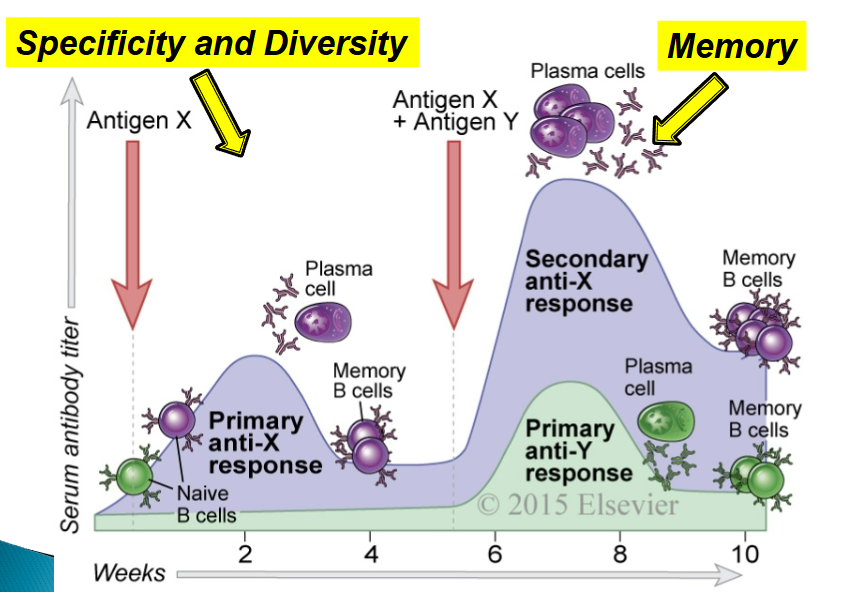
Q: Where does specificity and diversity occurs? Where does memory plays?
For both specificity and diversity, it occurs during the primary response. The memory occurs during the secondary phase.
CELLULAR COMPONENTS OF ADAPTIVE IMMUNE SYSTEM
Q: What do both lymphocytes and antigen-presenting cells are required to do?
Both are two major groups of cells that are required to generate an effective immune response
Q: What does APC stand for? What are the main purpose?
Antigen-presenting cells; primarily display antigens to T cells
Q: There are two major production of lymphocytes called B and T cells. What do they each recognize and make?
B cells recognize extracellular antigens and make antibody
T cells recognize intracellular antigens and function to destroy microbes or infected cells
Q: Where to B cells mature and does all express one or the same antigen-binding receptor?
Q: What is it called?
B cells mature in the bone marrow and each of them express ONE UNIQUE antigen binding receptor
It is called B cell receptor ( BCR)
Q: What is a naive B cell?
Q: What happen when there is a binding of an antigen to a naive B cell’s BCR?
It is a B cell that have not encounter any antigens before.
It causes the B cell to become activated and divide extensively
INFORMATION
Antigen-activated B cells differentiate into plasma cells
produce large amounts of antibody that they secrete and are generally short lived cells
Some activated B cells instead form memory B cells that have a long lifespan and display membrane-bound antibody
memory B cells respond quickly upon seeing antigen again
.
Q: Where do T cell mature at? Do they even came from the same place?
T cell progenitors arise in bone marrow BUT MUST migrate to thymus to mature
Q: Does T cells also express a unique surface or all of them are the same?
Each mature T cells expresses one unique T cell receptor on its surface
Q: What are the two major populations of T cells?
Q: What set both of them apart?
T helper cells (TH) and T cytotoxic cells (TC)
Both are easily distinguished by the surface proteins called CD4 and CD8 (YOU KNOW THIS OKAY)

Q: What is relationship between APC and T cells
APC present the antigen to the T cells
Q: What happen to a naive T cell once there is recognition of antigen by TCR?
Q: What is the term for it?
Just as B cells, recognition of antigen by TCR of a naive T cell will cause cell to become activated and divide extensively
the term for activated T cells are effector cells
Q: What does the helper T cells does for the adaptive immune responses?
Q: What do they activate and cause what type of responses
Q: What do they produce?
Helper T cells orchestrate adaptive immune responses
cell mediated and humoral
Helper T cells activate APC and play an important role in orchestrating inflammatory responses
Helper T cells mediate their actions by engaging in cell surface interactions and by producing cytokines
Q: Can cytotoxic T cells cause autoimmunity?
Yes they can;
CORRECT RESPOND: upon recognizing antigen they kill cells that are either infected with foreign intracellular microbes or cells that are damaged or abnormal.
Q: What are cytokines?
Q: What are interleukins (IL)?
Cytokines are polypeptides secreted by cells of both innate and adaptive immune system
they are produced by cells in response to microbes, sensing of antigen and also by many other stimuli
Because many cytokines ar produced by leukocytes, a subset of very important cytokines are called interleukins (IL)
INFORMATION OF GENERAL PROPERTIES OF CYTOKINES
Cytokine secretion is usually brief and self limited
there are important homeostatic cytokines produced at low levels at all times
most cytokines act close to where they are produced
.
Q: Most cytokines act close to where they are produced. Match the description with the correct term.
paracrine
autocrine
endocrine
Act on a nearby cell
act on same cell that produces cytokine
when produced in large amounts, cytokines can circulate and act at distant site
Autocrine: act on same cell that produces cytokine
Paracrine: act on a nearby cell
Endocrine: when produced in large amounts, cytokines can circulate and acta at distant site
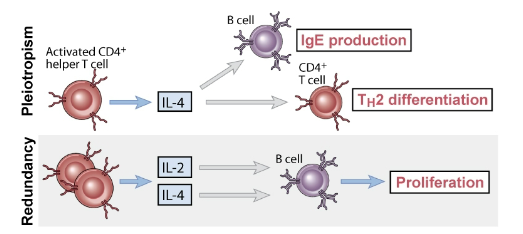
Q: Actions of cytokines can be pleotrophic and/or redundant. Match which term belongs to the description below
One cytokine can act on different cell types and mediate diverse biological effects
multiple cytokines can have same functional effects
Pleotropism: one cytokine can act on different cell types and mediate diverse biological effects
Redundancy: multiple cytokines can have same functional effects
Q: What happen during the the early reponses to microbes?
Innate immunity blocks entry of microbes and stops or limits their growth to prevent colonization
physical barriers such as skin or lining of gastrointestinal or respiratory tracts prevent microbe from entering body and are first line of defense
if microbe breach epithelial barriers, they encounter phagocytes like macrophages
macrophages express surface receptors that bind and help ingest microbes
macrophages are present in all tissue
macrophages produce toxic molecules and cytokines to destroy microbes and recruit other leukocytes to sites of infection t help contain them
Q: The microbes invaded the innate immune defenses, what does the adaptive immune does?
There are two main strategies to fight microbes
Secretion of antibodies that bind extracellular microbes to block their entry into cells and promote their ingestion and destruction by phagocytes
CTLs (CD8 T cells) destroy cells infected by intracellular microbes that re inside of cells and thus not accessible to antibodies

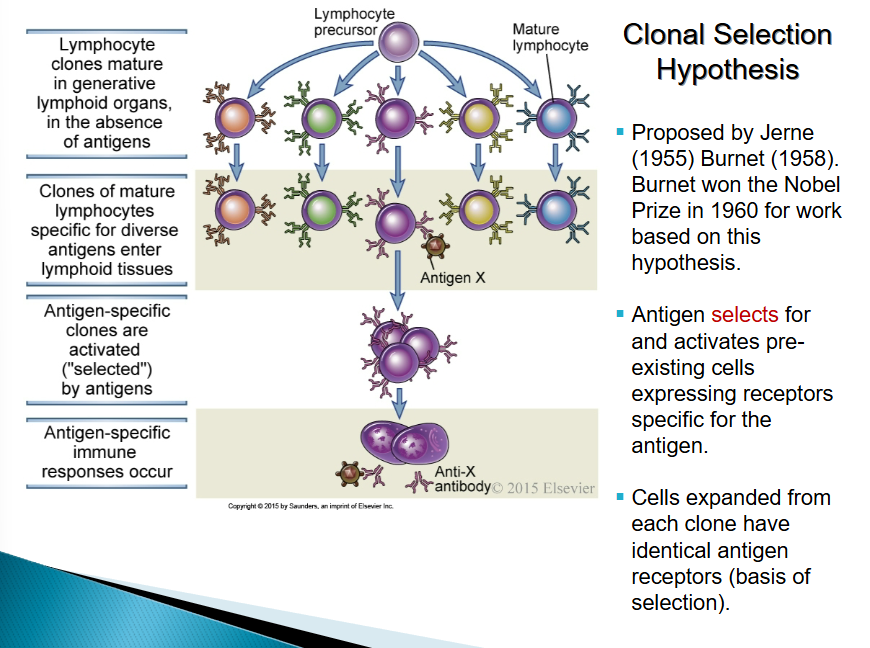
Q: What does clonal expansion mean?
Clonally expanded immune cells to become effectors
CELL MEDIATED IMMUNITY
Activated CD4 T cells proliferate and differentiate into effector cells whose function are mediated largely by cytokines they secrete
Interleukin-2 (IL-2) is produced earl in immune response and stimulates proliferation (clonal expansion)
some helper T cells produce cytokines like interferon-y (IFN-y) that activates macrophages to enhance ingestion and killing of microbes
other effector helper T cells secrete cytokine like IL-4 that help b cells to divide and make antibody
Activated CD8 T cells proliferate and differentiate Into CTLs that function largely by killing infected or damaged cells
HUMORAL IMMUNITY
Activated B cells proliferate and antibody that bind antigens to eliminate them
Response of B cells to most antigens requires activating signals or help form T helper cells
humoral responses combat microbes in may ways
antibody can neutralize microbes and prevent infections form becoming established
antibody can coat microbes (opsonization) to enhance their ingestion by phagocytes (phagocytosis)
antibody can activate complement system (a component of innate immunity)
Antibody-producing B cells can migrate to bone marrow and live for many years
MEMORY
Ideally, effective immune responses eliminate microbial invaders. This is followed by contraction phase of immune response, in which expanded clones of lymphocytes die, thus restoring homeostasis
A small number of responding cells survive contraction and become long-lived memory cells
memory responses are far more effective than naive T and b responses for 2 main reasons
memory cells are an expanded pool of antigen-specific lymphocytes (more cells)
Memory cells respond faster and are more effective at eliminating threats than naive cells (better cells)
vaccines aim to generate pathogen specific memory