Marine Communities Exam 4
 Call Kai
 Learn
 Practice Test
 Spaced Repetition
 Match
 Flashcards
 Knowt Play
1/44

There's no tags or description
Looks like no tags are added yet.
45 Terms
Lecture 18 Study Guide: Rocky Subtidal
•Where are kelp forests located and why are they located in those habitats?
•Explain the ecological services provided by kelp forests.
•Explain threats to kelp forests.
•Explain the trophic cascade in kelp forests.
•Explain zonation in kelp forests.
•Differentiate between mangroves, salt marshes, kelps, and seagrasses. What ecological functions do all provide? How do they differ ecologically? In what climate, substrate would you expect to find each?
•Compare the rocky intertidal to rocky subtidal. How are they similar? Different? With regard to zonation patterns? Does the rocky subtidal follow the RSP?
•Compare kelp forests to the RSP and Menge and Sutherland’s Consumer Stress Model.
•Explain the attraction vs. production debate. How could you design experiments to get at the key question?
What community type does this describe?
From intertidal/subtidal boundary to about 200 m
Hard bottoms, bedrock, boulder fields, cobble, and rock walls
Vertical, horizontal, or overhanging
Rock stems from geologic uplift
Common but not omnipresent habitat
NOT found in the GOM
North America has been moving west, leaving soft sediments on the eastern side
Rocky Subtidal
(Subtidal means it is always underwater)

What effect does slope have on biota?
Horizontal or gentle slope (with light)
•leafy macroalgae (kelp) dominant, although inverts present
Lots have swim bladders
•sea urchins graze kelp
Vertical or steep slope
•sessile inverts (suspension-feeding bryozoans, ascidians, brachiopods, sponges, soft corals and predaceous anemones) dominant with little leafy macroalgae
Differences between walls and floor less pronounced at >30m (deeper you go), where light limits algae.
Tropics have few kelps (they like colder water) so not great difference between walls and floor.
(Urchins are important, in the presence of urchins, foliose algae is replaced by calicified (or coralline) algae).
Cold-water, non-reef building corals are very common, solitary, act as fish nurseries, and face threats from _______.
Trawling on hard bottoms
•Trawls scrape bottom, disturbing or killing benthic animals
•Many species are slow growers and slow to recover
•Kelp harvesting
•Sewage and pollution

What community does this describe?
•Brown macroalgae common in temperate regions with hard bottoms
•In shallow, clear (need light penetration to bottom for young kelp), nutrient-rich water
•Well developed near upwellings
•California has excellent kelp forests
What ecological services do kelp forests provide?
•Kelp forests monopolize space and act as “foundation” species
•Habitat and structure (nursery)
•Detrital based food chain for many invertebrates, fish and mammals
•Export detritus to surrounding waters
•Carbon sink

In the Pacific Coast US, what is zonation of kelp forests driven by?
•Zonation driven largely by depth
•Waves weaker in deeper waters
•Must be shallow enough for light to reach bottom, however
•Giant kelps (Macrocystis) where wave action is weak and water is shallow enough for light (deeper water)
•Laminaria, Egregia in shallower inshore waters with stronger wave action
What is the dominant competitor in kelp forests?
Laminaria (found in shallower waters where it can get enough light).
Other guys cannot grow where there is lots of Laminaria, and grow in a tolerance refuge down below away from them. Laminaria cannot grow there because of a lack of light.
____ like to graze on kelp. What effects do grazers have on kelp diversity?
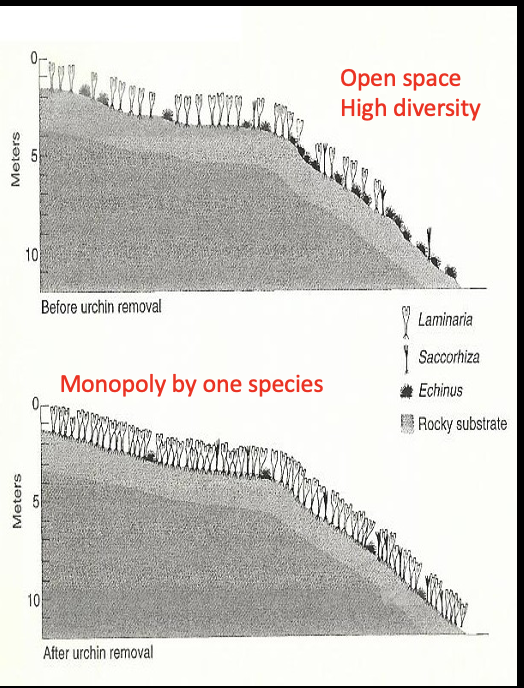
Urchins. Grazers increase diversity by grazing Laminaria; without them, Laminaria would take over. Urchins are suppressing the competitive monopoly (monopoly forming competitor), increasing diversity.
Relative to other marine mammals, sea otters have a ______ SA/V ratio. This makes it _____ for sea otters to maintain an interior body temp of 37 degrees C.
higher...harder
Heat moves in and out of them more easier, which makes it harder for them to keep a stable temperature. They have a very inefficient metabolism, however, that generates a lot of heat to keep them warm. They have to eat a lot, like 25% of their body weight daily.
_____ in Alaska are omnivores and love to eat urchins, that graze on kelp.
Sea otters
•Sea otters (Enhydra lutris) hunted to near extinction in 1800's by fur traders.
•Currently re-colonizing islands in southeast Alaska.
•Some islands have them, some don’t and “natural experiments” are possible.

Describe the trophic cascade with otters…
•On islands with otters, kelp is lush and is dominant space holder. (Otters eat urchins that graze on kelp)
•On islands without otters, kelp is rare. (Urchins are able to eat more kelp)

Describe this four level trophic cascade…
When orcas returned, otter population decreased, urchins increased, and kelp density went down. Orca return had a negative effect on the kelp
Which of the following is NOT a part of the RSP?
a. space is limiting
b. monopolies form
c. unless disturbance suppresses the dominant competitor
d. unless predators suppress the dominant competitor
e. unless there is a tolerance refuge
f. unless competitive networks reduce competition
f. unless competitive networks reduce competition
How does the rocky subtidal relate to the “rocky shore paradigm?”
•Competition for space is keen, and in absence of predators, monopolies are common
•Presence of sea urchins often dictates kelp community
•Tolerance refuge? Light related with kelp
•Disturbance? Storms can increase diversity (support for IDH).
With regard to the rocky shore paradigm, urchins are most analogous to _____.
a. Spartina
b. Mytilus
c. Pisaster
d. marsh periwinkles
c. Pisaster (the sea star that eats Mytilus (the mussels)).
With regard to the rocky shore paradigm, Laminaria is MOST analogous to _____.
a.Mytilus
b.Pisaster
c.Acorn barnacles
d.Limpets
a. Mytilus
In the rocky subtidal, ________ has a tolerance refuge from ___________.
Macrocystis...Laminaria
Do we have a natural rocky subtidal habitat here where we live?
No
Artificial rocky subtidal habitats are a hot topic.
Any structure designed to enhance existing habitat or create new habitat…
Artificial reef
•enhanced local fisheries result.
•Artificial reefs “grow” biomass (algae and barnacles, bryozoans, corals, amphipods) that may feed fish.
•Artificial reefs can offset some habitat loss.
•Reefs also provide shelter from predation and improve water quality.
•Oil rigs are artificial reefs, but not all artificial reefs are oil rigs.
- Some examples are reef balls, sculptures, sunken ships, artificially created reefs.
Oil rigs act as artificial reefs, but what do you do with rigs when they shut down?
•Colonized by many organisms including large fish.
•Over 7,000 rigs in GOM (3,000 current).
•Oil rigs operate for finite time period.
There is a rigs to reefs program. Can leave some of the rig out there to continue to provide habitat for organisms.
What are 2 arguments for the major unanswered question: where do the fish on the rigs/other artificial reefs come from?
~Perhaps fish are more productive near the reefs and more are produced because of the increased food supply or fish just aggregate there (by behavior) not increasing the number of fish. No definitive answer but big implications for management. Difficult to study due to confounding! Production argument:
Part 1 - larval supply is abundant, but suitable habitat is limiting.
Part 2 - Increasing habitat (artificial reefs) increases total abundance of fish (productivity). Artificial Reefs are good for organisms that use them and good for conservation (good way to offset damage by trawling or other to natural habitats).
According to the production argument, the fish that you find at an artificial reef are basically produced there. Larvae settle there and live out their lives there.
Attraction argument:
Part 1 - Fish larvae are limiting; there are supply side limitations.
Part 2 - Increasing habitat (artificial reefs) attracts fish from natural habitats. Do not increase total number of fish.
Artificial reefs don’t increase total number of fish, just moves them around.
Problem - May lure fish to habitats with higher fishing pressure (if there’s more fishing at artificial reefs). Artificial reefs may be bad for total fish abundance and conservation,
Who wrote the review paper in 1989 about artificial reefs?
Bohnsack - Are high densities of fishes at artificial reefs the result of habitat limitation or behavioral preference?
Regarding the question: How to determine where the fish on artificial reefs come from? What is one method scientists have tried?
Stable isotopes (diet between fish at natural vs artificial reefs).
Hedges g = measures the effect size – size of impact.
Artificial reefs may have a net positive effect, but it is tricky.

Lecture 19 Study Guide - Coral Reefs
Terms: Scleractinia, Hermatypic, mutualism, amensalism, zooxanthellae, coral bleaching
•Draw the locations of corals on a globe and be able to explain why they are found in those locations. Why is coral diversity greater in the Pacific than Atlantic?
•Explain the sources of calories and nutrients for corals. Where do they get the majority of nutrition from?
•How are coral reefs so productive given low nutrient supply?
•What factors allow coral reefs to be so diverse? There are several.
•Why are high rates of competitive exclusion not commonly found on coral reefs?
•Explain Darwin’s model of atoll formation. What evidence supports his hypothesis?
•Explain zonation patterns on atolls. What causes the zonation patterns?
•What are the roles of predation and disturbance in coral reefs?
•Does the RSP apply to coral reefs? Why or why not?
•List and describe the major threats to coral reefs.
•Explain the process of coral bleaching and why it is a problem for corals.
•Why are corals so susceptible to climate change?
What are corals?
Scleractinian (stony) corals combine with sponges, coralline algae, and other invertebrates to build reefs.
What is the coral (stony corals) habitat?
•Subtidal tropical habitat
• Complex habitat with high biodiversity
• 0.1% of ocean environment
• Colonies grow at a rate of 1-10cm/year
• Strong competitive, symbiotic and mutualistic relationships, complex predator-prey interactions and chemical defenses
How are reefs formed?
•Reefs are built by a thin veneer of living organisms (the colorful parts are only the outside).
•Corals, sponges, coralline algae, and giant clams build the reef with calcium carbonate.
•Encrusting algae in crevices cement the reef.
•Dynamic with erosion and growth.
•Reefs may be 100s m thick.

Where are corals found?
• Need temperatures >20 °C (warm/hot)
• Best between 23-25 °C
• Best at 35‰ but tolerate higher salinity better than lower.
Stop and think!
• Where is the Great Barrier Reef? Why?
off the northeast side of Australia because closer to tropics, warmer. West side tends to have more deserts. On the eastern side, ocean gyres rotate coming down from the equator.
• Need clear water
• Low nutrients
• Shallow water
•Compensation depth at 15-20% of surface light
•Found 50-70 m with majority < 25 m
Where are corals distributed?
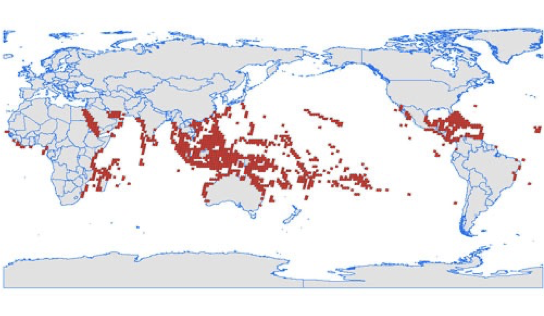
Reef-building corals grow best in warm, shallow, clear blue and nutrient-poor waters of Indo-Pacific and Caribbean. Those in the middle of the pacific are around islands.
Relate corals to Darwin’s paradox…
•Remember that there are corals in the middle of the Pacific.
•The water around coral reefs is actually nutrient poor.
•Production is high (50 gC/m2/y)
Darwin’s Paradox:
•Island Mass Effect (IME) helps explain
•Island alters flow, captures plankton, increased nutrients from animal waste, etc.

T/F: Coral reefs are diverse.
True.
0.1% of marine habitat is coral reef
1 M species on reefs but only 100,000 described
Two epicenters with peak species diversity (Indo-pacific >> Caribbean)
150 species of Acropora in Indo-Pacific and 3 in Caribbean
Fish species diversity very high
500 species on one reef
Coral Nutrient Recycling & Coral Diversity: IME and tightly cycled nutrients help to explain productivity, but why so diverse?
Habitat:
high habitat complexity - lots of niches.
some species use crevasses with/without algae
benign environment
Stress:
corals not desiccation tolerant (don’t like being out of water)
Tolerate hypersaline ok (40PSU), do not tolerate low salinity
Limits vary, but often live near upper thermal limits
Need temperatures >20 °C
Typically only experience temp flux of 4-5 °C (tropical) with a max temp of 30 °C
Best between 23-25 °C
Thermal stress causes bleaching
Overall, a benign environment (Maybe that helps to explain the high diversity)
Ecological Reasons:
Facilitation
High rates of niche partitioning
Competitive networks & other competitive interactions
Evolutionary Reasons:
Lots of geographic isolation
Strong sexual selection
High speciation rates
Do disturbances help figure out why coral reefs are diverse?
NO. They have negative impact.
•Waves/storms topple coral heads.
•Can take 10-20 yrs to recover from storms
•Disturbance has a negative effect on corals, IDH doesn’t often apply
•Remember the role of competition in IDH
•So, you would expect disturbance to reduce diversity here too
•So that doesn’t help answer why coral reefs are so diverse.
One type of facilitative interaction you would see in a coral reef.
Facilitation - common in coral reefs
Coral get 90% nutrition from zooxanthellae (rest from feeding on zooplankton). Zooxanthellae get nutrients. Obligate mutualists.
Coral is transparent, these zooxanthellae sit on top and have color.
Another type - cleaning stations
fish clean/remove parasites from larger fish
Describe niche partitioning in coral reefs…
High niche partitioning (day/night specialists)
Different species use different zones on atolls (type of reef)
Some species use crevasses with and without algae
Complex habitat with lots of niches
What kind of competitive interactions are in coral reefs?
Competitive networks common
Overgrowth similar to Mytilus does occur…
some corals grow over the top of another
Shading
Allelopathy (chemical defenses)
Corals that produce more chemical defenses grow slower
Slow growing corals produce toxins, not excluded
Does RSP apply here?
What kind of coral reefs is this?
directly fringes landmass and intergrades into barrier style
fringing
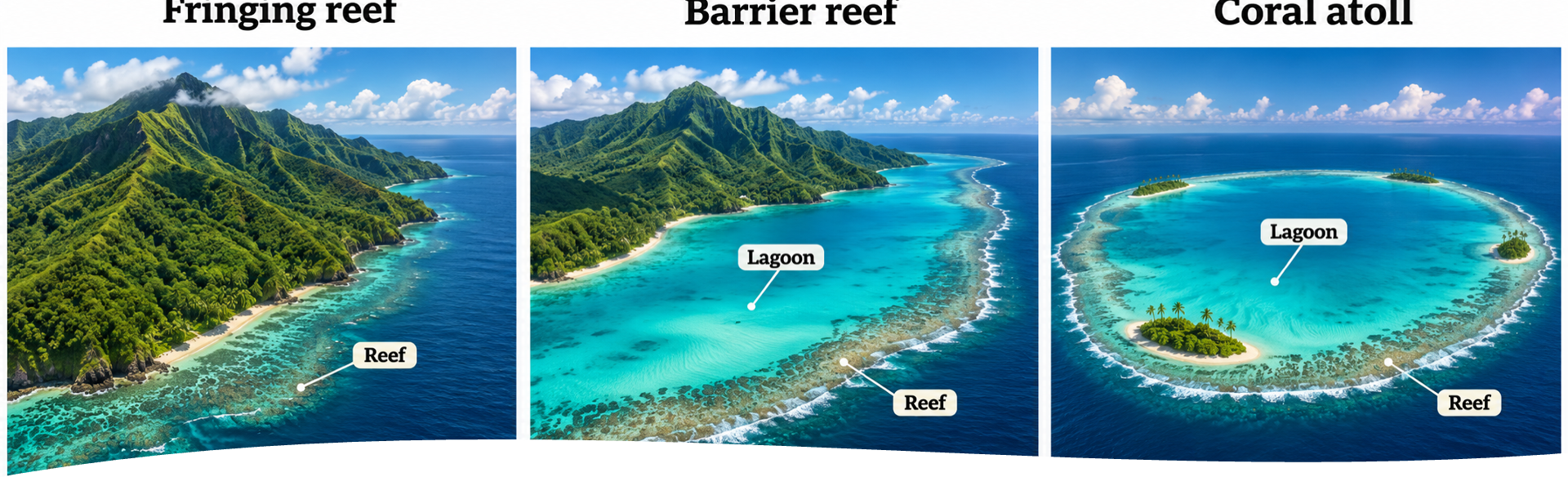
What kind of coral reefs is this?
separated from land mass by a lagoon or deep channel
Barrier
• Great Barrier Reef is 2000 km long.
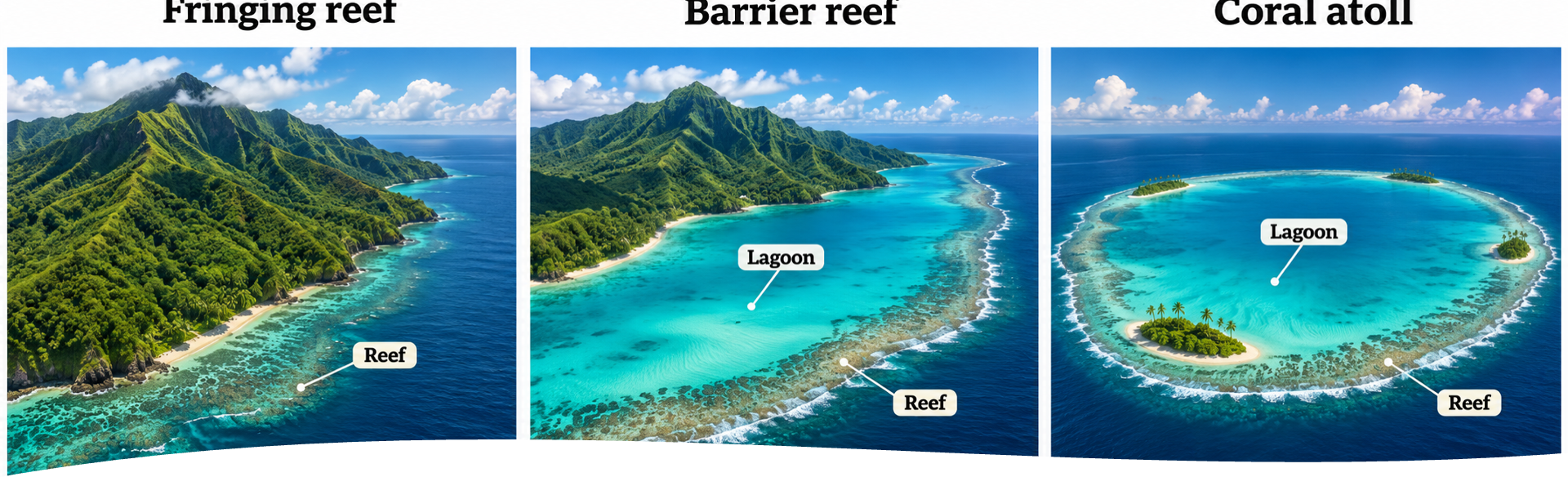
What kind of coral reefs is this?
reefs that arise in deep water far from mainland
Atolls
• A lagoon is frequently in the middle of this circular island composed of limestone.


What did Darwin discover about types of coral reefs?
Different reef types are actually just at different stages of development.
Evidence supporting Darwin’s hypothesis when reef was cored, revealing underlying volcanic rock.
Some recent studies have suggested there is more to atoll formation, however. Changes in sea level may be important.
In atolls, where is the highest wave action?
windward slope; steep slope
What causes atoll zonation? 3 things
Atoll zonation due to 1) wave energy 2) light 3) suspended sediment:
Better coral growth on the leeward side of the atoll (wave action is not as as strong).
Windward slope - highest wave action; steep slope.

What are some coral predators?
Coral eaters – parrotfish (contributor to white sand beaches), crown of thorns seastar, urchins, polychaetes, nudibranchs.
Trophic cascades equivocal – complex food webs.
Coral reefs are too complex for a trophic cascade. Because they are so diverse, theres a couple apex
Overharvesting of giant triton snail contributed to increased CoT seastar? Protected since 1960s but still low numbers.