Pyruvate Dehydrogenase
 Call Kai
 Learn
 Practice Test
 Spaced Repetition
 Match
 Flashcards
 Knowt Play
1/19

There's no tags or description
Looks like no tags are added yet.
20 Terms
Aerobic respiration Step 1
carbon from metabolic fuels generate Acetyl-CoA

Aerobic respiration Step 2
oxidation of acetyl-CoA to CO2, reduced electron carriers, and a small amount of ATP
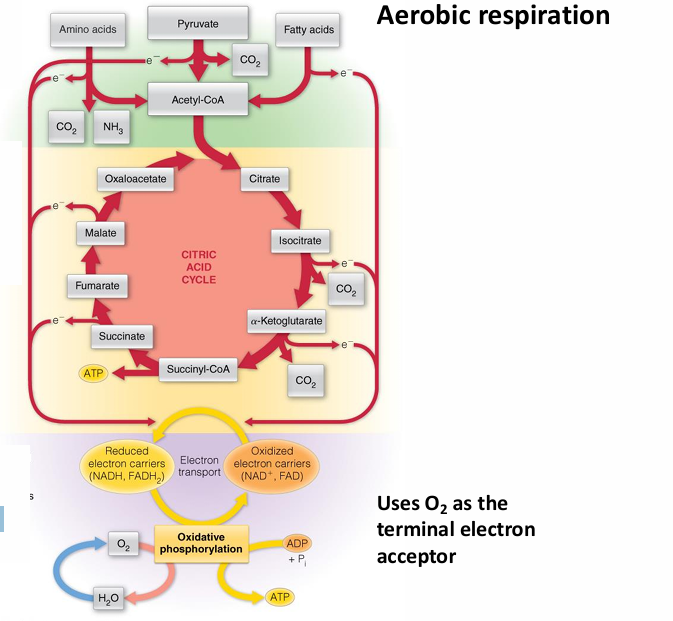
Aerobic respiration Step 3
reduced electron carriers are reoxidized, generating ATP
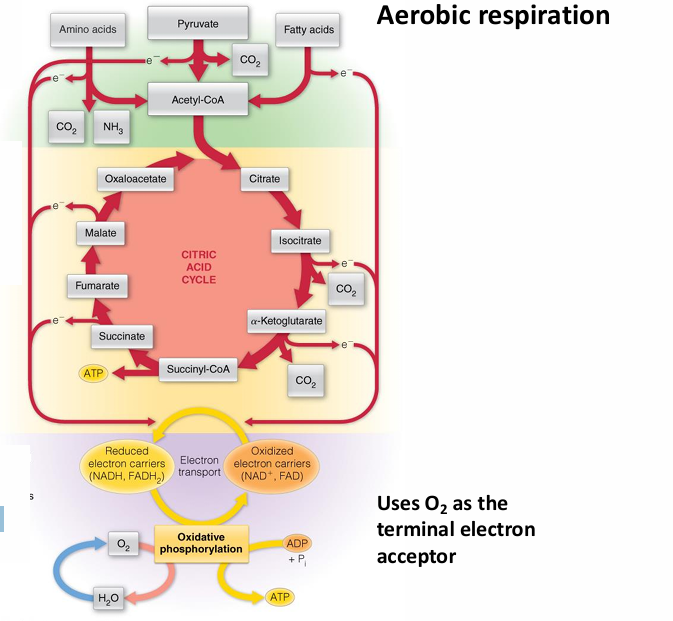
The TCA cycle derives energy by…
oxidizing pyruvate and releasing CO2
Step 0 TCA cycle
Pyruvate is oxidized to acetyl-CoA
Pyruvate dehydrogenase complex

The acetyl-group of Acetyl-CoA
contains 2 carbons
Step 3 TCA Cycle
isocitrate is oxidized to a-ketoglutarate

Step 4 TCA Cycle
a-ketoglutarate is oxidized to succinyl-CoA

pyruvate further oxidation
In aerobic organisms, pyruvate is transported into the mitochondria to be further oxidized
Pyruvate oxidation and the citric acid cycle mostly takes place
within the mitochrondrial matrix
TCA cycle functions
to produce energy
to produce key anabolic intermediates
TCA Cycle generates…
mostly reducing equivalents to be converted later into ATP during oxidative phosphorylation
TCA cycle formula

Pyruvate Dehydrogenase Complex structure
60 core E2 enzymes Surrounded by 12 E3 dimers Outer layer of 30 E1 tetramers
Pyruvate Dehydrogenase Complex cofactors used
Uses 5
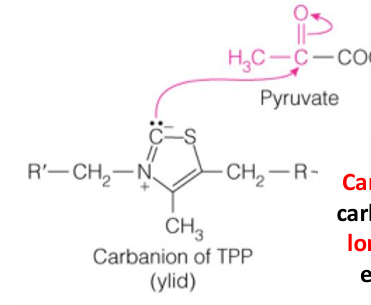
Reaction 1 of pyruvate dehydrogenase complex
Reaction 1: pyruvate reacts with TPP on E1. Decarboxylation to form a carbanion that attacks pyruvate a-keto acid carbonyl
Reaction 2 of pyruvate dehydrogenase complex
Transfer hydroxyethyl group to lipoamide swinging arm cofactor.
Disulfide reduced, hydroxyethyl group oxidized to acetyl thioester.
On E2.

Reaction 3 of pyruvate dehydrogenase complex
Transfer acetyl group to CoA-SH, making Acetyl-CoA. E2

Reaction 4 of pyruvate dehydrogenase complex
Regenerating lipoamide : Reoxidize the S’s of lipoamide, reducing a disulfide bond on E3.
Reaction 5 of pyruvate dehydrogenase complex
Transfer electrons to FADH2 on E3, then to NAD+