Reproductive System
 Call Kai
 Learn
 Practice Test
 Spaced Repetition
 Match
 Flashcards
 Knowt Play
1/58

There's no tags or description
Looks like no tags are added yet.
59 Terms
What cell type does meiosis occur in?
The germ cell line (ovaries or testes)
Gametogenesis in males
spermatogonium
primary spermatocyte
secondary spermatocytes
spermatids
mature sperm
What kind of division is the division from spermatogonium to primary spermatocyte?
Nonreductive division
How many chromosomes do spermatocytes have?
46 chromosomes
What kind of division is the division from primary spermatocyte to secondary spermatocyte?
Reductive division that separates the homologs.
How many chromosomes do secondary spermatocytes have?
23 chromosomes
Where does crossing over occur in male gametogenesis?
In the first meiotic reductive division that turns primary spermatocytes into secondary spermatocytes
What kind of division is the second meiotic division that turns secondary spermatocytes in spermatids?
non reductive that separates sister chromatids
Progression of female gametogenesis
oogonium
primary oocyte
secondary oocyte and first polar body
fertilization
zygote and second polar body
Where do oocytes and spermatocytes come from
differentiate from oogonium and spermatogonium respectively
Do polar bodies possess chromosomes?
Yes→both polar bodies end up with 23 chromosomes
Where does crossing over occur in female gametogenesis?
In the first reductive, meiotic division that turns primary oocytes into secondary oocytes and polar bodies
What happens to the polar body?
It’s a nonviable cell that disintegrates
What drives the second meiotic division?
Fertilization
Up until what time period are males and females indistinguishable anatomically in utero?
Up to 8 weeks
What induces external genitalia differentiation 8 weeks into development?
presence or absence of testosterone
What sex are humans by default?
female
What factor dictates whether testosterone is present/absent?
The SRY gene located on the Y chromosome
What does the SRY gene encode?
encodes a transcription factor that regulates genes that lead to the production of testosterone
When does internal sex determination occur in males?
7-8 weeks into development
When does internal sex determination occur in females?
8 to 9 weeks
What external structures do primordial fetuses have prior to 8 weeks?
genital tubercule
urogenital fold
labioscrotal fold
What internal structures do primordial fetuses have prior to 8 weeks?
wolfian duct
mullerian duct
gonadal ridge
What happens to the gonadal ridge in the presence of testosterone?
becomes the testes
What happens to the mullerian duct in the presence of testosterone?
mullerian duct regresses
What happens to the wolfian duct in the presence of testosterone?
develops into:
epididymus
vas deferens
seminal vesicles
ejaculatory duct
What happens to the gonadal ridge in the absence of testosterone?
becomes the ovaries
What happens to the mullerian duct in the absence of testosterone?
the mullerian ducts turn into…
uterus
fallopian tubes
inner vagina
What happens to the wolfian duct in the absence of testosterone?
The wolfian duct regresses/disintegrates
Schematic of fetal sex determination in males
The SRY gene causes the development of the gonadal ridge into testes, with leydig cells and sertoli cells. The causes secretion of MIS (from sertoli cells) and testosterone (from leydig cells), which induces changes to wolfian duct, mullerian duct, and external genitalia structure

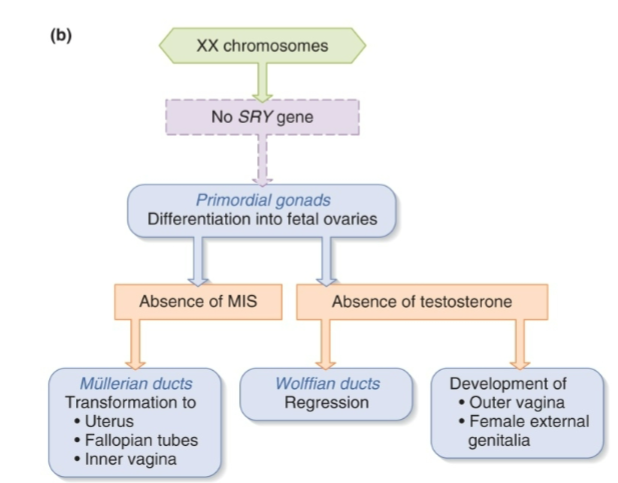
Schematic of fetal sex determination in females
The absence of the SRY gene causes the development of the gonadal ridge into ovaries. No MIS is secreted. No testosterone or dihydrotestosterone is secreted. This induces changes to wolfian duct, mullerian duct, and external genitalia structure
What hormone causes external genitalia development in male fetuses?
dihydrotestosterone
Anatomical path within the penis
testes and testicular sac
rete testis network
epididymus
vas deferens
seminal vesicle, prostate gland, and bulbourethral gland
ejaculatory duct
urethra
Anatomy of the testes
Highly tubular on the inside→seminiferous tubules is where sperm arise
Anatomy of the seminiferous tubules
interstitium surrounding the tubules contains blood vessels and leydig cells
sertoli cells line the tubule lumen
Function of blood vessels that surround the seminiferous tubules
Form the blood-testes barrier
very impermeable capillaries
Function of leydig cells
secrete testosterone under the influence of LH
Function of sertoli cells
Support spermatogenesis and nourish developing sperm under the influence of FSH
Secrete luminal fluid
Respond to testosterone and FSH to secrete paracrine factors that stimulate sperm proliferation and differentiation
Secrete paracrine factors that affect Leydig cells
Phagocytosis of defective sperm
secrete inhibin
secrete Müllerian inhibiting substance
Structure of sertoli cells
apex of sertoli cells is continuous with the seminiferous tubule lumen
base of sertoli cells is continuous with the basement membrane and contain sperm stem cells
As you move up the sertoli cell, you will see more mature sperm dividing
How are sertoli cells connected?
Via tight junctions
Are sperm fully mobile once they emerge out of sertoli cells?
No!
What helps propel sperm out of the sertoli cells?
Smooth muscles
Purpose of inhibin
provides negative feedback for FSH secretion
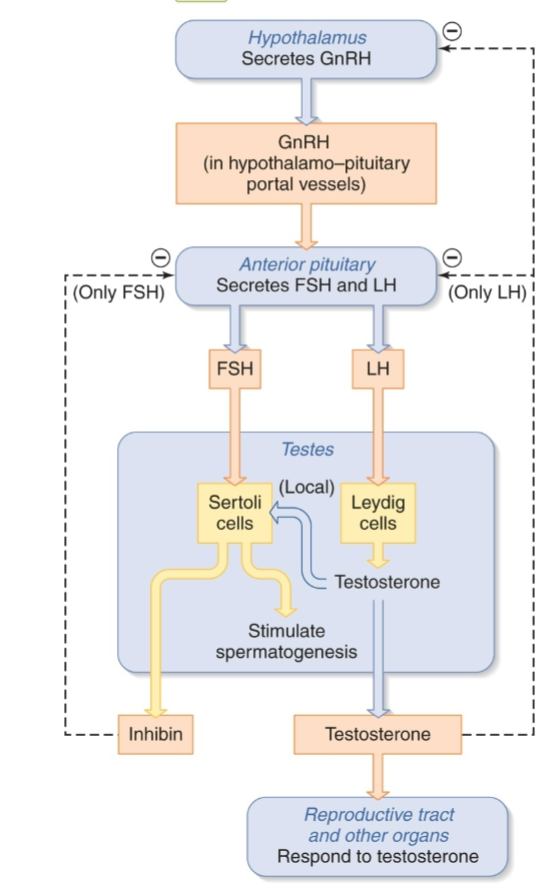
HPE axis flowchart for testes
testosterone provides long loop feedback on LH and GnRH secretion
inhibin provides long loop feedback on FSH secretion
What inputs trigger erection?
CNS neurons synapse with peripheral neurons that innervate the penis, carrying efferent signals about thought, emotions, and sensory inputs of sight, smell, etc.
Input from penis mechanoreceptors
Erection control cascade diagram
inputs from CNS and mechanoreceptors trigger the activation of NO-releasing neurons AND decrease sympathetic activity in the penis
Arteries dilate, causing erection

How NO works to dilate afferent arteries
NO activates a guanylyl cyclase
cGMP produced from GTP
cGMP activates a protein kinase, leading to smooth muscle relaxation of the arteries and erection
Actions of phosphodiesterase
breaks down cGMP
Actions of viagra
blocks phosphodiesterase, which allows cGMP to stick around for longer, leading to more prevalent erectile response
What mediates the ejaculatory reflex?
mechanoreceptors→leads to contraction of smooth muscle in entire male reproductive tract
Functions of testosterone
initiate and maintain spermatogenesis
decrease GnRH secretion
decrease LH secretion
induces male secondary sex characteristics (deep voice, hair, muscle, etc)
induces differentiation of male accessory reproductive organs
opposes breast tissue growth
stimulates EPO secretion
stimulates protein anabolism and bone growth
inhibits bone growth at the end of puberty
sex drive and aggressive behavior
When is puberty in males?
12-16 years old
Main changes associated with puberty in males and females
reproductive maturity
Andropause
A steady decrease in testosterone levels starting around age 40 that may decrease libido and mood
Is oogonia a renewing supply?
No→whatever you’re born with is how many eggs you can make
When does the first meiotic division of oogonium occur?
Starts prior to birth and finishes during ovulation
When does the second meiotic division of oogonium occur?
Completes upon fertilization
What must occur for proper maturation of an oocyte?
A follicle must develop around the oocyte