orgo 1 exam 2
 Call Kai
 Learn
 Practice Test
 Spaced Repetition
 Match
 Flashcards
 Knowt Play
1/34

There's no tags or description
Looks like no tags are added yet.
35 Terms
alkane definition
-ane ending
only carbon and hydrogen
all c’s are sp3 hybridized (4 bonds/lone pairs) (only single bonds)
alkane naming formula
prefix (substituents/branches) + parent (how many carbons) + suffix (what functional group) (-ane for alkanes)
alkane parent chain names
1 carbon: methane
2 C: ethane
3 C: propane
4 C: butane
5 C: pentane
6 C: hexane
7 C: heptane
8 C: octane
9 C: nonane
10 C: decane
11 C: undecane
12 C: dodecane
steps to name alkanes
find the parent chain (longest continuous carbon chain)
if 2 are the same length, choose the one w/larger number of branches
number atoms in parent chain starting at end closest to first branch
if each end is the same distance, choose the one closer to the second branch
identify/number substituents based on number of carbons (prefix + -yl)
if 2 off of 1 carbon, both have same number
write as 1 word
hyphens separate prefixes and substituents
commas separate numbers
write alphabetically
if 2+ identical substituents, use multiplier prefixes (di, tri, tetra)
complex substituents
number all substituents at point of attachment to parent chain and identify it
substituent is alphabetized according to first letter of its complete name (including numerical prefix) and is set off in parenthesis

conformations and conformer definition
conformations: different arrangements in space of atoms within a molecule due to rotations around single carbon-carbon bonds (C-C) (basically shapes of a molecule) (shapes impact a molecules stability)
conformer: any specific conformation/shape
conformational analysis
study of energies of different conformations
represented with newman projections (viewing the molecule sideways)
newman projections
front carbon: represented with a dot, carbon closer to you
back carbon: represented with a circle, carbon farther from you
eclipsed vs staggered conformation
eclipsed: most stable, all groups line up
staggered: least stable

decahedral angle
aka: θ
angle between the 2 planes
defines conformers
dihedral angles of staggered and eclipsed conformations
staggered: 60, 180, or 360 degrees
eclipsed: 0, 120, or 240 degrees
torsional strain vs steric strain
torsional: slight repulsion between electron clouds in C-H bonds as they pass each other in an eclipsed conformer
steric: when atoms are forced to occupy the same space, repulsion results
H-H eclipsing energy
1.0 kcal/mol
due to torsional strain
H-CH3 eclipsing energy
1.3 kcal/mol
mostly torsional strain, slightly steric strain
CH3-CH3 eclipsing energy
3.0 kcal/mol
torsional and steric strain
CH3-CH3 gauche energy
0.9 kcal/mol
due to steric strain
due to a 60 degree dihedral angle between the largest groups
anti-conformation
a conformation with a 180 degree dihedral angle between the largest groups
energy difference between staggered and eclipsed conformations
staggered: 0kcal/mol (the most stable form)
eclipsed: 3.0 kcal/mol
cycloalkane conformational analysis
ideal angle for sp3 carbon is 109.5 degrees
angle strain
strain that results from the compression of the ideal 109.5 degree angle
non planar conformation
minimized ring strain and torsional strain
makes molecule more stable

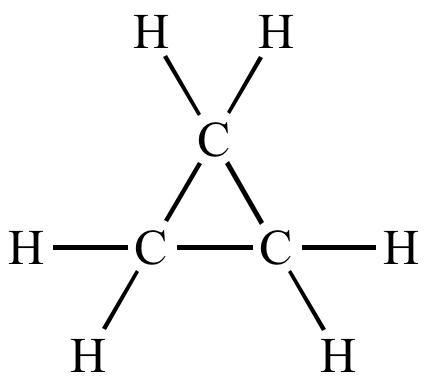
cyclopropane
least stable cycloalkane due to angle strain (60 degrees between bonds) and torsional strain
cyclobutane
compared to cyclopropane: reduced angle strain (b/c 90 degrees)
non planar conformation

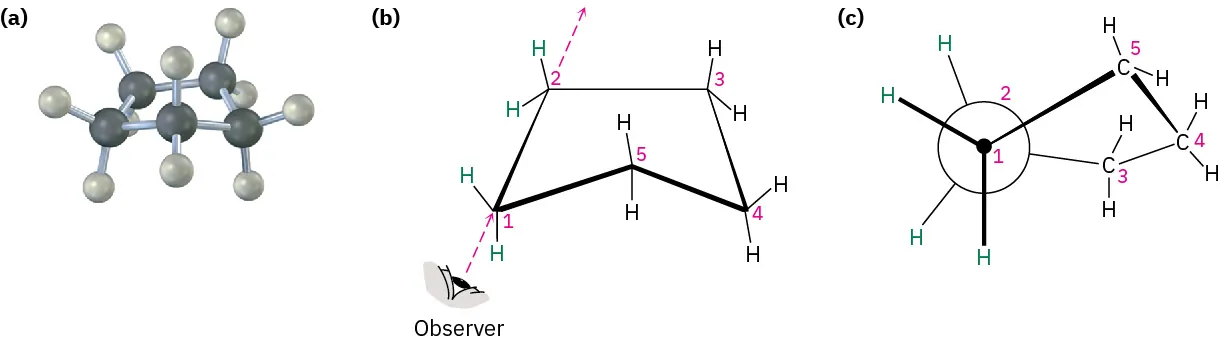
cyclopentane
no angle strain
envelope strain minimizes torsional strain
5th carbon is above or below the plane
cyclohexane
most stable cycloalkane
no angle or torsional strain
non planar (chair conformation)
most common in nature

cycloalkane stability ranking
least stable: cyclopropane
cyclobutane
cyclopentane
most stable: cyclohexane
why does cyclohexane not exist in boat form
the flagpole H’s IH’s that face up) repel each other and all other H’s eclipse, making it very unstable

chair conformation drawing
arm rest bonds first (parallel and slightly tilted)
head rest (above plane) and foot rest (below plane) carbons added
3 pairs of parallel lines

flipped chair
head rest carbon becomes foot rest
foot rest carbon becomes head rest
both the original and flipped chair conformations have the same energies
hydrogens in chair conformation
axial hydrogen: run vertically, alternate up and down
equitorial hydrogen: run parallel to the arm rest bonds not involved in the vertex, alternate up and down
if axial is up, equitorial is down
if equitorial is up, axial is down
flipped chair: axial become equitorial, equitorial become axial

1, 3-diaxial interaction
gauche interaction between methyl group on carbon 1 and CH2 group on carbon 3
energy is 1.8 kcal/mol (2 × 0.9)
substituted cyclohexane
substituent in equatorial orientation: no energy b/c parallel to bonds
substituent in axial orientation: gauche interaction occurs (CH3-CH2), less stable conformation
consequences of 2 bulky substituents (of at least -CH3) attached to neighboring carbons
1 axial and 1 equatorial: gauche
1 axial and 1 axial: no gauche b/c anti
1 equatorial and 1 axial: gauche
1 equatorial and 1 equatorial: gauche
primary/secondary/tertiary/quaternary carbons
primary: only 1 carbon atom bonded
secondary: only 2 carbon atoms bonded
tertiary: 3 carbon atoms bonded
quaternary: 4 carbons atoms bonded
structural/constitutional isomers vs geometric isomers
structural: same formula, different connectivities
geometric: identical connectivities, different spatial orientation
cis/trans