Chapter #17 The citric acid cycle/ TCA cycle/ Krebs cycle
 Call Kai
 Learn
 Practice Test
 Spaced Repetition
 Match
 Flashcards
 Knowt Play
1/41

There's no tags or description
Looks like no tags are added yet.
Name | Mastery | Learn | Test | Matching | Spaced | Call with Kai | Chat |
|---|
No analytics yet
Send a link to your students to track their progress
42 Terms
What is the TCA cycle?
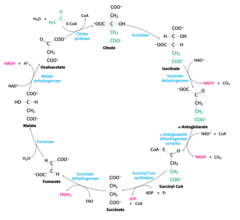
It is the final common pathway for the oxidation of fuel molecules—carbohydrates, fatty acids, and amino acids. It oxidizes acetyl CoA, producing two molecules of CO2, one molecule of ATP, 3 NADH, and 1 FADH per 1/2 glucose molecule.

How many oxidation-reduction reactions are the TCA cycle?
Carries out 4 oxidation-reduction reactions.
What is the 1st oxidation-reduction reaction are the TCA cycle?
Production of α-ketoglutarate using Isocitrate dehydrogenase.
What is the 2nd oxidation-reduction reaction are the TCA cycle?
Production of Succinyl-CoA using the α-ketoglutarate dehydrogenase complex.
What is the 3rd oxidation-reduction reaction are the TCA cycle?
Production of fumarate using Succinate dehydrogenase.
What is the 4th oxidation-reduction reaction are the TCA cycle?
Production of Oxaloacetate (OAA) using malate dehydrogenase.
How many substrate level phosphorylations take place in the TCA cycle?
One substrate level phosphorylation. The production of succinate using Succinyl CoA Synthetase.

Where does the TCA cycle take place?
In eukaryotes, the enzymes of the TCA cycle are located in the mitochondrial matrix. In prokaryotes, these enzymes are located in the cytoplasm (along with those of glycolysis).

What are the enzymes of the TCA cycle?
Step #1 Citrate Synthase
Step #2 Aconitase (iron-sulfur protein)
Step #3 Isocitrate Dehydrogenase
Step #4 α-ketoglutarate dehydrogenase complex
Step #5 Succinyl CoA Synthetase
Step #6 Succinate Dehydrogenase
Step #7 Fumarase
Step #8 Malate Dehydrogenase
Mnemonic for intermediates of TCA cycle:
Can I Keep Selling Sex For Money Officer
C = Citrate
I = Isocitrate
K = a-ketoglutarate
S = Succinyl CoA
S = Succinate
F = Fumarate
M = Malate
O = Oxaloacetate
Mnemonic for enzymes of TCA cycle:
Crazy Ass Individuals Keep Screwing Sexy Freaky Models:
C = Citrate synthase
A = Aconitase
I = Isocitrate dehydrogenase
K = α-Ketoglutarate dehydrogenase
S = Succinyl-CoA synthetase
S = Succinate dehydrogenase
F = Fumarase
M = Malate dehydrogenase
What is the 1st step of the TCA cycle?
A reaction catalyzed by Citrate synthase where OAA condenses with Acetyl CoA to form Citryl CoA which quickly hydrolyzed to Citrate. The hydrolysis of the thioester gives this reaction a -ΔG and thus drives it forward.

What is the 2nd step of the TCA cycle?
A reaction catalyzed by Aconitase where citrate is isomerized to isocitrate. This is done through a dehydration reaction where OH is removed from C3 to form cis-aconitate and then a hydration reaction to form Isocitrate. Ultimately, the OH is moved to C2

What is the 3rd Step of the TCA cycle?
An oxidative decarboxylation reaction catalyzed by Isocitrate dehydrogenase where Isocitrate is irreversibly oxidized and decarboxylated to form α-ketoglutarate. NAD+ oxidizes the C2 OH to a carbonyl forming oxalosuccinate (very unstable) intermediate that loses a CO2 to form α-ketoglutarate.

Where did the CO2 released from the formation of Alpha ketoglutorate come from?
It part of OAA and actually was part of the previous acetate to enter the TCA cycle.
What is the 4th step of the TCA cycle?
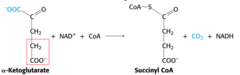
A oxidation and decarboxylation reaction catalyzed by the α-ketoglutarate dehydrogenase complex where the α-ketoglutarate goes to succinyl-CoA (4C). The C1 will leave as a CO2 molecule, NAD+ oxidizes the molecule.
What is unique about the 4th step of TCA?
It is the last decarboxylation reaction in TCA and gets us back to a 4 carbon molecule (like OAA). A lot of the energy is captured in the reduction of NAD+. Some is also captured in the formation of the thioester.
What is the 5th step of the TCA cycle?
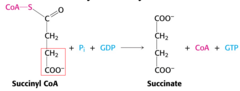
A reaction catalyzed by Succinyl CoA Synthetase where Succinyl-CoA is used to produce Succinate. The energy of the thioester is used to drive the incorporation of Pi onto GDP to make GTP. The now free C1 is clearly visible as a carboxyl group.
What is the 6th step of the TCA cycle?
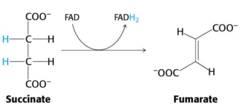
A reaction catalyzed by Succinate dehydrogenase where succinate is oxidized to fumarate by FAD getting reduced to FADH2. This one removes 2 H, one from both C2 and C3.
What's the 7th step of the TCA cycle?
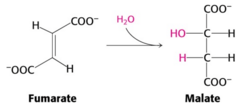
A reaction catalyzed by Fumarase where the C=C created gets hydrated by to form malate.
What is the 8th step of the TCA cycle?
An oxidation reaction catalyzed by Malate dehydrogenase that oxidizes the C2 OH to a carbonyl by reducing NAD+ to generate OAA which continues the cycle.

What are the products of the TCA cycle?
For each acetyl CoA that goes in, 2 CO2, 1 ATP, 3 NADH + H+ and 1 FADH2 are produced. The NADHs may be used to make up to 2.5 ATP each and the FADH2 may be used to make up to 1.5 ATP. The GTP is equivalent to an ATP. In total, 10 ATP is produced per acetyl CoA.
What is the Pyruvate dehydrogenase complex?
A complex of 3 enzymes that oxidatively decarboxylates pyruvate to Acetyl CoA by performing 3 steps. The 1st activity is the oxidative-decarboxylation of pyruvate. The 2nd is the transfer of the acetyl group onto CoA. The 3rd is the regeneration of lipoamide, a cofactor, and the reduction of NAD+.

What are the enzymes of the Pyruvate Dehydrogenase complex?
E1 (Pyruvate dehydrogenase), E2. (Dihydrolipoamide acetyltransferase), and E3 (Dihydrolipoamide dehydrogenase). The complex has 3 different cofactors: Thiamine pyrophosphate, lipoamide and FAD.

What is the Role of E1?
It is pyruvate dehydrogenase component with TTP as a prosthetic group. It catalyzes the rate limiting step where pyruvate is decarboxylated to yield hydroxyethyl-TPP.
What Thiamine pyrophosphate (TPP)?
It's a 5 member ring that is prosthetic group for E1. One of its C can ionize to a carbanion. This carbanion serves as an attacking group for a nucleophilic reaction with the carbonyl C of pyruvate leading to the formation of Hydroxyethyl-TPP.

How does Pyruvate get Decarboxylated?
It occurs when there is an electron shift in the addition compound that leads to the breaking of the bond between the carboxyl group and C2 of pyruvate. This electron shift is facilitated by the (+) charge on the TPP ring N which allows it to act as an electron sink forming Hydroxyethyl-TPP. The new form has 2 resonance states.

How is Hydroxyethyl-TPP oxidized?
The hydroxyethyl group is transferred from TPP to lipoamide by reducing the disulfide of lipoamide to 2 sulfhydryls. The product formed is acetyllipoamide.

Where does Lipoamide come from?
It is made from lipoic acid linked through an amide to the side chain of a lysine in E2

How is acetyl CoA made from acetyllipoamide?
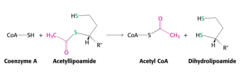
The acetyl group is transferred from acetyllipoamide to the sulfhydryl end of CoA to form acetyl CoA. This leaves the lipoamide ring in the reduced form of dihydrolipoamide.
What happens to dihydrolipoamide?
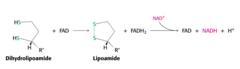
The pyruvate dehydrogenase complex cannot complete another catalytic cycle until the dihydrolipoamide is oxidized to lipoamide. In the fourth step, the oxidized form of lipoamide is regenerated by dihydrolipoyl dehydrogenase (E3). Two electrons are transferred to an FAD prosthetic group of the enzyme and then to NAD+.
What is the net outcome of the Pyruvate Dehydrogenase Complex?
Pyruvate + CoA + NAD+ → AcetylCoA + CO2 + NADH + H+
What is the cause of Beriberi disease?
It is caused by a deficiency in thiamine (B1). Because Thiamine Pyrophosphate is a prothetic group the Pyruvate dehydrogenase complex, a-Ketoglutarate dehydrogenase complex, and Transketolase, this can lead to Neurological and cardiac problems.
What does amphibolic mean?
It refers to a metabolic pathway that functions in both catabolism and anabolism.
How is the TCA cycle Amphibolic?
The TCA cycle can be used to generate NADH and FADH (catabolic) and it's intermediates can be used to various other biosynthetic processes such as AA biosynthesis and porphyrin biosynthesis.

How does Oxaloacetate get replenished?
It can be replenished using 1 ATP, pyruvate, and CO2 using the enzyme pyruvate carboxylase.
What is the glyoxylate shunt?
A modification of the TCA cycle that allows plants, bacteria, protists and fungi to use acetate as their sole carbon and energy source. It allows the cell to run TCA for energy and for biosynthesis even when no pyruvate is around.
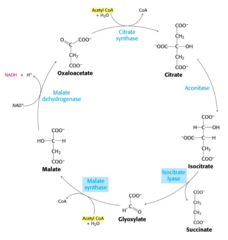
How does the Glyoxylate shunt run?
It requires Acetyl CoA. It does this by using acetyl CoA synthetase. It takes acetate, ATP, and CoA to acetyl CoA, AMP, and PPi. It uses Uses 2 high energy bonds:
- Acetate + ATP + CoA -> acetylCoA + AMP + PPi
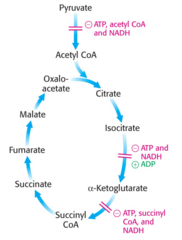
How is the TCA cycle controlled?
The pyruvate dehydrogenase complex, Isocitrate Dehydrogenase, and α-ketoglutarate dehydrogenase complex are all allosterically regulated enzymes.
How is the pyruvate dehydrogenase complex allosterically regulated?
It is inhibited by ATP, Acetyl CoA, and NADH. It is stimulated by pyruvate, CoA, and NAD+.

How is Isocitrate Dehydrogenase allosterically relegated?
It is inhibited by ATP and NADH. It is stimulated by ADP
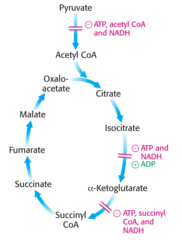
How is the α-ketoglutarate dehydrogenase complex allosterically regulated?
It is inhibited by ATP, Succinyl CoA, and NADH.