prin lecture quizzes for midter
 Call Kai
 Learn
Learn Practice Test
 Spaced Repetition
 Match
Match Flashcards
 Knowt Play
1/83

There's no tags or description
Looks like no tags are added yet.
Name | Mastery | Learn | Test | Matching | Spaced | Call with Kai | Chat |
|---|
No analytics yet
Send a link to your students to track their progress
84 Terms
the force exerted by blood against the arterial walls when the heart contract is known as:
blood pressure
which of the following patients requires prophylactic antibiotic treatment prior to dental hygiene care?
a patient with a history of infective endocarditis
the use of a prophylactic antibiotic prior to dental care in a patient with a history of IE is to reduce the risk of infection from oral bacteria entering the bloodstream (T/F)
TRUE
a thorough medical history helps the clinician to minimize the risk of medical emergencies during treatment (T/F)
TRUE
what is the most common pulse point on the body for measuring the pulse rate?
radical pulse
vital signs help to identify undiagnosed medical conditions. vital signs are recorded annually. (T/F)
first is TRUE, second is FALSE
in hypertension stage 1, both the systolic and the diastolic must be elevated above 130/80 mmHg (T/F)
FALSE
the benefits of patient assessment include:
-provides baseline info
-opens a dialogue between the provider and the patient
-may indicate the need for medical consultation prior to care
what describes an ASA II patient?
a patient with mild systemic disease
blood pressure is recorded as the diastolic over the systolic (T/F)
FALSE
the most common oral side effect related to medications is:
hyposalivation
a patient that presents for dental hygiene treatment with a medical history indicating an MCS-2A means the condition or disease is controlled (T/F)
FALSE
which medication is recommended for a patient requiring prophylactic antibiotic prior to dental care with no allergies to medications?
amoxicillin 2g
the acceptable range for an adult heart range is between 120-150 bpm (T/F)
FALSE
the rhythmic, knocking sounds heart during blood pressure measurement are known as
Korotkoff sounds
abnormal vital signs can be attributed to patient conditions, equipment failure, or operator error. the normal blood pressure measurement for an adult patient is 120/80 mmHg and below. (T/F)
the first statement is true, the second is false
a patient presents with a blood pressure reading of 130/92 mmHg. this is classified as:
stage 2
routine dental treatment may not occur on a patient with stage 2 hypertension (T/F)
FALSE
when preparing to measure an individuals blood pressure, what is the anatomical landmark used for proper placement of the cuff?
antecubital fossa
which of the following procedures does not require prophylactic antibiotic before treatment?
fluoride varnish application
which assessment instrument is used for measuring a lesion?
probe
the descriptive term “ulcer” is used to describe an elevated lesion. an ulcer may or may not be filled with fluid. (T/F)
both statements are FALSE
what descriptive terms may be used to describe the consistency of a lesion?
soft, spongy, resilient, hard, or indurated
which of the following areas are common sites of cancerous lesions?
lateral borders of tongue and floor of the mouth
early oral cancerous lesions often present with many observable signs symptoms. all patients, regardless of risk factors should be screened for oral lesions. (T/F)
first statement is FALSE, second is TRUE
a lesion that is below the level of the skin or mucosa is known as a depressed lesion. a plaque is an example of a depressed lesion (T/F)
first is TRUE, second is FALSE
what are examples of blisterofrm lesions?
bulla, vesicle, and pustule
an elevated, solid lesion that does not contain fluid and is greater than 5mm but less than 1cm in diameter is known as a:
nodule
one objective for the head and neck exam as part of the complete assessment is the recognition of deviations from normal that may be signs or symptoms of disease (T/F)
TRUE
which of the following terms is a descriptive term used to describe the extent of the lesion present?
localized
an elevated, blisterform lesion greater than 1cm in diameter with a purplish color is described as a:
bulla
using the index finer of one hand to palpate the floor of the mouth, while a finger or fingers from the opposite hand press on the same area from under the chin extraorally is known as what type of palpation?
bimanual
which of the following best describes the rationale for completing the extraoral and intraoral exam with a systematic approach?
to minimize missing anatomical areas and any possible abnormalities
when recording an intraoral lesion the clincian should record any history of the lesion, the location and extent, size and shape, color, surface texture, and consistency of the lesion (T/F)
TRUE
a sessile lesion has a narrow, stalk-like base (T/F)
FALSE
which of the following is the most accurate procedure for diagnosing an oral lesion?
excisional biopsy
to evaluate both occipital nodes at the same time during the extraoral exam, the clinican uses what type of palpation?
bilateral
what is the recommended time to observe an unidentifiable lesion before referring for excisional biopsy?
2 weeks
correct palpation of the cervical chain of lymph nodes involves light “walking” of the fingers down the area (T/F)
FALSE
which of the following best describes what the clinician will feel during teh palpation of normal lymph nodes in an extraoral exam?
usually not palpable and non-tender
a blisterform lesion is elevated, solid, and does not contain any fluid (T/F)
FALSE
which of the following terms is used to describe a white plaque that cannot be wiped off?
leukoplakia
a flat lesion on the same level as the normal skin or mucosa but may differ in color than the surrounding tissue is describe as a plaque. (T/F)
FALSE
percussion is exam using the sense of touch through tissue manipulation or pressure on an area with gloved fingers or hands (T/F)
FALSE
the descriptive term “erythema” means a lesion is what color:
red
abfraction is the wearing away of tooth structure from extrinsic or instrinsic chemical factors (T/F)
FALSE
attrition from tooth to tooth contact most often occurs on which surface of the teeth?
incisal/occlusal
the bacterial process by which minerals are removed from tooth structure by acidogenic bacteria is known as:
caries
root caries occurs primarily on the enamel of the tooth structure (T/F)
FALSE
a lack of occlusal or incisal contact between certain maxillary and mandibular teeth wehre the teeth cannot come together is known as:
open bite
the roots of permanent teeth completely form approximately how many years after eruption into the oral cavity?
3 years
permanent teeth that erupt in the place of exofliated primary teeth are known as:
succedaneous teeth
tetracycline staining is an example of:
intrinsic stain
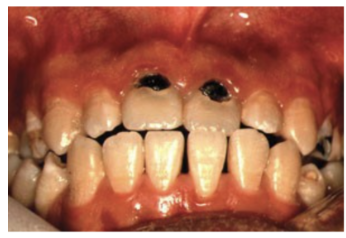
the dental caries shown on teeth #8 and #9 are which class of dental caries?
class V
which of the following describes rampant caries?
rapidly spreading caries involving 10 or more new lesions
abrasion of the tooth structure may occur from chemical exposure on a tooth surface (T/F)
FALSE

the premolar restoration in the image below is what type of restorative material?
amalgam

the wearing away of the incisal surfaces of the lower anteior teeth shown here from tooth to tooth contact is known as:
attrition
dental fluorosis results from too of a type of antibioitc (T/F)
FALSE
erosion is the mechanical wearing away of tooth structure (T/F)
FALSE
dentinogenesis imperfecta results from:
genetics
enamel hypoplasia resutls from a disturbance to the enamel matrix after formation of the enamel (T/F)
FALSE

the malocclusion of the anterior teeth shown here is documented as:
edge-to-edge
the space between the free gingiva and the tooth is known as:
gingival sulcus
a healthy gingival margina is located:
1-2 mm coronal to the CEJ
in health, the gingiva produces an excess of gingival crevicular fluid (T/F)
FALSE
which of the following terms best describes the consistency of healthy gingiva?
firm
the shape of the interdentl papilla in health is described as:
pointed
the periodontal assessment is part of the treatment phase of process of care (T/F)
FALSE
in health, the color of the gingiva is:
uniformly pink or pigmented
which of the following best describes the junctional epithelium?
it forms the base of the sulcus and is continuous with the sulcular epithelium
which of the following is the fixed point on a tooths surface where the clinical attachement level is measured from?
CEJ
which of the following best describes the shape of the interdental papilla in health?
the tip of the papilla fills the interdental space
the ____ is a depression under the contact area between facial and lingual papilla that conforms to the contact area
col
in gingival health, bleeding on probing may be present in more than 10% of all sites (T/F)
FALSE
a healthy sulcus is line with keratinized tissue (T/F)
FALSE
in health, the texture of the gingiva may appear:
stippled
which of the following structures of the periodontium is clincially significant in allowing bacteria to penetrate its membrane to underlying tissues?
sulcus
the junctional epithelium connects to the tooth by hemidesmosomes and the basal lamina (T/F)
TRUE
which area of the periodontium typically has the widest area of attached gingiva?
facial aspect of maxillary anterior teeth
on radiographs, the periodontal ligament appears as a radiopaque space surrounding the tooth (T/F)
FALSE
which of the following best describes the free gingival margin?
it surrounds the tooth but is not attached to the tooth or bone
how many probing sites are recorded per tooth?
6