bio 2 exam study set
 Call Kai
 Learn
Learn Practice Test
 Spaced Repetition
 Match
Match Flashcards
 Knowt Play
1/153

There's no tags or description
Looks like no tags are added yet.
Name | Mastery | Learn | Test | Matching | Spaced | Call with Kai | Chat |
|---|
No analytics yet
Send a link to your students to track their progress
154 Terms
What are the four major biological macromolecules?
Carbohydrates, lipids, proteins, and nucleic acids.
What are the seven important functional groups?
Hydroxyl, carbonyl, carboxyl, amino, sulfhydryl, phosphate, and methyl.
What does the hydroxyl group (–OH) do?
Makes molecules more water-soluble; found in sugars and alcohols.
What does the carbonyl group (C=O) do?
Found in sugars and helps distinguish types of sugars.
What does the carboxyl group (–COOH) do?
Acts as an acid by releasing H⁺ ions.
What does the amino group (–NH₂) do?
Acts as a base by accepting H⁺ ions.
What does the sulfhydryl group (–SH) do?
Can form bonds that stabilize protein structure.
What is the function of the phosphate group?
Important in ATP energy transfer and DNA/RNA structure.
What can the methyl group (–CH₃) affect?
Molecule shape and activity, including gene expression.
What four groups/atoms attach to an amino acid's central carbon?
An amino group, a carboxyl group, a hydrogen atom, and an R group.
What makes each amino acid different?
Its R group, or side chain.
What is a monomer?
A small building-block molecule that can join with others.
What is a polymer?
A large molecule made of repeating smaller subunits.
What is dehydration synthesis?
Joins molecules by removing a water molecule.
What is hydrolysis?
Breaks bonds by adding water to separate subunits.
What are the monomers of carbohydrates?
Monosaccharides, or simple sugars.
What are the building blocks of proteins?
Amino acids.
What are the building blocks of DNA and RNA?
Nucleotides.
Are lipids true polymers?
No; they are built from components such as glycerol and fatty acids.
What are the main functions of carbohydrates?
Quick energy, energy storage, and structural support.
What is the chemical formula of glucose?
C₆H₁₂O₆.
What are examples of carbohydrates?
Glucose, sucrose, starch, glycogen, cellulose, and chitin.
What is a monosaccharide?
A single sugar molecule.
What is a disaccharide?
Two monosaccharides joined by a glycosidic bond.
What is a polysaccharide?
A long chain of monosaccharides.
What is the function of starch?
Stores glucose in plants.
What is the function of glycogen?
Stores glucose in animals, especially liver and muscles.

What is cellulose?
A structural polysaccharide in plant cell walls.

What is chitin?
A nitrogen-containing polysaccharide in arthropod exoskeletons.
What are the main functions of lipids?
Long-term energy storage, insulation, protection, membranes, and hormones.
What are the components of a triglyceride?
One glycerol molecule and three fatty acids.
What type of bonds join glycerol and fatty acids?
Ester bonds, formed by dehydration synthesis.
What is a saturated fat?
A fat with no carbon–carbon double bonds; usually solid at room temperature.
What is an unsaturated fat?
A fat with one or more carbon–carbon double bonds; often liquid at room temperature.
What is a monounsaturated fat?
A fat with one carbon–carbon double bond.
What is a polyunsaturated fat?
A fat with more than one carbon–carbon double bond.
How do cis and trans fats differ?
Cis hydrogens are on the same side; trans hydrogens are on opposite sides.
What are essential fatty acids?
Fatty acids the body needs but cannot make sufficiently, so they must come from food.
What is a phospholipid made of?
Glycerol, two fatty acids, and a modified phosphate group.
Why does a phospholipid have one side that loves water and one side that hates it?
They have a water-loving head and water-fearing tails.

How are phospholipids arranged in a membrane?
Heads face watery environments; tails point inward toward each other.
What are steroids structurally characterized by?
Four linked carbon rings.
What is cholesterol a precursor for?
Steroid hormones, vitamin D, and bile salts.
What are the main functions of proteins?
Catalysis, structure, transport, defense, movement, storage, and signaling.
What is an enzyme?
A biological catalyst that speeds up chemical reactions.
What is a catabolic reaction?
A reaction that breaks down molecules.
What is an anabolic reaction?
A reaction that builds more complex molecules.
What bond joins amino acids?
A peptide bond.
How is a peptide bond formed?
By dehydration synthesis between amino and carboxyl groups, releasing water.
What is a polypeptide?
A chain of amino acids joined by peptide bonds.
What is primary protein structure?
The sequence of amino acids in a polypeptide.

What is secondary protein structure?
Local folding into alpha helices and beta-pleated sheets, stabilized by hydrogen bonds.
What is tertiary protein structure?
The overall three-dimensional folding of one polypeptide chain.

What causes tertiary protein structure?
Interactions among amino acid R groups, such as hydrogen, ionic, and disulfide bonds.
What is quaternary protein structure?
Two or more polypeptide chains joined into one functional protein.

What is an example of quaternary protein structure?
Hemoglobin, which has four subunits.
What is protein denaturation?
A change in protein shape that alters or disrupts its function.
What can cause protein denaturation?
Changes in temperature or pH.
How can a change in amino acid sequence affect a protein?
It can change the protein's shape and function.
What does the Biuret solution test for?
Proteins.
What does the ethanol test detect?
Lipids.
What does Benedict's solution test for?
Reducing sugars.
What does iodine test for?
Starch.
What are the main functions of nucleic acids?
Store and transmit genetic information and help direct protein production.

What are the three parts of a nucleotide?
A nitrogenous base, a pentose sugar, and one or more phosphate groups.
What sugar is found in DNA?
Deoxyribose.
What sugar is found in RNA?
Ribose.
Which base is found in DNA but not RNA?
Thymine (T).
Which base does RNA use instead of thymine?
Uracil (U).
What are DNA's complementary base pairs?
A pairs with T; G pairs with C.
What are RNA's complementary base-pairing rules?
A pairs with U; G pairs with C.
What is DNA's main function?
Stores genetic information.
What is RNA's main function?
Helps carry out genetic instructions, especially during protein synthesis.
What does mRNA do?
Carries genetic instructions to a ribosome.
What does tRNA do?
Matches mRNA codons and delivers amino acids.
What does rRNA do?
Forms part of ribosomes and helps protein synthesis.
What is transcription?
Copying DNA information into RNA.
What is translation?
A ribosome reads mRNA codons and joins amino acids into a polypeptide.
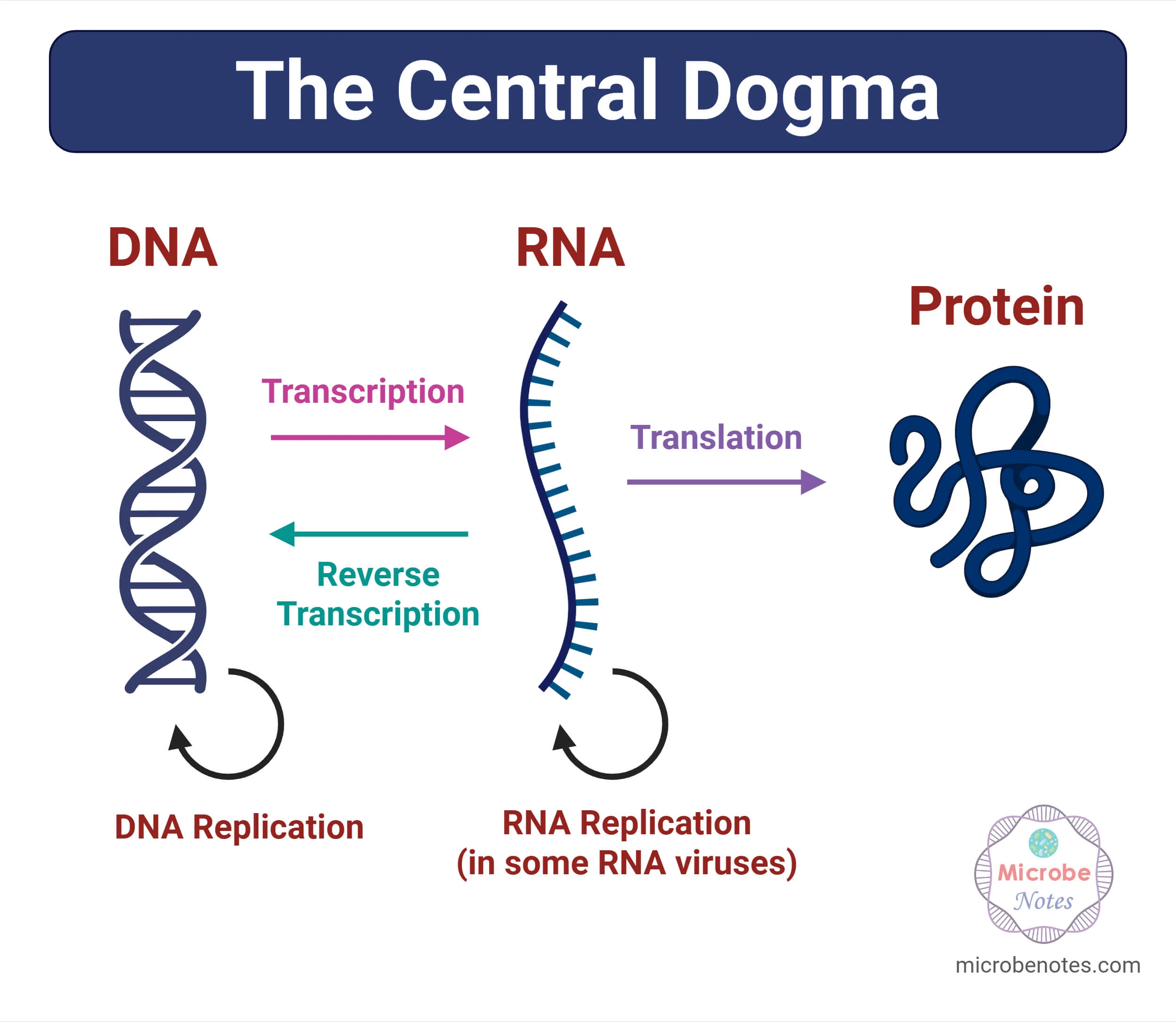
What is the central dogma?
DNA → RNA → protein; DNA can also replicate.
What is ATP's role?
It acts as an energy carrier in cells.
What are the three statements of cell theory?
All living things consist of cells; cells are life's basic unit; cells come from preexisting cells.
What four components are found in all cells?
Plasma membrane, cytoplasm, DNA, and ribosomes.
Which two domains contain prokaryotes?
Bacteria and Archaea.
What characterizes prokaryotic cells?
They lack a nucleus and membrane-bound organelles; DNA is in the nucleoid region.
What characterizes eukaryotic cells?
They have a nucleus and membrane-bound organelles.
What three features distinguish plant cells from animal cells?
Plant cells have a cell wall, chloroplasts, and a large central vacuole.
What structures are characteristic of animal cells in the slides?
Centrosomes with centrioles and lysosomes.
What is the function of the nucleus?
Contains DNA as chromatin and helps control cell activities.
What does the nuclear envelope do?
Separates DNA from cytoplasm; nuclear pores regulate movement.
What is the nucleolus?
The region where ribosomes are assembled from RNA and proteins.
What do ribosomes do?
Synthesize proteins by joining amino acids.
What is the function of mitochondria?
Convert energy from food molecules into ATP.

What are cristae?
Folds of the inner mitochondrial membrane.

What is the mitochondrial matrix?
The space enclosed by the inner mitochondrial membrane.
What do chloroplasts do?
Carry out photosynthesis.

What is the stroma?
The fluid inside a chloroplast surrounding the thylakoids.
What are thylakoids and grana?
Thylakoids are membrane sacs; a stack of them is a granum.
What is the function of the central vacuole?
Regulates water balance and helps plant cells expand.
What is the plant cell wall made of?
Cellulose.
How does a plant cell wall differ from a bacterial cell wall?
Plant walls contain cellulose; bacterial walls typically contain peptidoglycan.