Ch. 15 – Microbial Mechanisms of Pathogenicity
 Call Kai
 Learn
Learn Practice Test
 Spaced Repetition
 Match
Match Flashcards
 Knowt Play
1/62

There's no tags or description
Looks like no tags are added yet.
Name | Mastery | Learn | Test | Matching | Spaced | Call with Kai | Chat |
|---|
No analytics yet
Send a link to your students to track their progress
63 Terms
What is pathogenicity?
The disease process; the ability of a pathogen to cause disease in a host.
What is virulence?
A "special" ability; the enhanced ability of a pathogen to cause infection.
What is a virulence factor, and what does it do for the pathogen?
A characteristic or trait of the pathogen that makes it harmful (dangerous), the "special thing" that makes it able to cause disease.
Contributes to virulence.
Enhances the survival of the pathogen.
Give 3 examples of virulence factors, and explain antigenic variation.
Capsules, toxins, and antigenic variation.
Antigenic variation: the antigen changes its appearance/composition (ex: changing viral spikes).
What are mechanisms of pathogenicity?
The different ways by which a microbe/pathogen can cause an infectious disease.
List the 7 mechanisms of pathogenicity (the parts of the disease process) in order.
Number of invading microbes.
Portals of entry.
Adherence.
Penetration of host defenses.
Evasion of host defenses.
Damage to host cells.
Portals of exit.

What are the 3 portals of entry microbes use to enter a host (in order to cause infection)?
Mucous membranes: respiratory tract, GI tract, and genitourinary tract.
Skin: through broken skin.
Parenteral route.
Entering the bloodstream through a needle
What is the parenteral route, and give 2 examples.
Non-oral entry (bypassing the GI tract); pathogens are deposited into the bloodstream.
Usually involves an "injection" into a blood vessel.
Ex: 1) intravenous (IV) entry by contaminated needles
2) insect bites (an infected insect = arthropod vector with a pathogen).
What happens if the number of invading pathogens is high enough?
It can overwhelm host defenses → infection → disease.
What is ID₅₀, and what does it measure?
Infectious Dose 50: a value for how many bacteria it takes; the number of pathogens required to make 50% of a population sick.
Measures virulence (the enhanced ability of a pathogen to cause infection).
Serves as an indicator for the preferred portal of entry (route) to cause a disease.
What does a low ID₅₀ mean?
Low ID₅₀ = high infectiousness/high virulence; takes just a few pathogens to make the population sick.
What does a high ID₅₀ mean? Give an example comparing low vs. high.
High ID₅₀ = low infectiousness/low virulence; takes a lot of pathogens to make the population sick.
Ex: pathogen #1 (ID₅₀ = 2) is very infectious vs. pathogen #2 (ID₅₀ = 50,000).
What pathogen causes anthrax, and what is an endospore?
Bacillus anthracis, a spore-forming bacterium.
Endospore = dormant stage of the pathogen.
What are the 3 portals of entry for anthrax and their ID₅₀ values?

What is the preferred route (portal of entry) for developing anthrax, and why?
Through the skin; it's the easiest/best entry for developing anthrax.
Low ID₅₀ = only a few spores required to get sick = very virulent (high virulence).
Ingestion has a high ID₅₀ = lots of spores required to get sick = less virulent (low virulence).
What can bacterial toxins do to a host?
Some bacteria produce toxins (strong or weak) that can cause death of the host (lethality of the toxin).
What is LD₅₀, and what does it measure?
Lethal Dose 50: a value (concentration/amount); the amount of toxin required to kill 50% of a population.
Measures the potency of a toxin (how strong/poisonous/dangerous the toxin is).
Toxigenic pathogens have different LD₅₀ values.
What does a low LD₅₀ mean?
Low LD₅₀ (low amount) = high toxin lethality/potency; only takes a small toxin amount to kill the population → very dangerous toxin.
What does a high LD₅₀ mean? Give an example comparing low vs. high.
High LD₅₀ (high amount) = low toxin lethality/potency; takes a large toxin amount to kill the population → not too dangerous toxin.
Ex: pathogen #2 (LD₅₀ = 3 mg/kg) is a highly lethal toxin vs. pathogen #1 (LD₅₀ = 1000 mg/kg).
What are the LD₅₀ values of these 3 bacterial toxins (poisons): botulinum, Shiga toxin, and staphylococcal enterotoxin?
Botulinum: 0.03 ng/kg.
Shiga toxin: 250 ng/kg.
Staphylococcal enterotoxin: 1350 ng/kg.
Which of these toxins is the most potent (lethal, strong), and why?
Botulinum toxin, because it has the lowest LD₅₀ value (smallest concentration needed to kill).
What are adhesion factors, and what is adherence (adhesion)?
Adhesion factors are for attachment of the pathogen to host tissue.
Adherence: the ability of pathogens to attach (bind) to host tissues/cells → infection.
What are bacterial adhesins (ligands), and what role can they play?
Substances on the pathogen that bind to receptors on the host cell membrane.
Adhesin (ligand) = on the pathogen; receptor = on the host cell.
Adhesins may act as virulence factors (VF).
What is the difference between pathogen adhesins and antigenic determinants?
Pathogen adhesins bind to host receptors.
Antigenic determinants bind to antibodies (Ab).
What are the 5 types of adhesins (ligands) that attach to host cell receptors?
Capsules: sticky, polysaccharide.
Fimbriae.
M proteins: present in the bacterial cell wall.
Opa proteins: present in the bacterial cell wall.
Hooks: anchors.
Give the example pathogen for each type of adhesin.
Capsules: Streptococcus mutans (on teeth).
Fimbriae: E. coli O157:H7 (pathogenic strain).
M proteins: Streptococcus pyogenes.
Opa proteins: Neisseria gonorrhoeae.
Hooks: Treponema pallidum → syphilis.
What are the 5 penetration factors (bacterial enzymes) that help pathogens penetrate/escape host defenses?
"-ase" enzymes produced by some bacteria:
Coagulase.
Kinase.
Hyaluronidase.
Collagenase.
IgA protease.
What does coagulase do vs. kinase?
Coagulase: helps form a blood clot → stops blood flow → host defenses (neutrophils, monocytes) cannot reach the bacterium; bacteria can also surround themselves inside a clot (bacteria protected).
Kinase: breaks down the blood clot surrounding the bacterium → bacterium is free to spread throughout the body.
What do hyaluronidase and collagenase do?
Hyaluronidase: breaks down hyaluronic acid in connective tissue.
Collagenase: breaks down collagen in connective tissue.

What is IgA protease, and what does it do?
An enzyme that breaks down other proteins such as IgA; destroys IgA antibodies.
What does evasion of host defenses mean, and what are the 3 ways pathogens survive inside phagocytes?
Evasion = escape; the pathogen fights back.
Pathogen escapes from the phagosome before lysosomal fusion.
Prevention of fusion of the lysosome with the phagosome.
Resist lysosomal enzymes.
What is mycolic acid, and how does it help a pathogen?
A lipid in the cell wall of genus Mycobacterium.
Resists lysosomal enzymes, so the pathogen reproduces in the phagocyte.
What is antigenic variation, and where is it a key virulence factor?
Pathogens change their surface antigens (antigenic determinants) through genetic mutations/recombination; ex: viral spikes.
A key virulence factor seen in viruses!
Ex: influenza virus and HIV; they can change their spikes → makes these viruses very dangerous!
What is a toxin, and what symptoms may it produce?
A poisonous substance (acting as an antigen/Ag) produced by pathogens (ex: toxigenic bacteria can make bacteria).
SXS: fever, cardiovascular problems, diarrhea, and shock
Shock = (sudden massive drop in BP).
What is toxigenicity vs. toxemia?
Toxigenicity: the ability of a pathogen to produce a toxin.
Toxemia: presence of toxin in the bloodstream.
What is a toxoid?
A chemically modified toxin that is no longer toxic (harmless; non-toxic toxin).
Stimulates an immune response.
What is an antitoxin, and how is it usually given?
Antitoxin = Ab/Ig; an antibody against a toxin (Ag), NOT against the bacteria!
Usually injected into the host (artificial passive immunity).
- Doesn’t target bacteria
What creates the symptoms of disease in many bacterial infections, and why are toxins important?
Some bacteria can produce toxins (toxigenic bacteria vs. non-toxigenic bacteria).
In many cases, it is the toxin (not the bacteria) that creates the symptoms of disease.
Ex: A key virulence factor seen in bacteria!
(VF = ability of some bact. to produce toxin)
What are the 2 types of toxins produced by some bacteria?
Exotoxins: there are 3 types.
- made of proteins → strong immune responseEndotoxins.
Made of lipids (lipid toxins) → weak immune response
What bacterial structure may be involved in toxin production?
Bacterial plasmids that carry genes for toxins (separate from the nucleoid region).
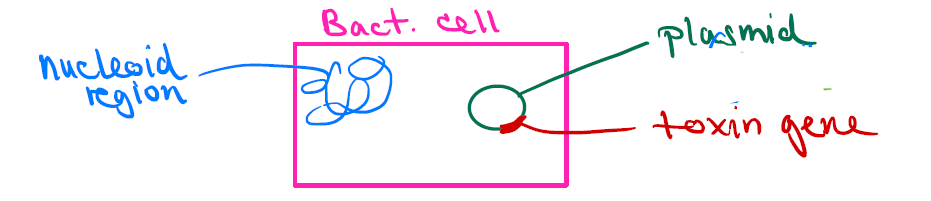
What are the 2 ways toxins get produced?
As a result of lysogeny involving phage conversion (phage = bacterial virus).
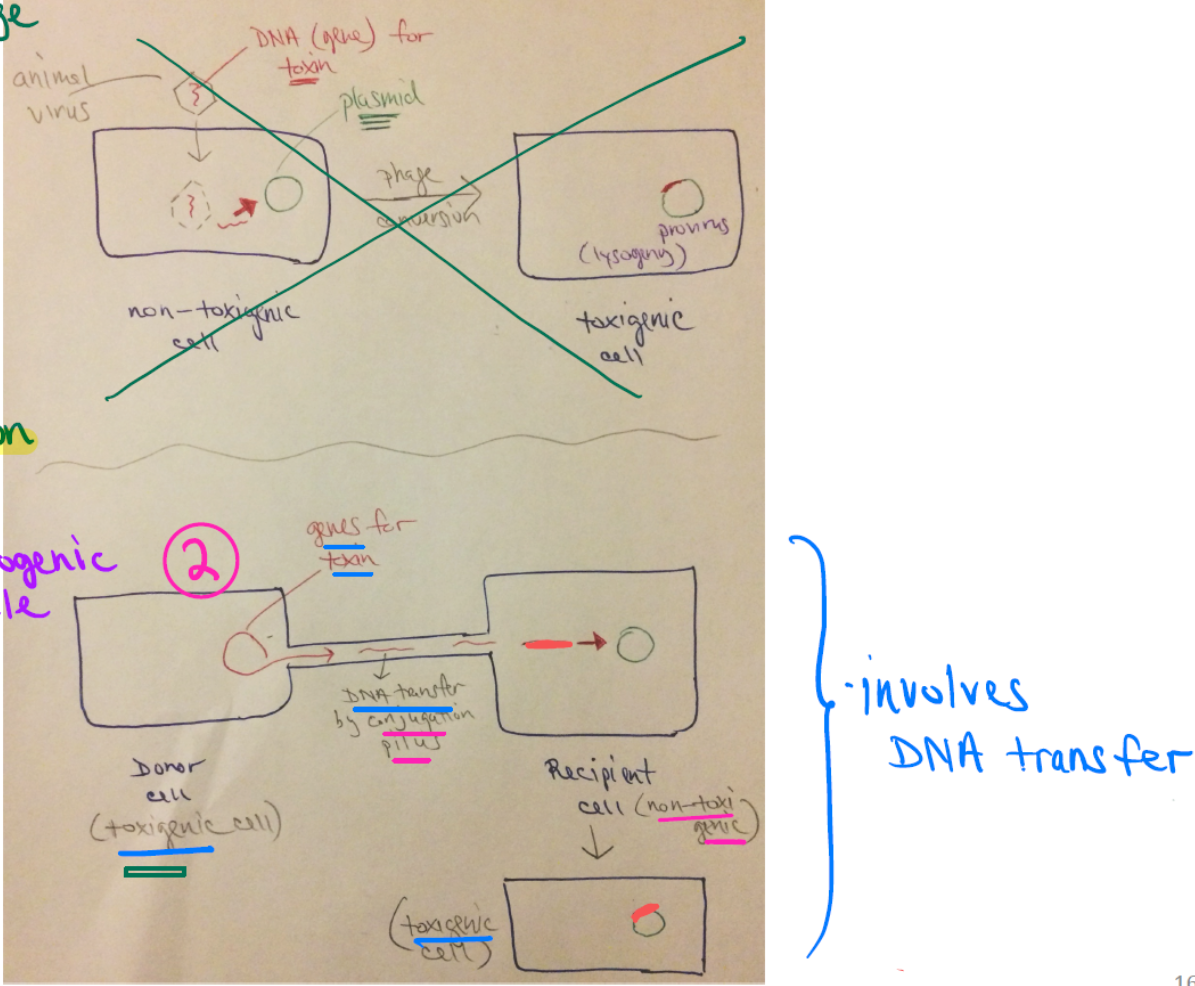
As a result of DNA transfer involving a conjugation pilus.
Describe how a non-toxigenic bacterium becomes toxigenic through lysogeny.
Method #1
A bacterial virus (phage) carrying DNA (gene) for a toxin injects it into a non-toxigenic bacterium.
The toxin gene inserts into the bacterium's plasmid (DNA) as a prophage (lysogenic cycle).
This process = phage conversion → the bacterium becomes toxigenic.

Describe how a non-toxigenic bacterium becomes toxigenic through DNA transfer.
Method #2
A donor cell (toxigenic) transfers genes for a toxin to a recipient cell (non-toxigenic) by a conjugation pilus.
The recipient cell becomes toxigenic.
What is an immunogen? Give an example.
Something that acts as an antigen; stimulates/activates the immune system to produce antibodies (Ab's).
Harmful microbe = pathogen = Ag = immunogen.
Ex: Toxin
What is a strong immunogen (toxin) vs. a weak immunogen (toxin)? Give examples.
Strong immunogen: good stimulator of the immune response (strong immune response) → Ab's made → no fever.
Ex: protein toxins.
Weak immunogen: poor stimulator of the immune response (weak immune response) → no Ab's made → fever.
Ex: lipid and polysaccharide toxins.
What is the exception to the rule that protein toxins don't produce fever?
Type I exotoxin (Super Ag), which will produce fever even though Super Ag's are protein toxins.
What are exotoxins, and which bacteria produce them? Give an example.
Proteins made inside the bacteria
Secreted by living cells during log phase
Mostly gram-positive
some gram-negative
Proteins, so no fever
Ex: Clostridium botulinum (gram-positive)

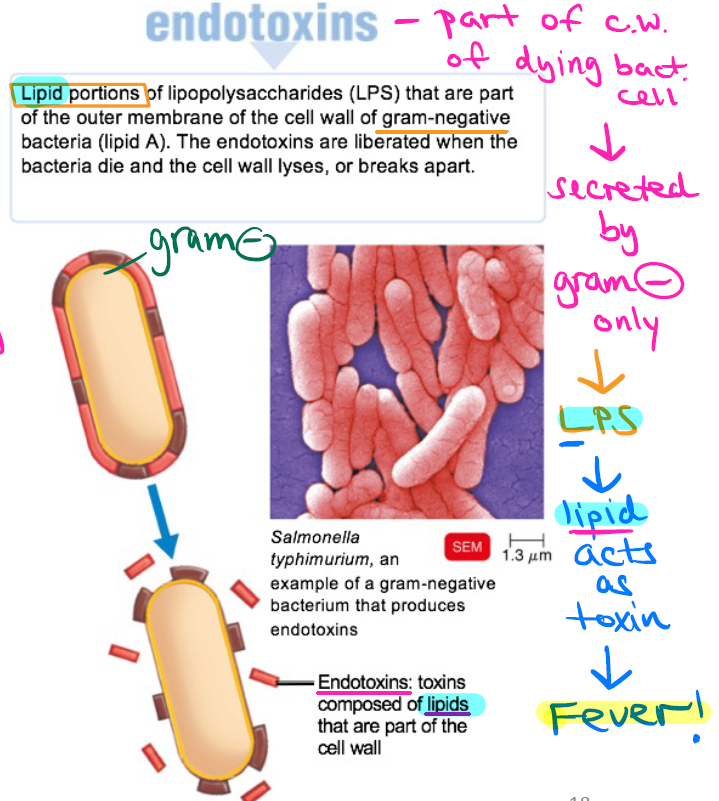
What are endotoxins, and which bacteria produce them? Give an example.
Lipid A portion of LPS in the gram-negative outer membrane
Part of the cell wall, released when the cell dies and lyses
Gram-negative only
LPS lipid acts as toxin → fever
Ex: Salmonella typhimurium
For exotoxins, what is their toxicity, are they neutralized by antitoxin, and what is their LD₅₀? Explain why.
Metabolic byproduct of a live bacterium (toxins secreted and released).
Protein → strong immune response → produces Ab.
Toxicity: high, because of a low LD₅₀.
Neutralized by antitoxin (an Ab): yes, because of the strong immune response.
LD₅₀: small → very dangerous!
Fever producing? → No
For endotoxins, what is their toxicity, are they neutralized by antitoxin, and what is their LD₅₀? Explain why.
Found in the LPS of the cell wall's outer membrane of a dying gram-negative cell.
Lipid → weak immune response → produces NO Ab.
Toxicity: low, because of a high LD₅₀.
Not neutralized by antitoxin (an Ab), because of the poor immune response (did NOT make Ab).
LD₅₀: large → not so dangerous.
Fever producing? → Yes
Summarize exotoxins vs. endotoxins (source, composition, fever).
Exotoxins: mostly gram-positive, protein, no fever (except Super Ag).
Very toxic → ABs made → Toxin eliminated due to strong immune response
Endotoxins: gram-negative, lipid, yes fever.
Not very toxic → no ABs made → Toxin not eliminated due to weak immune response
What are the 3 types of exotoxins, and who mostly secretes them?
Secreted mostly by gram-positive bacteria.
Type I: superantigens → Fever, nausea, vomiting, shock
Type II: membrane-disrupting (MD) toxins.
Type III: A-B toxins → inhibit protein synthesis
(most common so know this)^^^
Describe Type I exotoxins (superantigens): characteristic and mechanism of action.
Characteristic: are Ag's that cause a very strong immune response.
Mechanism: Super Ag causes proliferation of T cells → release cytokines → FEVER, nausea, vomiting, shock.
Describe Type II exotoxins (membrane-disrupting toxins): characteristic and mechanism of action.
Characteristic: cause lysis of host cells by disrupting their cell membranes.
Mechanism: MD toxins form channels in the cell membrane or disrupt the phospholipid part of the cell membrane.
Describe Type III exotoxins (A-B toxins): characteristics and mechanism of action.
Characteristics: consist of 2 parts (A & B); most common type of exotoxins.
Mechanism: A-B toxins inhibit protein synthesis in host cells.
What is the pyrogenic response, and what triggers it?
The pyrogenic response = fever.
Triggered by endotoxins: from the dying gram-negative bacterial cell wall → LPS → lipid toxin.
Also Type 1 exotoxin (super antigen)
Describe the 4 steps of how endotoxins cause fever.
A macrophage ingests a gram-negative bacterium.
The bacterium is degraded in a vacuole, releasing endotoxins (LPS) that induce the macrophage to produce cytokines.
The cytokines (from the macrophage) are released into the bloodstream and travel to the hypothalamus, the temperature control center of the brain.
The cytokines induce the hypothalamus to reset the body's "thermostat" (body temp) to a higher temperature, producing fever.


What are 3 pathogenic properties of some fungal toxins? Give an example.
Some fungal toxins:
Can contaminate the food supply.
Can provoke an allergic response.
Are carcinogenic (cancer-causing).
Ex: aflatoxin (aflatoxin B1 is the most toxic; maize is most vulnerable to contamination).
KNOW AFLATOXIN prof mentioned.
What kingdom are parasitic protozoa in, and how do they damage the host?
Kingdom Protista.
A large number of protozoa feed on host tissue → damage to the intestinal lining resulting in diarrhea or dysentery (mucous bloody diarrhea).
What are the 2 ways protozoa avoid (escape) host defenses?
Growing in phagocytes.
Antigenic variation (a virulence factor).
What are helminths, what kingdom are they in, and why are they not very pathogenic?
Helminths = worms; Kingdom Animalia.
Not very pathogenic: they use the host's nutrients or tissues without killing the host.
What happens when helminths are present in the GI tract in large numbers?
They interfere with host food absorption, leading to symptoms of fatigue and weight loss.
Due to anemia (worms taking the host's nutrients).
What are the 5 portals of exit, and how do pathogens leave through each?
Pathogens leave the same way they entered the body.
Respiratory tract: → by coughing and sneezing.
Gastrointestinal tract: → through feces and saliva.
Genitourinary tract: → through urine and secretions from the genitals.
Skin: → through broken skin.
Blood: → through arthropods that bite, or needles/syringes.