Lec 6 ANSC323
 Call Kai
 Learn
Learn Practice Test
 Spaced Repetition
 Match
Match Flashcards
 Knowt Play
1/34

There's no tags or description
Looks like no tags are added yet.
Name | Mastery | Learn | Test | Matching | Spaced | Call with Kai | Chat |
|---|
No analytics yet
Send a link to your students to track their progress
35 Terms
General Properties of Sensory Systems: All sensory systems detect a
specific type of x, convert it into x
(transduction), encode its x, duration, and location, and
then x it along labeled lines to the brain, where x
occurs.
General Properties of Sensory Systems: All sensory systems detect a
specific type of stimulus, convert it into neural signals
(transduction), encode its intensity, duration, and location, and
then transmit it along labeled lines to the brain, where perception
occurs.
Describe the different types of receptors for somatic and special
senses.
Somatic Senses Hardware:
Simple Neural Receptors: Naked ("free") nerve endings very sensitive to pain (nociceptors) and temperature.
Complex Neural Receptors: Nerve endings enclosed in protective connective tissue capsules (enhances the system to detect touch/vibration, e.g., Pacinian corpuscles).
Special Senses Hardware:
Non-Neural Receptors: Highly specialized cells (not neurons) that release neurotransmitters onto an associated sensory neuron (e.g., hair cells in the ear).
Explain how receptors convert physical stimuli into electrical signals using transduction, threshold, adequate stimulus, receptive field, and receptor potential.
Adequate Stimulus: The particular form of energy a receptor is specifically sensitive to (e.g., photons for eyes, pressure for skin).
Transduction: The actual process of converting environmental energy into an action potential.
Receptor Potential: The local, graded change in membrane potential caused by stimulus entry.
Threshold: The minimum level of stimulus energy required to fire an action potential to the CNS.
Receptive Field: The specific physical zone where a stimulus can activate that neuron.
Explain how the central nervous system is able to determine modality, location, intensity, and duration of a stimulus
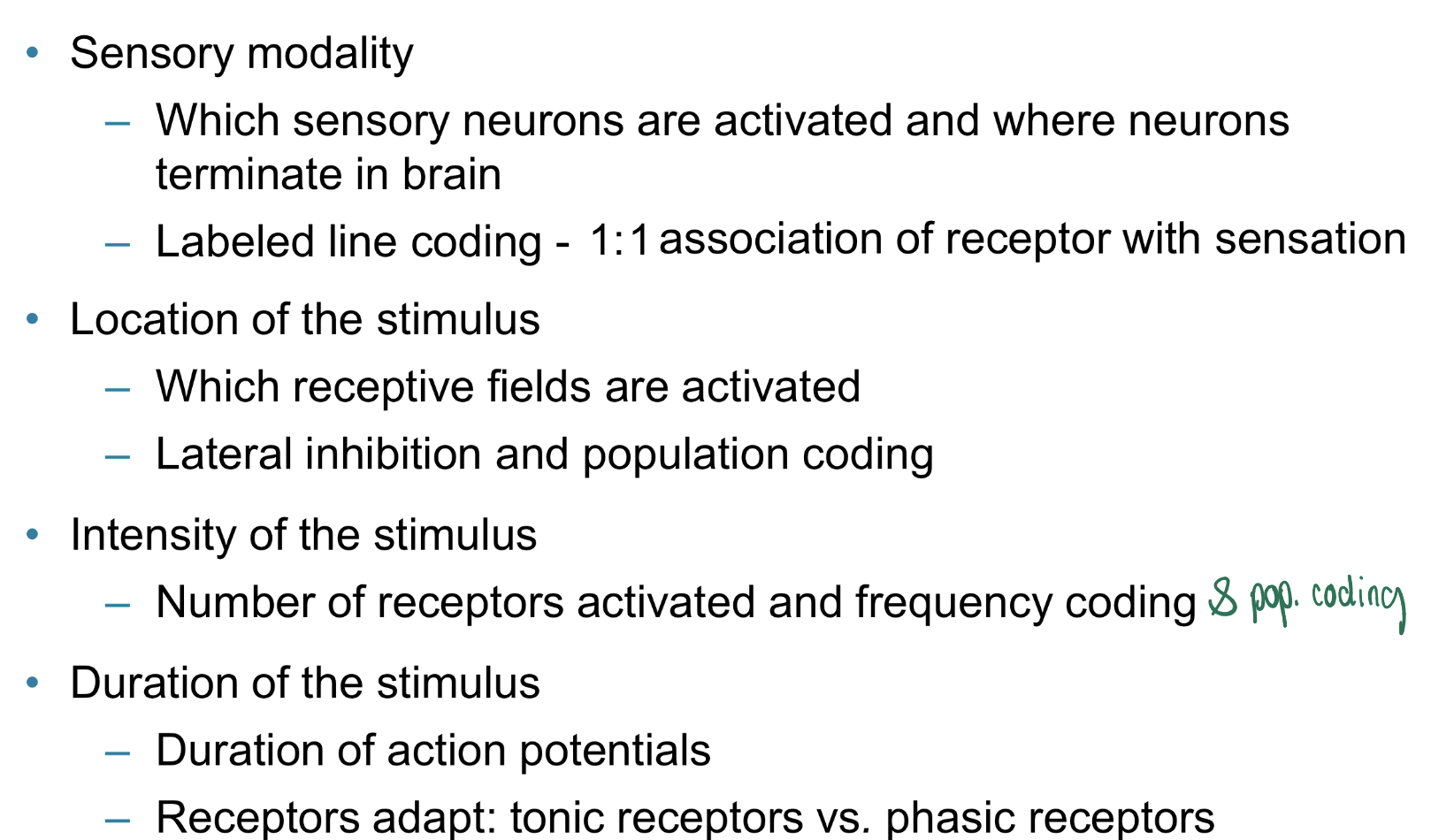
1. Modality (What is it?): Determined by which sensory neurons are activated and where they terminate in the brain (Labeled Line Coding).
2. Location (Where is it?): Coded by which specific receptive fields are activated. Further sharpened by lateral inhibition (the most impacted neuron sends signals to inhibit its neighbors to be more specific).
3. Intensity (How strong?): Coded by the number of receptors activated (population coding) and the speed/rate of action potentials fired (frequency coding).
4. Duration (How long?): Coded by the total duration of the series of action potentials.
Explain how tonic and phasic receptors adapt to a continuous stimulus.
Tonic Receptors (Slow Adaptation):
Slowly adapting free nerve endings that respond continuously for the duration of a stimulus.
Rule: They always respond and are slow to adapt (e.g., pain and temperature).
Phasic Receptors (Fast Adaptation):
Rapidly adapting receptors that fire a quick burst when a stimulus starts, then turn completely off.
Rule: Adapt fast to a constant stimulus (e.g., getting used to clothes touching your skin).
Trace the pathways for somatic sensation from receptor to the somatosensory cortex.
= 3 neuron route:
Primary Sensory Neuron: Cell body sits in the dorsal root ganglion. Its axon stays on the same sideof the body until it reaches the medulla.
Secondary Sensory Neuron: Connects in the CNS, crosses over the midline (decussation), and travels up to the thalamus. (Note: The thalamus gets all sensory info EXCEPT smell).
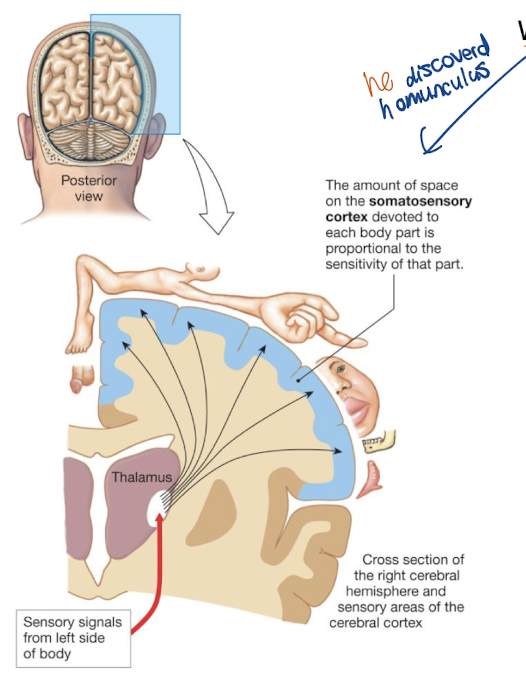
Tertiary Sensory Neuron: Projects from the thalamus to the primary somatosensory cortex(postcentral gyrus of parietal lobe).
Key Visual: Wilder Graves Penfield discovered the homunculus mapping here, where cortical space matches tissue sensitivity, like the fingures are SO sensitive compared to wrist
Explain how pain and itch are mediated by nociceptors, and describe the neural pathways for pain.
The Fiber Types:
(A-delta) fibers: Small, myelinated (actions can jump); transmits sharp, localized fast pain.
C fibers: Small, unmyelinated (slow local current flow); transmits dull, diffuse slow pain, heat, and itch.
Reflexes: Pain activation triggers a protective withdrawal reflex integrated in the spinal cord across a 3-neuron loop.
Gate Control Theory:
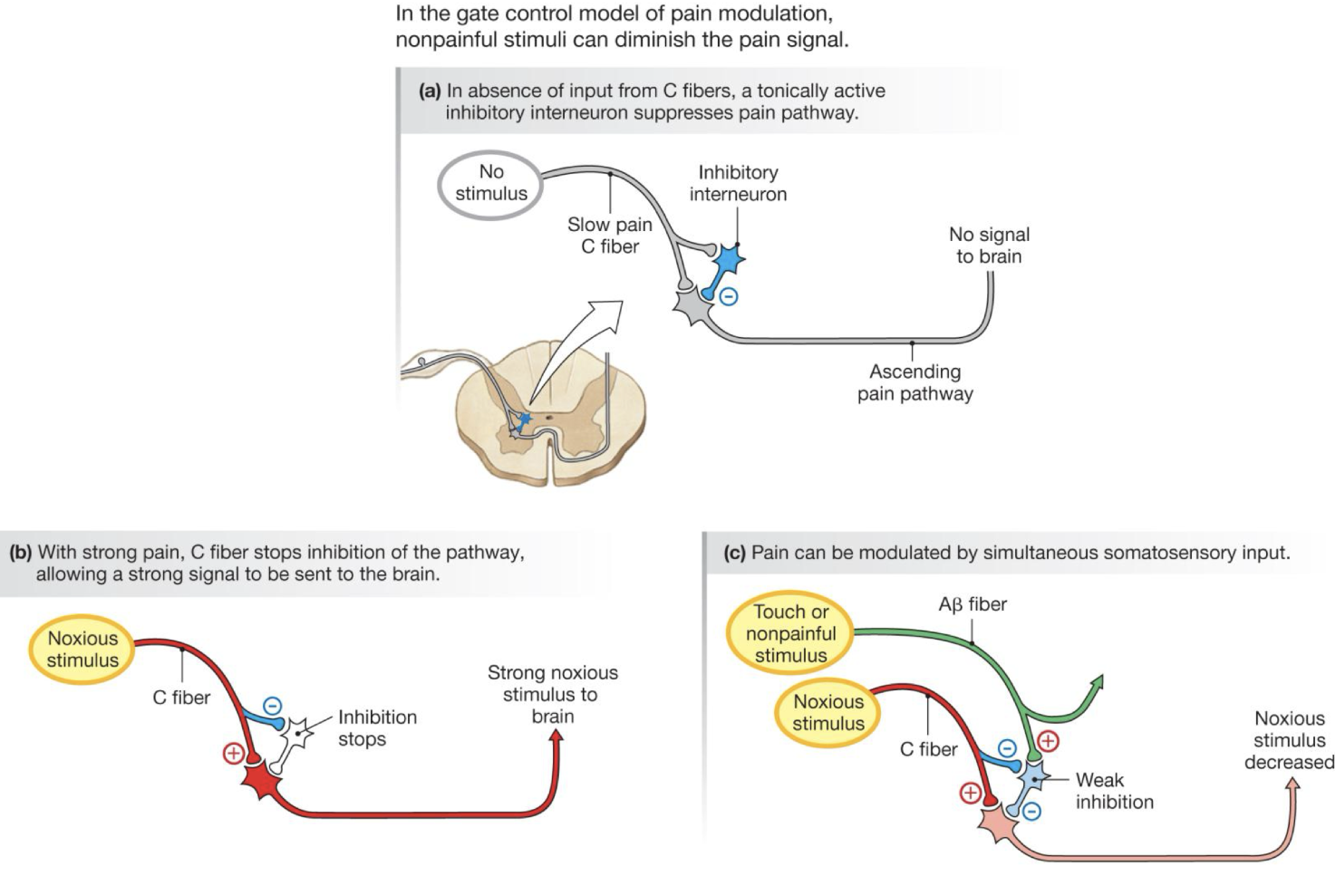
In pure pain, C fibers inhibit internal spinal interneurons, opening the gate to send pain up the spinothalamic tract.
If you rub the area, fast 𝐴 𝛽 mechanical fibers activate that inhibitory interneuron, closing the gate and blocking the pain signal from reaching the brain.
primary vs secondary vs tertiary sensory neurons
three-neuron chain that routes somatic sensory information from the body up into conscious awareness.
Location/Route:
Primary: Travels from the receptor surface into the spinal cord or medulla.
Secondary: An interneuron that crosses the midline (decussates) and travels up to the thalamus.
Tertiary: Projects from the thalamus directly up to the somatosensory cortex.

mechanoreceptors=
= Receptors sensitive to physical deformation or mechanical energy.
Function: Responds to pressure (baroreceptors), cell stretch (osmoreceptors), vibration, acceleration, and sound waves.
Analogy: A guitar pickup translating the physical vibration of a metal string into an electrical audio signal.
thermoreceptors, what specific channel do they use?
=Free nerve endings built to sense varying degrees of thermal energy.
Location: Terminate within the subcutaneous layers of the skin.
Function: Uses Transient Receptor Potential (TRP) cation channels to detect warm or cold ranges.
Analogy: A basic digital temperature probe measuring external air warmth.
somatosensory receotors are odtern found where?
= The complete collective family of neural receptors that gather somatic sensory data.
Location: Subcutaneous and deeper layers of the skin, muscles, and viscera.
Function: Picks up mechanical contact, thermal shifts, or tissue damage to send upstream.
Chemoreceptors:
eceptors built to detect specific chemical concentrations or organic molecules.
Function: Monitors internal levels like oxygen, blood pH, and glucose, or external chemicals (taste and smell).
Analogy: A pool pH testing kit that changes colors based on chemical acidity.
Senses & Modalities: special senses include?
Specialized organs in the head (vision, hearing, taste, smell, equilibrium).
Sensory systems with dedicated organs specialized in vision, hearing, taste, smell, and equilibrium.
Location: Localized entirely within specialized sensory structures of the head (eyes, ears, tongue, nasal cavity).
Example: Spotting a red stop sign using the photoreceptors in your retina.
Senses & Modalities: somatic senses include? what is Proprioception, and Proprioceptors
= General body sensations that monitor touch, temperature, pain, itch, and proprioception across the body.
Location: Distributed widely throughout the skin (epidermis/dermis) and internal visceral organs.
Proprioception= Conscious/unconscious awareness of body position and movement in space,integrated within the Central Nervous System (CNS), specifically processing inputs climbing up the spinal cord to the cerebrum and cerebellum.
Proprioceptors = Specialized mechanoreceptors that monitor the physical stretch + position and tension of musculoskeletal structures.
Location: Embedded deep within muscles (muscle spindles), tendons (Golgi tendon organs), and joint capsules.
Example: Receptors in your calf tracking stretch to prevent you from losing your balance when leaning forward.
Somatosensory Receptor vs Chemoreceptors vs Mechanoreceptors vs Thermoreceptors vs Photoreceptors
Somatosensory Receptors: Diverse peripheral receptors tracking changes on the body surface or deep tissues.
Chemoreceptors: Respond to chemical ligands (taste, smell, blood gases).
Mechanoreceptors: Respond to physical deformation (pressure, stretch, vibration).
Thermoreceptors: Free nerve endings detecting temperature fluctuations.
Photoreceptors: Rods and cones converting light energy into electrical signals in the retina.
neural vs nonneural receptos

simple vs complex vs non-neural sensory receptors
Simple Receptors: Naked nerve endings for raw survival alerts.
Complex Receptors: Encapsulated nerve endings that filter touch sensations.
Non-Neural Receptors: Specialized cells that capture delicate special senses. (ears)

frequncy vs population coding
Population Coding: Signaling intensity by recruiting a larger absolute number of parallel receptors — Analogy: A stadium crowd getting louder because thousands of individual people start cheering at once.
Frequency Coding: Signaling intensity by speeding up the firing rate of action potentials down a single axon — Analogy: A machine gun firing bullets faster and faster to deliver a heavier stream of damage.

Sensory Physiology & Transduction: what is transduction, adequate stimulus, threshold, receptor potential
Transduction: Converting physical/chemical environmental energy (eg pressure or heat) into graded neural potentials — Analogy: Like a microphone converting mechanical sound waves into an electrical audio signal.
Adequate Stimulus: The specific energy form a receptor is most evolutionary tailored to detect — Example: Light waves are the adequate stimulus for your eyes, whereas punching your closed eye just makes you see blurry flashes.
Threshold: The bare minimum stimulus intensity needed to launch an action potential — Analogy: The minimum pressure needed to click a mouse button down; anything lighter does nothing.
Receptor Potential: The initial graded electrical shift generated inside the sensory receptor cell — Analogy: The half-pulled trigger of a gun before it actually snaps and fires.
Fields & Neural Coding: what is receptive fiels, convergent, and 2 point discrimination test?
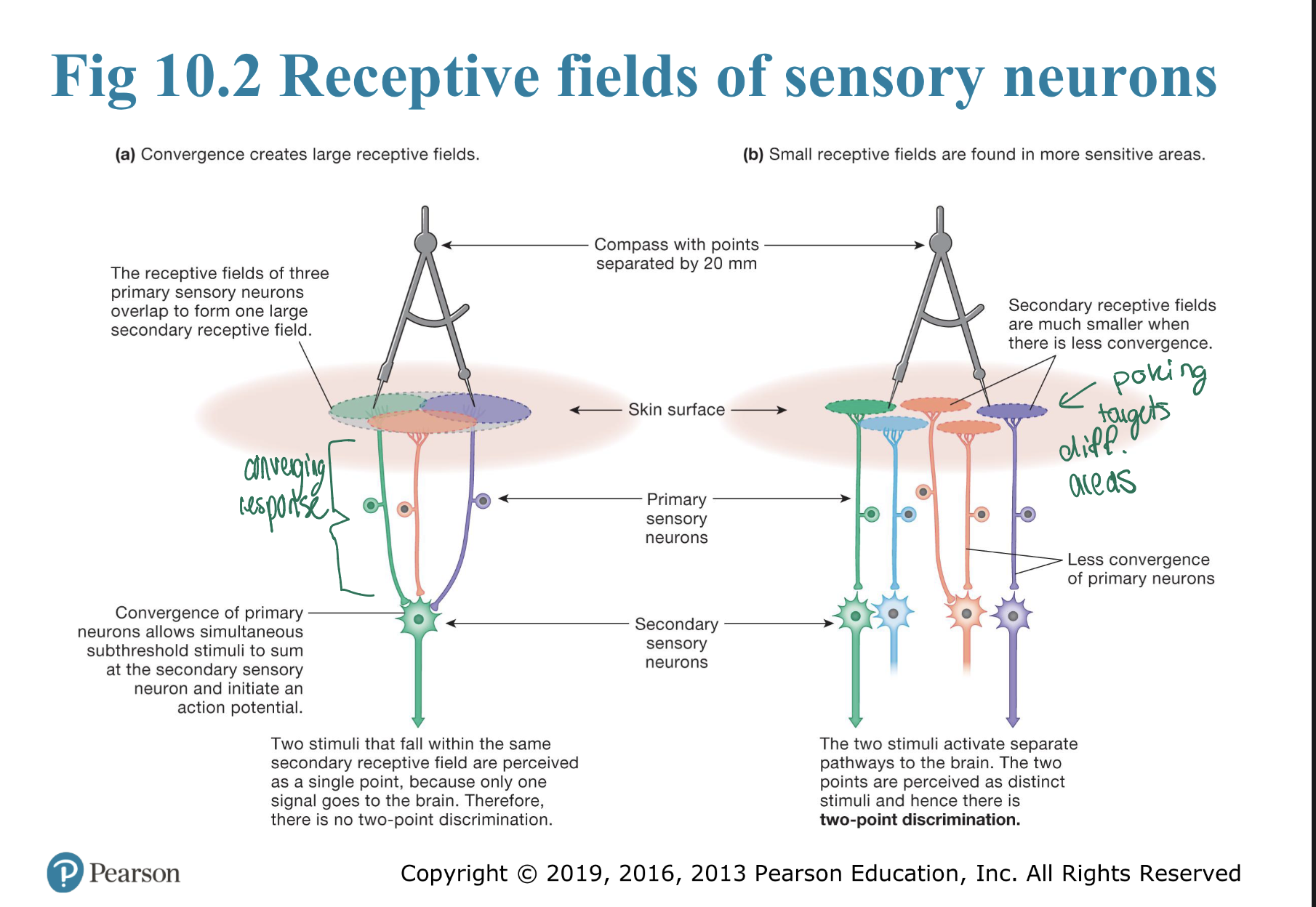
Receptive Field: The physical boundary area where a stimulus can prompt a specific neuron to fire they may overlap, abd neighboring fiels may converge— Analogy: The specific square footage monitored by a single security camera.
Convergence: Multiple primary neurons grouping onto one secondary neuron, trading away point-accuracy for high sensitivity — Analogy: Three local streams flowing into one single large river.
Two-Point Discrimination Test: A mechanical skin assessment mapping receptive field density and tactile acuity — Example: Feeling two paperclip points easily on your sensitive fingertip, but only feeling one point on your upper back.
– Sensitive areas have smaller receptive fields
– Less sensitive areas have larger receptive fields
Fields & Neural Coding: what is inhibitory modulation, habitualization, labeled line-coding
Inhibitory Modulation: Central nervous system damping to filter out background sensations — Analogy: Noise-canceling headphones blocking out the steady roar of an airplane engine.
Habitualization: Non-associative learning that decreases attention toward constant, harmless sensory loops — Example: getting used to train at 9pm near your house
Labeled Line Coding: Discerning the type of sense based entirely on the unique wire track it travels up to the cortex — Analogy: Plugging an HDMI cable into a TV; the TV automatically knows to display video because of the specific socket used.
Fields & Neural Coding: what is phasic receptors and tonic receptors, which adapt faster to stimulus?
Phasic Receptors: Fast-adapting trackers firing only at the start/end of a stimulus change (e.g., texture, feeling clothes) — Analogy: A motion-sensor light that turns on when you enter but goes dark if you stay perfectly still.
Tonic Receptors: Slow-adapting trackers firing continuously throughout a constant stimulus (e.g., posture, ongoing pain) — Analogy: A smoke detector that keeps blaring non-stop as long as there is smoke in the room.
A home smoke detector that sounds continuously while smoke is present (tonic) vs. a motion sensor that beams a quick flash only when someone passes the door (phasic).

how does CNS inetrgrate sensory information? what is simplified path?
– Spinal cord to brain by ascending pathways
– Directly to brain stem via cranial nerves
Neural Pathways & Cortex: what are primary sensory neurons, dorsal root ganglia , tertiary sensory neurons, somatosensory cortex and who discovered it
Primary Sensory Neurons: First-order peripheral pathways carrying raw signals directly into the CNS — Analogy: The local postal carrier picking up a letter directly from your house.
Dorsal Root Ganglia:Nodules along the dorsal roots (just outside grey matter) of spinal nerves that house the cell bodies of unipolar primary sensory neurons.— Analogy: A regional post office sorting building sitting right outside the main city limits.
Secondary Sensory Neurons: Second-order cells in the spinal cord/medulla that cross the midline and push signals to the thalamus — Analogy: The cross-country shipping truck crossing state lines to deliver mail to a major sorting center.
Tertiary Sensory Neurons: Third-order cells acting as the final bridge from the thalamus to the cortex — Analogy: The final courier bringing the package from the local hub directly to the CEO's desk.
Somatosensory Cortex: The termination region in the parietal lobe (postcentral gyrus) where somatic sensations are mapped into conscious awareness. — Analogy: A highly organized wall map where a pin lights up corresponding exactly to where a package was dropped off on earth.

the thalamus gets all sensory info except…
SMELL!!!

whate are pacinian corpuscles, merkel receptors, meissners corpuscles, ruffini corpuscles
Pacinian Corpuscles: Deep dermis, fast-adapting phasic mechanoreceptors sensing high-frequency vibrations in deep layers of the skin, muscle, joints, organs— Example: Feeling the rumbling bass of a heavy subwoofer speaker through the floorboards.
Merkel Receptors: Superficial epidermis, slow-adapting tonic mechanoreceptors sensing steady texture and edges — Example: Running your fingertip across Braille text to distinguish raised bumps.
Meissner’s Corpuscles: Superficial dermis, fast-adapting phasic mechanoreceptors sensing light touch and flutter — Example: Sensing a tiny ant crawling delicately across the back of your wrist.
Ruffini Corpuscles: Deep dermis, slow-adapting tonic mechanoreceptors parsing skin stretch and joint tension — Example: Feeling your skin pull tight when you wrap your hand firmly around a baseball bat.
what are: Nociceptors, Aδ (A-delta) Fibers, C fibres?
Nociceptors: Free nerve endings specialized in alerting the brain to tissue damage or severe distress , Respond to strong noxious stimulus that may damage tissue
– Found in the skin, joints, muscles, bones, and viscera
– Not found in CNS
— Example: The sudden, burning shock felt when accidentally touching a hot curling iron.
Aδ (A-delta) Fibers: Small, myelinated, rapid tracks delivering quick, sharp, localized "fast pain" — Analogy: A high-speed fiber-optic internet cable sending an emergency alert.
– Fast pain, Sharp and localized
C Fibers: Small, unmyelinated, sluggish tracks crawling diffuse, aching, systemic "slow pain" — Analogy: Dial-up internet slowly loading a large, lingering webpage.
- Slow pain
▪ Duller and more diffuse
what is withdrawal reflex, gate-control theory?
Withdrawal Reflex: A polysynaptic spinal pathway snatching a limb from danger without waiting for the brain's input — Example: Jerking your bare foot off a sharp rock before you consciously realize it hurts.
Gate Control Theory: Spinal cord interneurons blocking nociception input when overwhelmed by overlapping mechanoreceptor signals — Example: Vigorously rubbing your shin after banging it against a coffee table to dull the throbbing pain.
stimulus properties: what differntiates sensory modality, location of stimulus, intensity of stimulus, duration of stimulus?
what is lateral inhibition?
important for perception

dorsal column system vs spinothalamic tract vs pyramidal/sensory decussation, when do they differ in crossing over!!
Dorsal Column System: An ascending pathway carrying fine touch, vibration, and proprioception that ascends the spinal cord on the same side before crossing over in the medulla — Example: Feeling the precise texture of a smooth silk fabric vs. a rough piece of wood.
Spinothalamic Tract: An ascending pathway carrying pain and temperature that crosses over immediately within the spinal cord before climbing to the brain — Example: Pulling your foot back instantly when stepping onto a scalding hot pavement surface.
Pyramidal/Sensory Decussation: The exact physical crossing point where sensory pathways switch sides, ensuring the left brain perceives the right side of the body — Analogy: A highway crossover lane that diverts all incoming traffic to the opposite side of the median.

spinoreticular vs spinomesencphalic vs spinohypothalamic
Spinoreticular Tract: alertness, A pain pathway branching off into the reticular formation to control arousal and behavioral awareness — Analogy: A building's fire alarm line that flashes the emergency lights to wake everyone up.
Spinomesencephalic Tract: A pain pathway routing to the midbrain to participate in reflexive eye tracking and endogenous pain control — Example: Automatically turning your head and eyes down toward your foot the split-second you stub your toe.
Spinohypothalamic Tract: A pain pathway routing to the hypothalamus to activate visceral and emotional stress defenses — Example: Experiencing a sudden spike in heart rate and breaking out into cold sweat after slamming your finger in a door.
what are TRP channels,
Thermoreceptors use cation channels called transient receptor
potential (TRP) channels
what causes itch?
– From skin nociceptors
– Histamine (and other substances) activate C fibers,
causing itch
what is nociceptors pathways? chronic vs referred pain
Local chemicals mediate inflammatory response at site of injury
–
+ K , histamine, prostaglandins, serotonin, substance P
– Inflammatory pain – increased sensitivity to pain at sites of injury
• Reflexive protective responses integrate at the level of the spinal cord
• Ascending pathways to cortex become conscious sensation
• Withdrawal reflex – protective reflexive response to pain
• Referred pain – poorly localized pain perceptions from visceral and somatic
pain pathways converging on a single ascending tract
• Chronic pain – pathological (neuropathic) pain reflects damage to or long-
term changes to nervous system
