Nervous System Anatomy & Structures w/ Matching & Labelling (RAD 1101)
 Call Kai
 Learn
 Practice Test
 Spaced Repetition
 Match
 Flashcards
 Knowt Play
1/188

There's no tags or description
Looks like no tags are added yet.
189 Terms
Organization of the Nervous System

The central nervous system (CNS) contains the:
1. brain
2. spinal cord
The peripheral nervous system (PNS) contains the:
1. nerves and ganglia
What are the functions of the nervous system?
communication, body control, and conscious activity
What is the primary function of the nervous system?
communication
CENTRAL NERVOUS SYSTEM
brain and spinal cord
CNS: THE BRAIN
1. forebrain
1a. cerebrum
1b. dicephalon
2. midbrain
3. hindbrain
3a. pons
3b. cerebellum
3c. medulla oblangata

CNS - FOREBRAIN: CEREBRUM

The cerebrum is the ________ part of the brain
largest
The cerebrum is 2 hemispheres (right and left cerebral) joined by a thick fibrous band that provides communication between each hemisphere known as the:
corpus callosum

The outer (cortex) part of the cerebrum that contains dendrites and cell bodies of nerve cells is:
gray matter

The inner part of the cerebrum that contains the axons of nerve cells is:
white matter

Folds on the outer surface of the brain is known as:
convolutions (or gyri)

Shallow grooves between convolutions is known as:
sulci

What does the sulci (or sulcus) do?
separate the cerebrum into lobes
Deep grooves that divide the brain into lobes and also into two hemispheres is known as:
fissures

Lobes of Cerebrum

This lobe of the cerebrum is the motor area which controls voluntary movements, thought, and speech:
frontal lobe

What is the speed of thought or thought process?
70 to 120 meters per second (mps)
This lobe of the cerebrum is the sensory area which controls touch, taste, heat and cold, judgment of distance, size and shape:
parietal lobe

This lobe of the cerebrum is the center for hearing and smell:
temporal lobe

This lobe of the cerebrum is the center for vision:
occipital lobe

This lobe of the cerebrum is the central lobe for taste and lies deep within the hemispheres:
insula lobe

Fissures and Sulci

A deep groove that divides the cerebrum into right and left hemispheres is the:
longitudinal fissure

A deep groove that separates the cerebrum (occipital lobe) from the cerebellum below is the:
transverse fissure

A shallow groove that separates the frontal and parietal lobes is the:
central sulcus

A shallow groove that separates the frontal and parietal lobes from the temporal lobe is the:
lateral sulcus

CNS - FOREBRAIN: DIENCEPHALON

The diencephalon is located between what?
between the cerebrum and midbrain
What are the two parts of the diencephalon?
1. thalamus
2. hypothalamus
Part of the diencephalon in the forebrain that relays sensory nerve impulses from spinal cord towards the brain is the:
thalamus
Part of the diencephalon in the forebrain that regulates secretions of the pituitary gland, body temperature, thirst, appetite, water balance, metabolism and sleep is the:
hypothalamus
The diencephalon is the ______ part of the brain
center
CNS - MIDBRAIN
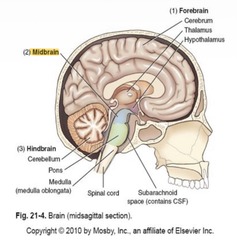
The midbrain is located between what?
between the forebrain and pons

The midbrain transmits impulses and messages by neurons due to:
nerve fiber tracts
What are the two parts of the midbrain?
1. cerebral peduncles
2. quadrigeminal bodies

The part of the midbrain that transports nerve impulses is the:
cerebral peduncles

The part of the midbrain that is the reflex centers involving vision and hearing (relay system/station) is the:
quadrigeminal bodies

The midbrain is the ________ of the spinal cord
beginning
CNS - HINDBRAIN

What are the three parts of the hindbrain?
1. pons
2. cerebellum
3. medulla oblangata

The pons is located where?
below midbrain

The round structure in the hindbrain that conducts nerve impulses is the:
pons

The cerebellum is located where?
the two small lobes joined at midline posterior to the pons

The part of the hindbrain that acts as the coordinator of voluntary muscular movements that is concerned with balance, posture, and equilibrium is the:
cerebellum

The medulla oblangata is located where?
between the pons and spinal cord

The part of the hindbrain that contains vital reflex centers that controls respiration, circulation, blood pressure, swallowing, peristalsis, digestive secretions, and vomitting (involuntary movements) is the:
medulla oblangata

CNS - MENINGES

What are the meninges?
protective coverings of the brain and spinal cord
What are the 3 layers of the meninges?
1. dura mater
2. arachnoid
3. pia mater

The meninge layer that is the tough outer layer under the bone is the:
dura mater

The meninge layer that is the weblike middle layer is the:
arachnoid

The meninge layer that is the delicate inner layer which is the actual covering of the brain itself is the:
pia mater

The cerebrospinal fluid filled space between arachnoid and pia mater is the:
subarachnoid space

The fold or extension of dura mater that makes a crescent shape is the:
falx cerebri
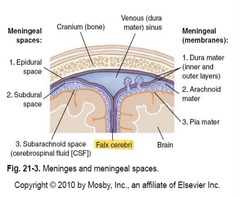
The _____ _____ dips into the longitudinal fissure between cerebral hemispheres which separates the hemispheres
falx cerebri
An extension of the dura mater that separates the cerebellum and the inferior portion of the occipital lobes is the:
tentorium cerebelli

The tentorium cerebelli is:
transverse
CNS - VENTRICLES
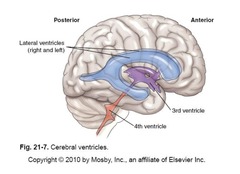
The fluid filled spaces within the brain where cerebrospinal fluid originates are the:
ventricles
How many ventricles are there?
4
What are the 4 ventricles?
1. lateral ventricles (2)
2. 3rd ventricle
3. 4th ventricle
How many lateral ventricles are there? What are they?
2; right and left

The lateral ventricles contain 3 what?
horns
What are the 3 horns of the lateral ventricles?
anterior, posterior, and inferior horns

Ventricular Openings

The openings between the lateral and 3rd ventricles are known as the:
foramina of Monro (or interventricular foramina)

The opening between the 3rd and 4th ventricle is the:
aqueduct of Sylvius (or cerebral aqueduct)

The opening between the 4th ventricle and subarachnoid space is the:
foramen of Magendie
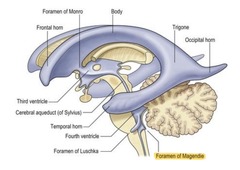
Where is the foramen of Magendie located?
at midline of the roof
The 2 openings between the 4th ventricle and subarachnoid space are the:
foramina of Luschka

What does the foramina of Luschka do?
drain fluid into the cisterna magna

CNS - CEREBROSPINAL FLUID (CSF)

The clear, colorless fluid that is similar to lymph is the:
cerebrospinal fluid (CSF)
Where is cerebrospinal fluid (CSF) formed?
in choroid plexuses of the ventricles

What are the functions of the cerebrospinal fluid (CSF)?
1. protective cushion for the brain and spinal cord
2. carries nourishment from blood to the brain and spinal cord
3. removes cellular wastes from the brain and spinal cord
The circulation of CSF is as follows:
1. ventricles of the brain
2. subarachnoid space around the brain and spinal cord
3. central canal of the spinal cord
CNS - SPINAL CORD

Where does the spinal cord lie?
lies within spinal canal formed by vertebral foramen
How far does the spinal cord extend to?
extends from the foramen magnum at the base of the skull to L-2
The spinal cord is the continuation of what structure in the brain?
the medulla oblangata
The spinal cord is the _______ center and is a _________ pathway
reflex center and conduction pathway

What does the spinal cord carry?
carries motor and sensory tracts to and from the brain

The nerves in the spinal cord below level of L-2 is known as:
cauda equina

CNS - NERVE ROOTS

The anterior (or ventral) nerve roots are the:
motor nerve roots

The nerve roots that carry nerve impulses away from the brain to the spinal cord toward muscles and more are the:
motor nerve roots
The posterior (or dorsal) nerve roots are the:
sensory nerve roots
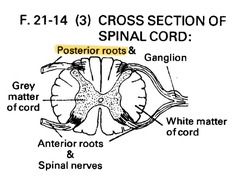
The nerve roots that carry nerve impulses toward the spinal cord to the brain are the:
sensory nerve roots
PERIPHERAL NERVOUS SYSTEM
cranial and spinal nerves
PNS - CRANIAL NERVES
How many pairs of cranial nerves are there?
12 pairs
The order of the cranial nerves is as follows:
1. olfactory*
2. optic*
3. oculomotor
4. trochlear
5. trigeminal
6. abducent
7. facial
8. auditory*
9. glossopharyngeal
10. vagus*
11. accessory
12. hypoglossal
The cranial nerves extend from the brain and serve what?
serve the head, neck, and part of the thorax
What is the 1st cranial nerve?
olfactory nerve
The 1st cranial nerve is the olfactory nerve. What is its function?
smell
What is the 2nd cranial nerve?
optic nerve
The 2nd cranial nerve is the optic nerve. What is its function?
vision