BIO 308 ~ Exam 1
 Call Kai
 Learn
Learn Practice Test
 Spaced Repetition
 Match
Match Flashcards
 Knowt Play
1/75

There's no tags or description
Looks like no tags are added yet.
Name | Mastery | Learn | Test | Matching | Spaced | Call with Kai | Chat |
|---|
No analytics yet
Send a link to your students to track their progress
76 Terms
What is water potential?
the propensity or potential for water to move from one location to another
influenced by various internal variables, including matrix potential, pressure potential, solute potential, etc..
always negative because of the other solutes that exist within a cell’s cytoplasm
moves from higher water potential to lower potential (less negative to more negative)

Solute potential
the amount by which the presence of a solute in pure water reduces the water potential
Pressure potential
water potential increases when a pressure greater than atmospheric pressure is exerted on the solution
Osmosis
the movement of water across a selectively permeable membrane from an area of high water potential (low solute concentration) to an area of lower water potential (higher solute concentration) → more positive to more negative
hypertonic: water leaves the cell
hypotonic: water enters
isotonic: equal
Turgor pressure
the pressure of water pushing the cell membrane against the cell wall
increase in pressure = plant cells firm and support the plant
decrease in pressure = plants wilt (not firm)
Water movement: Soil-Plant-Atmosphere Continuum (SPAC)
the continuous movement of water from the soil, through the plant, and into the atmosphere
the plant is the pathway that carries water upward
1.) Soil → roots
water starts in the soil
water moves into the roots because of differences in water potential (high → low)
happens through osmosis
2.) Roots → xylem
once water enters the roots, it eventually reaches the xyem
xylem = specialized plant tissue that transports water and dissolved minerals (nutrients) from the roots upward through the plant (water pipes)
carries water from the roots → stem → leaves
3.) Xylem → leaves
water continues moving upward through the xylem toward the leaves
major reason why this happens: transpiration
transpiration = the loss of water vapor from a plant, mainly through the stomata
when water evaporates from the leaves, it creates a pull that helps draw more water upward through the xylem
Xylem
plant tissue that transports water and minerals from the roots upward to the leaves
system of tiny pipes running through the plant
soil → roots → xylem → stem → leaves → atmosphere
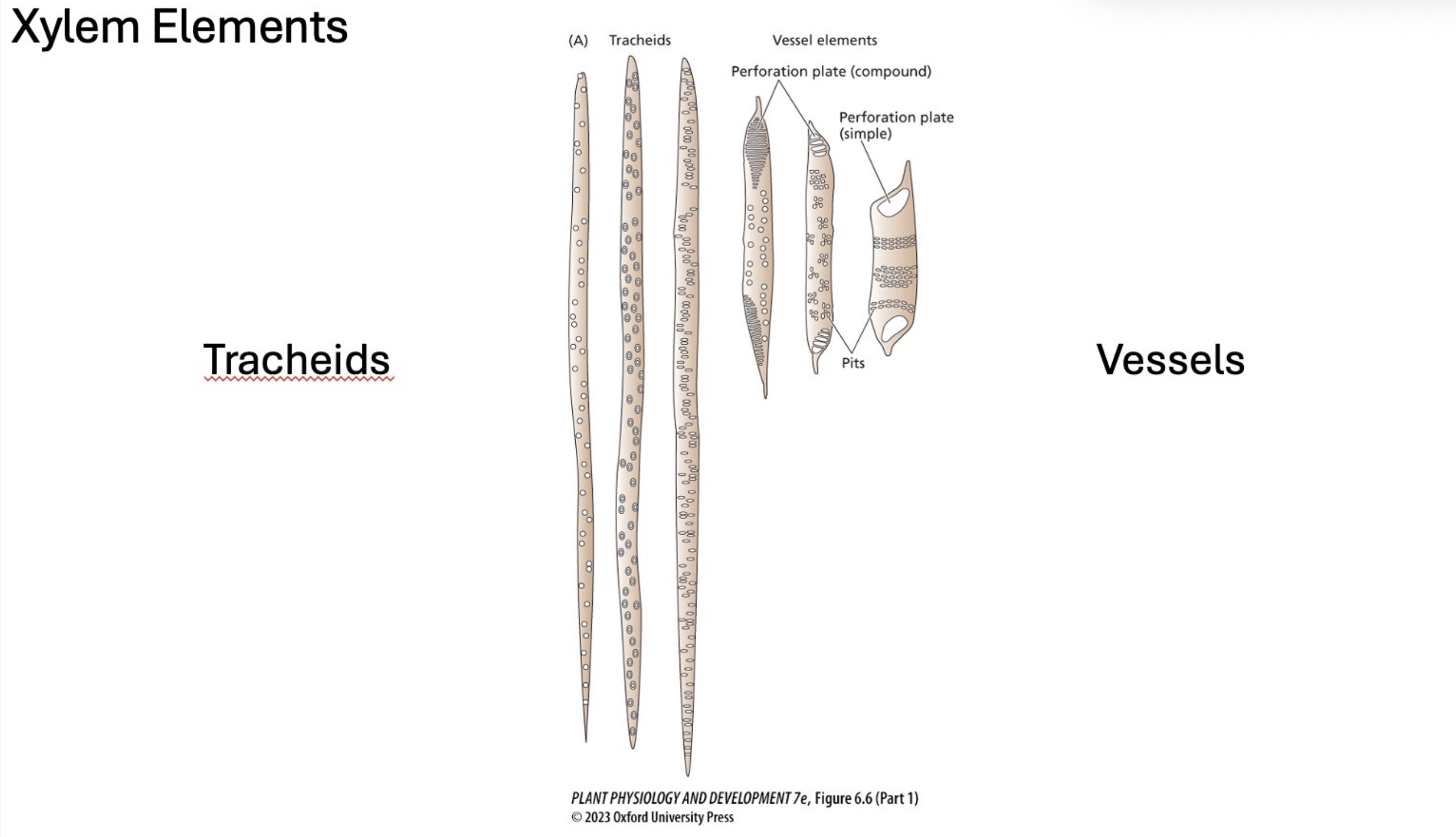
Main water-conducting cells: tracheids
long, narrow cells that transport water through small openings in their walls
Main water-conducting cells: vessel elements
wider cells that connect end-to-end to form larger tubes called vessels
How does water move through the xylem? - water potential
water moves through xylem because there’s a water potential gradient
high water potential → low water potential
How does water move through the xylem? - transpiration
(1) water evaporates from the leaves, (2) creating tension (negative pressure) in the xylem, (3) because water molecules stick together (cohesion) water gets pulled upward, (4) water is pulled from the roots and eventually from the soil
water evaporates from leaf → pulls water upward → xylem brings more water from the roots
What is cavitation?
happens when the tension in the xylem becomes so strong that water changes from a continuous liquid column and a gas bubble forms
this can happen when the plant becomes very dehydrated
water forming inside a water pipe
What is embolism?
the gas-filled blockage in the xylem that results from cavitation
cavitation = gas bubble forming
embolism = gas bubble blockage, prevents normal water transport
What is embolism resistance?
the plant’s ability to prevent or tolerate/block the spread of gas bubbles in its xylem
some plants have xylem structures that make them more resistant to embolism → smaller/narrower conduits (water pipes)
drought → stronger tension in xylem → cavitation → gas bubble → embolism → reduced water transport
Aquaporin
tiny water channels in a cell membrane
outside cell → aquaporin → inside cell
allows water to cross the membrane much faster than water could through the membrane by itself
Aquaporin selectivity
the aquaporin chooses what can pass through
mainly selective for water molecules
H2O is a yes; ions, large molecules, charged particles are a NO
extremely narrow, specific chemical properties that help water pass while excluding ions (positively charged regions of the protein channel)
plant can move water across cell membranes without allowing other ions to freely cross at the same time
Aquaporin gating
can open/close → drought, water availability, pH, and other cellular signals
Aquaporin gating: PIP (Plasma Membrane Intrinsic Proteins)
PIP - Plasma Membrane Intrinsic Proteins: located in the plasma membrane (surrounds the cell)
outside cell → plasma membrane (PIP) → inside cell
one cell to another, soil/root area into root cells, through different tissues of the plant
Aquaporin gating: TIP (Tonoplast Intrinsic Proteins)
TIP - Tonoplast Intrinsic Proteins: membrane that surrounds the vacuole, moves water between the cytoplasm and the vacuole
vacuole: large compartment that can store water and other substances
contributes to turgor pressure
Soil texture
the relative amounts of sand, silt, and clay in the soil
Soil texture - Sand
largest particles, large spaces between particles, water drains quickly
Soil texture - Silt
medium sized particles, holds more water than sand, moderate drainage
Soil texture - Clay
smallest particles, very tiny spaces between particles, holds water tightly
Soil water availability
how much of the water in soil is actually accessible to plants
not all water in soil can be used by a plant, some water is held too tightly by soil particles for roots to pull it away
Sand vs. clay
sand = water drains easily (less water remains)
clay = lots of water remains (some held too right for plants to extract)
loam (sand, silt, and clay) = good balance between water retention and availability
Water-holding capacity
the amount of water soil can retain after excess water drains away
sandy soil → water drains quickly = low water-holding capacity
clay soil → water is retained = high water-holding capacity
DOES NOT automatically mean high water availability
soil texture = determines how much water soil can hold, this affects how much water is available to plants
How can water transport?
3 different paths for water to take from the soil into the xylem
How can water transport? ~ Apoplastic pathway (around the cells)
water moves through the cell walls and the spaces between cells
does not cross cell membrane
fast pathway because it can move through continuous cell-wall spaces
the casparian strip eventually blocks this pathway at the endodermis, forcing water to cross a cell membrane
soil → cell wall → cell wall → xylem
How can water transport? ~ Symplastic pathway
water enters a cell and then moves through the cytoplasm of neighboring cells
cells are connected by tiny channels called plasmodesmata
water crosses a cell membrane when it first enters the symplast
can move cel to cell through the plasmodesmata
soil → cell → cell → cell → xylem
How can water transport? ~ Across membranes
water repeatedly moves across cell membranes as it travels through the root
cell → membrane → cell → membrane → cell
aquaporins can help water cross these membranes
this pathway gives the plant more control over water movement
Casparian strip
waterproof barrier in the endodermis of the root
its job is to force water and dissolved substances to cross a cell membrane before entering the xylem
Why → otherwise water could simply travel through cell wall straight into the xylem without being regulated
soil → root → endodermis → xylem
controls what enters the xylem
YOU CAN’T JUST GO AROUND, YOU HAVE TO PASS THROUGH A CELL MEMBRANE
Roots
how water gets from the soil into the xylem
Root anatomy - epidermis
outer layer of the root, directly contacts the soil, water enters the root here
outside → inside
soil → epidermis → cortex → endodermis → pericycle → xylem
Root anatomy - Cortex
located between the epidermis and endodermis, water travels through the cortex toward the center of the root
Root anatomy - endodermis
a layer of cells surrounding the vascular tissue, contains the casparian strip, acts as the checkpoint controlling what enters the xylem
Root anatomy - xylem
located toward the center of the root, transports water upward through the plant
Casparian strip
a waterproof barrier located in the cell walls of endodermal cells
blocks the apoplastic pathway
makes sure that water move through the membrane, regulates what enters the xylem
soil → cell walls → casparian strip → xylem
Suberin
water-resistant substance found in plant cell walls
the casparian strip contains a lot of suberin
hydrophobic, makes the cell wall less permeable to water and other substances
can also be deposited in other root tissues and can make roots less permeable to water
Hydraulic conductivity
hydraulic conductivity (k) = how easily water can move through a tissue or structure
the water permiability of the root
high hydraulic conductivity = water moves easily
low hydraulic conductivity = water movement is restricted
depends on things such as: aquaporins, cell membranes, cell-wall properties, suberin, root anatomy
soil → epidermis (water enters) → cortex (water moves inward) → endodermis (casparian strip and suberin) → water crosses membrane → xylem (water moves upward)
Stomata
tiny pores on the surface of leaves that control gas exchange
stoma = the pore/opening
guard cells = two specialized cells surrounding the pore
when they swell: stoma opens
when they lose water: stoma closes
allow CO2 in → photosynthesis
O2 out, water vapor out (transpiration)
How do stomata open/close? - OPEN
turgor pressure in the guard cells is key
when open:
guard cells take up K+ and other solutes
this makes water potential more negative
water enters guard cells through osmosis
guard cells become more turgid
their shape changes because of the special arrangement of their cell walls
the pore opens
solutes increase → water enters → guard cells swell → pore opens
How do stomata open/close? - CLOSE
K+ and other solutes leave guard cells
water potential becomes less negative
water leaves guard cells
guard cells lose turgor
the pore closes
solutes decrease → water leaves → guard cells lose turgor → pore closes
ABA-mediated guard-cell signaling
ABA = abscisic acid
ABA is a plant hormone that helps plants respond to drought/water stress when a plant experiences water stress: drought → ABA increase → guard cells lose ions/water → stomata close
ABA-mediated guard-cell signaling - PATHWAY
drought → ABA increases
water = limited
ABA binds to receptors in guard cells
ABA activates signaling pathway inside the guard cell
ion channels are activated
ABA causes anion channels to open, allowing negatively charged ions to leave
promotes K+ leaving guard cells
water leaves
with fewer solutes inside, the guard cells’ water potential becomes less negative → water moves out by osmosis
guard cells lose turgor
stoma closes
ABA = avoid beign arid
WE’RE LOSING WATER CLOSE THE FING STOMATA
What are plant drought strategies?
all plants have different strategies for dealing with drought or periods of limited water
major difference: how a plant manages its leaf water status during drought
1.) isohydric: tries to keep leaf water potential stable ~ protect water status
2.) anisohydric: allows lead water potential to decrease more during drought → keep using water even as water status drops
What are plant drought strategies? - Isohydric
close their stomata relatively early as soil dries
soil becomes drier
plant detects water stress
ABA increases
stomata close
transpiration decreases
leaf water leaves the plant
leaf water potential stays relatively stable
drought → stomata close → less water loss → protect lead water status
advantage: decreases risk of xylem cavitation and embolism (not too dehydrated)
disadvantage: less CO2 enters leaf (less photosynthesis)
What are plant drought strategies? - Anisohydric behavior
allow their leaf water potential to decrease more during drought (keep their stomata open longer)
soil becomes drier
plant continues allowing some stomatal opening
transpiration continues
leaf water potential becomes more negative
photosynthesis can continue for longer
advantage: can continue taking in CO2 and carrying out photosynthesis during drought
disadvantage: lower water potential = risk of xylem cavitation and embolism
What are leaf functional traits?
measurable characteristics of leaves that affect how they capture resources, grow, survive, and use water and nutrients
leaf area → size of the leaf
leaf mass per area (LMA) → how much dry mass a leaf has for its area
leaf nitrogen content → related to photosynthetic machinery
leaf lifespan → how long the leaf stays on the planet
photosynthetic rate → how quickly the leaf fixes CO2
leaf thickness → can affect durability and resource use
Leaf Economics Spectrum (LES)
describes the general pattern where leaf traits fall along a spectrum from “fast” leaves → “slow” leaves
Fast return leaves
leaves are built to capture resources and photosynthesize quickly
tend to have:
low LMA
high photosynthetic rates
high nitrogen content
shorter leaf lifespan
relatively low investment in tough leaf tissues
grow fast → photosynthesize fast → replace the lead quickly
grow fast → photosynthesize fast → replace the leaf quickly
common when resources like light, water, and nutrients are relatively available
Slow-return leaves
these leaves are built for durability and long-term survival
they tend to have:
high LMA
lower photosynthetic rates
lower nitrogen concentration
longer leaf lifespan
more investment in tough structural tissues
invest more → make a durable leaf → keep it for a long time
these leaves can be useful when resources are limited because the plant gets a longer return on its investment in the lead
Photosynthetic elements
the structures and substances in a plant that allow it to capture light energy and use it to make sugars through photosynthesis
chloroplasts → where photosynthesis occurs
chlorophyll → pigment that absorbs light energy
thylakoid membranes → where the light-dependent reactions occur
photosystems → protein complexes that capture light
stomata → allow CO2 to enter the leaf
CO2 → carbon source used to make sugar
water H2O → provides electrons for the light reactions
Where does photosynthesis happen?
mainly occurs in the mesophyll cells of leaves
inside these cells are chloroplasts:
thylakoids
grana = stacks of thylakoids
thylakoid membrane contains the proteins and pigments needed for the light-dependent reactions
Chlorophyll
green pigment that captures light energy
absorbs mainly red and blue light
chlorophyll A and B + carotenoids
Stomata and CO2
stomata regulate gas exchange
CO2 → enters through stomata → reaches photosynthetic cells
needed for sugars during the calvin cycle
Light-dependent reactions - thylakoid membrane (mesophyll)
light + H2O → ATP + NADPH + O2
- light = converted into chemical energy
Calvin cycle - inside the chloroplast (outside grana → stroma of chloroplast)
CO2 + ATP + NADPH → sugars (glucose or starch)
light → energy → CO2 → sugars
What is carbon fixation?
taking CO2 from the atmosphere and turning it into an organic carbon compound that the plant can use to build sugars and other molecules
CO2 (inorganic carbon) → organic carbon
happens during the calvin cycle in the stroma of the chloroplast
Rubisco - ribulose-1, 5-biphosphate carboxylase/oxygenase
the main enzyme responsible for carbon fixation in C3 plants
attaches CO2 to a 5-carbon molecule called RuBP
CO2 + RuBP → unstable 6-carbon compound → 2 molecules of 3-PGA
grabs CO2 and starts the calvin cycle (in moderate conditions)
can accidentally bind O2 instead of CO2 (photorespiratation)
especially common when temps are high, drought, closed stomata, CO2 inside leaf decreases, O2 becomes more abundant
drought → stomata close → CO2 decreases → O2 to CO2 ratio increases → rubisco binds to O2
PEP carboxylase
another enzyme that fixes CO2 (hot and dry conditions, high light)
key for C4 plants
does not bind to O2
attaches CO2 to a 3-carbon molecule called PEP, producing a 4-carbon compound
helps C4 plants concentrate CO2 around Rubisco, reducing photorespiration
C3, C4, and CAM photosynthesis
all of these plants perform photosynthesis and use CO2 to make sugars
light energy, water, CO2, chloroplasts, light-dependent reactions, calvin cycle, Rubisco can run the calvin cycle
main difference is how and when they capture CO2, especially under hot and dry conditions
C3 Photosynthesis
the most common pathway
CO2 enters through stomata → Rubisco directly fixes CO2 → calvin cycle
the first stable has 3 carbons, which is why it is C3
advantage: simple and efficient when water and temperatures are moderate, does not require extra CO2
trade-off: C3 plants are more vulnerable to photorespiration, especially when it’s hot and dry
when stomata close to conserve water: when CO2 decreases → rubisco more likely to bind to O2 → respiration increases
C4 Photosynthesis
C4 plants have an extra step that concentrates CO2 around Rubisco
PEP carboxylase first fixes CO2 → forms a 4-carbon compound → CO2 is released near Rubisco → calvin cycle
this helps keep Rubisco surrounded by CO2
advantages: less photorespiration, better performance in hot/sunny environments, can keep stomata more closed and still capture CO2 effectively, high water use efficiency than C3 plants
trade-off: C4 phtosynthesis requires extra energy to concentrate CO2
plant spends more ATP to get this advantage
CAM Photosynthesis
CAM plants are especially adapted to very dry environments
major difference is when CO2 is captured
night: temperatures are cooler and the air is more humid
stomata open → CO2 enters → PEP carboxylase fixes CO2 → 4-carbon acids are stored
day: stomata close to reduce water loss
the stored 4-carbon compounds release CO2 → CO2 is given to Rubisco → calvin cycle continues
advantage: extremely good water conservation
trade-off: CAM plants generally have slower growth and productivity because CO2 uptake is limited, carbon must be stored and processed over time
Overview on photosynthesis
C3 → less energy, more photorespiration
C4 → more energy, less photorespiration and better water efficiency
CAM → very low transpiration, generally slower carbon gain and growth
CO2 come from: atmosphere → stomata → inside the lead → photosynthetic cells
What is water-use efficiency (WUE)?
describes how much carbon a plant gains through photosynthesis compared with how much water it loses
how much photosynthesis a plant gets for the amount of water it loses
higher WUE = more carbon gained per amount of water loss
especially important in dry environments where water is limited
How do plants lose water?
most water loss happens through stomata during transpiration
stomata open → CO2 enters, water vapor can leave
open stomata = more CO2, more photosynthesis, more water loss
closed stomata = less CO2, less photosynthesis, less water loss
How do plants adapt to dry environments? - stomatal control
plants close their stomata when water is scarce
drought → ABA increases → stomata close → water loss decreases
protects plant from dehydration
How do plants adapt to dry environments? - CAM photosynthesis
CAM plants open their stomata at night instead of during the day time (hot)
night → stomata open → CO2 enters
day → stomata close → stored CO2 is used
night = cooler and less dry, reduces water loss
How do plants adapt to dry environments? - C4 photosynthesis
C4 plants concentrate CO2 around rubisco, allowing them to maintain carbon fixation while keeping stomata more closed than C3 plants
higher WUE than C3 plants, especially in hot and sunny environments
How do plants adapt to dry environments? - smaller leaves
smaller leaves generally have less surface area exposed to the atmosphere, which can reduce water loss
thick leaves, waxy cuticles, leaf hairs, rolled leaved (can reduced exposure to dry air)
How do plants adapt to dry environments? - thick/waxy cuticle
the cuticle is a waxy layer covering the outside of leaves
a thicker waxy cuticle helps reduce water loss directly through the leaf surface
cuticle = waterproof coating
How do plants adapt to dry environments? - deep or extensive roots
some plants develop roots to reach further underground
others develop extensive shallow roots to quickly capture water after rainfall
depends on their environment
plants can use these strategies to reduce water loss and improve water intake