Crime - Lecture 5
 Call Kai
 Learn
 Practice Test
 Spaced Repetition
 Match
 Flashcards
 Knowt Play
1/80

Earn XP
Description and Tags
Brain Functioning
81 Terms
randy craft - the freeway killer
brought up by respectable, hardworking middle-class parents
uneventful home life
smart school kid (high school and college)
eventually gained a BA in Economics
between 1971 and 1983, thought to have raped, tortured, mutilated and murdered 67 male teenagers and young men
scorecard serial killer - kept detailed notes of his victims
Antonio bustamante
poor family
started using drugs and became addicted to heronin
from age 22, escalation in criminal career, became impulsive, got argumentative and got into fights
arrested 29 times for a variety of crimes - was in and out of prison for a decade
in 1986, he brutually beat a 80-year-old man to death during a sloppy, impulsive robbery - left his fingerprints everywhere
atypical onset of criminal career; very late onset
head injury from a crowbar at age 20
radical change in personality → increasingly impulsive and emotionally labile
Antonio bustamante & randy craft - PET scan
neuroimaging is being increasingly used to prove diminished responsibility in the criminal justice system
lesion in the vmPFC can cause radical changes in personality
control vs. bustamante
less activity in orbitofrontal cortex
three brain scans:
brain activity between randy craft and control is similar
needed cognitive abilities as his crimes involved a lot of planning (e.g. theory of mind)
can we establish a causal link between brain and behaviour?
correlational not causal evidence

raine et al. - first neuroimaging study on murderers - method
22 murderers vs 22 age- and sex-matched controls
murderers pleading not guilty by reason of insanity (NGRI)
positron emission tomography (PET) brain scan
32-min continuous performance task (no group difference)
raine et al. - first neuroimaging study on murderers - results
sustained attention involves the PFC
murderers had reduced activity in the PFC compared to controls
reduction in brain activity was very specific
limited to the PFC
differences could not be explained by differences in ethnicity, schizophrenia, mental illness, or head injury
PFC is functionally and structurally connected to the limbic system
e.g. particular regions such as the amgydala
controls responses of the limbic system (emotional response)
individuals can become more impulsive
PFC is implicated in social skills

raine et al. - replication/extension - 2nd neuroimaging study on murderers - method
41 murderers vs 41 age-, sex-, and ethnicity-matched controls
PET brain scan
32-min continuous performance task (no group difference)
cortical and subcortical assessment
raine et al. - replication/extension - 2nd neuroimaging study on murderers - results
extended study previously by looking at subcortical structures
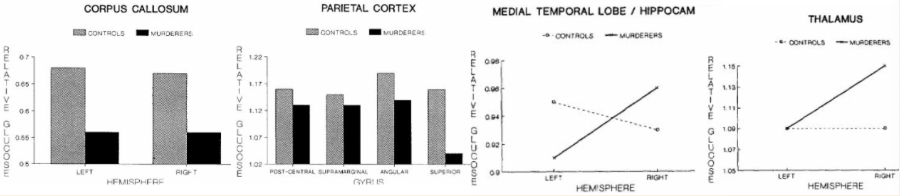
reduction in activity in several regions
found reductions in the PFC, but also in the corpus callosum
also found differences in the parietal cortex
found abnormal assymetric activity
murderers had reduced activity in the left hemisphere of the brain
including the hippocampus and thalamus
raine et al. - PFC: reactive vs proactive aggression - methods
sample taken from another raine study, divided into 15 proactive murderers, 9 reactive, 41 controls
PET and continuous performance task
proactive: instrumental
reactive: spur-of-the-moment
looked into prison files to see whether the murder was premeditated or reactive
raine et al. - PFC: reactive vs proactive aggression -
affective/reactive
in the lateral & medial cortex, they show less activity than the control
predatory/proactive
no real reduction in activity
no group difference from control, but do from reactive

raine et al. - subcortical regions: reactive vs. proactive aggression
no group differences in the left hemisphere
differences in the right hemisphere
both affective and proactive murderers show a high level of subcortical responses, however the difference is:
the proactive murderers have good PFC functioning, which enables them to control the limbic system better
can act in a more planned, controlled, and organised way

coccaro et al. - amygdala-prefrontal network for reactive aggression (fMRI) - method
10 patientd with intermittent explosive disorder vs 10 healthy, matched controls
IED: recurrent acts of impulsive, affectively driven aggression that are completely disproportionate to any actual provocations
get angry really quickly
fMRI while viewing emotionally salient faces (angry, disgusted, fearfuk, happy, neutral, sad, surprised)
how individuals with IED would react to angry facial expressions
coccaro et al. - amygdala-prefrontal network for reactive aggression (fMRI) - results
expected that in IED patients the connectivity between the PFC and the amygdala would be disrupted
no sig. differences between patients and controls in accurately recognising the facial expression
in terms of trait anger, state anger, and depression, the IED patients were much higher than the controls

coccaro et al. - cortico-limbic network for reactive aggression (fMRI) - results
relative to controls, individuals with IED exhibited exaggerated amygdala reactivity and diminished OFC activation to faces expressing anger
extent of amygdala and OFC activation to angry faces were differentially related to prior aggressive behaviour across the subjects
unlike controls, aggressive subjects failed to demonstrate amygdala-OFC coupling during responses to angry faces

hyde et al. (2013) - core theoretical integration
the integration of cognitive and affective neuroscience with a developmental psychopathology framework to investigate youth ASB
hyde et al. (2013) - core principles of developmental psychopathology applied to ASB
equifinality (distinct pathways yield the same outcome)
multifinality
probablisitic risk (biological traits confer vulnerability moderated by GxE transactions)
heterotypic continuity (identical underlying liabilities manifest differently across developmental stages)
hyde et al. (2013) - dual-pathway model of amygdala reactivity in youth ASB
AB + CU+ youth display amygdala hypo-reactivity to distress cues (fearful faces), whereas AB + CU- youth exhibit amygdala hyper-reactivity relfecting emotional dysregulation and exaggerated threat sensitivity
hyde et al. (2013) - attentional and methodological caveats in amygdala reactivity findings
amygdala hypoactivation in AB + CU+ youth diminishes under high attentional load, deficits may stem from abnormal visual scanning (reduced gaze toward the eyes), and ‘neutral’ baseline faces may be actively perceoved as ambiguous or hostile
hyde et al. (2013) - PFC and fronto-amygdalar dysfunctions in youth antisocial behaviour
reduced OFC/vmPFC activation and impaired uncinate fasciculus connectivity disrupt punishment sensitivity and emotion regulation
ACC hypoactivation causes failure to shift from reward to error monitoring
dlPFC hypoactivation impairs executive motor inhibition
hyde et al. (2013) - roles of the ventral striatum and insula in youth conduct problems
ventral striatum hyper-reactivity mediates reward anticipation, sensation seeking, and impulsivity
atypical anterior insula activation and connectivity disrupt interoceptive integration, disgust processing, and empathy for others’ pain
hyde et al. (2013) - molecular genetic and neurochemical correlates in youth ASB
the 5-HTTLPR short allele and low-activity MAOA interact with maltreatment to predict reactive aggression and high cortisol reactivity
conversely, long alleles, high-activity MAOA, and low resting cortisol associate with CU traits and blunted threat reactivity
hyde et al. (2013) - primary sampling and design limitations of extant neuroimaging studies
small sample sizes from unrepresentative middle-class backgrounds, and artificial dichotomous splits (e.g. median splits on continuous CU scales) that obscure dimensional neurobiological relationships
hyde et al. (2013) - confounding clinical developmental limitations in youth neuroimaging
comorbidities (ADHD, depression, substance misuse) confound disease specificity
broad cross-sectional age bands (e.g. ages 10-18) conflate dynamic adolescent neurodevelopmental stages
task heterogeneity undermines replication
hyde et al. (2013) - subtype-tailored clinical interventions recommended
AB + CU- youth benefit from de-escalation, affect regulation, and time-outs to down-regulate hypoer-arousal
AB + CU+ youth require reward-oriented contingencies (rather than punishment) and explicit eye-gaze coaching to remediate empathic deficits
koenigs et al. (2010) - target scope and central thesis
evaluates published human structural and functional neuroimaging studies exclusively in adult psychopathy, arguing that severe methodological inconsistencies across studies - rather than valid biological discrepancies - drive contradictory and unreplicated neural correlates
koenigs et al. (2010) - key structural MRI alterations linked to psychopathy
reduced volume/deformations in the amygdala and hippocampus
reduced grey matter in PFC and temporal cortex (notably right superior temporal gyrus)
increased striatal and corpus callosum volume
microstructural disruption in the uncinate fasciculus
koenigs et al. (2010) - task-dependent fMRI discrepancies in psychopathy
the amygdala exhibits hypoactivation during fear conditioning, moral judgement, and social cooperation, but hyper activation during passive emotional scene viewing
the ventral striatum shows hypoactivation during emotional memory tasks, but hyperactivation during reward anticipation
koenigs et al. (2010) - three competing theoretical models evaluated
fronto-amygdalar/emotion circuit deficit model (Blair; core deficit in amygdala-vmPFC reinforcement learning)
paralimibic dysfunction model (kiehl; broader network including OFC, insula, cingulate, and superior temporal gyrus)
information processing/attention integration model (newman; selective attention moderates emotional and limbic reactivity)
koenigs et al. (2010) - methodological issues 1: conflating categorical psychopathy with dimenional trait variation
studies conflate between-group designs comparing forensic clinical psychopaths with correlational designs measuring self-reported traits in healthy student/community samples, based on the flawed assumption that normal personality trait variation shares neural mechanisms with severe clinical pathology
koenigs et al. (2010) - methodological issue 2: inconsistent diagnostic criteria and lenient PCL-R cutoff scores
instead of adhering to standard cutoffs (PCL-R >/= 30 in North America; >/= 28 in Europe), most studies use cutoffs in the mid-20s, contaminating cohorts with intermediate scores (21-29), who exhibit normal startle reflex patterns identical to non-psychopaths
koenigs et al. (2010) - methodological issue 3: failure to account for primary vs. secondary psychopathy subtypes
neuroimaging studies treated psychopathology as a monolithic construct, failing to subtype by anxiety:
low-axiety (primary) psychopaths exhibit classic lab deficits
high-anxiety (secondary) psychopaths perform like healthy controls
creates conflicting hyper- versus hypo-activation findings
koenigs et al. (2010) - summary of proposed methodological recommendations for future psychopathy neuroimaging
enforce strict PCL-R diagnostic cutoffs
recruit adequately powered cohorts
incorporate anxiety/personality subtyping into fMRI designs
clearly separate clinical psychopathy from trait variation
adopt standardised cognitive and affective paradigms
koenigs et al. (2010) - three methodological pillars driving the psychopathy neuroimaging replication crisis
conflation of group comparisons (clinical) with dimensional trait measures (healthy samples)
sub-threshold PCL-R cutoff scores diluting true psychopathic samples with intermediate scorers
total neglect of primary versus secondary (low-anxious vs high-anxious) subtyping
koenigs et al. (2010) - similarities with hyde et al. (2013)
both papers assert that antisocial constructs cannot be treated as unitary biological phenotypes
neural signatures critically diverge according to affect/anxiety regulation in adults and CU traits in youth
decety et al. (2009) - three competing hypotheses on empathic dysfunction in aggressive youth
blunted empathic response (amygdala hypo-reactivity to distress cues)
pain-induced negative affect/personal distress (overwhelming visceral distress triggering reactive aggression)
positive affect/sadism (deriving positive arousal or reward from observing pain)
decety et al. (2009) - sample characteristics and psychiatric comorbidity
16 male adolescents (n = 8 aggressive childhood-onset CD vs. n = 8 healthy controls) selected from a 9-year long longitudinal study
88% of CD youth had comorbid ADHD compared to 25% of controls
decety et al. (2009) - experimental fMRI paradigm and primary contrasts
ppts viewed 3-frame animated clips of hands/feet in 4 conditions:
pain caused by accident (PCA)
pain caused by other (PCO)
no-pain (NPS)
alleviated pain (APO)
key contrasts were PCA > NPS (pain resonance) and PCO > PCA (agency/intentional harm)
decety et al. (2009) - behavioural and neural responses to accidental pain (PCA > NPS) in CD youths
conscious pain ratings were normal (equal to controls)
fMRI revealed significant hyper-activation in the pain matrix (anterior insulation, aMCC, SMA), bilateral amygdala, ventral striatum, and temporal poles in CD youth, refuting a simple blunted empathy model
decety et al. (2009) - neural recruitment during intentional harm (PCO > PCA) in controls vs CD youth
controls recruited fronto-parietal moral and regulatory regions (mPFC, lateral OFC, right TPJ, anterior PCC)
CD youth failed to recruit these structures, showing restricted activation in anterior insula, SMA, medial OFC, and precentral gyrus
decety et al. (2009) - left amygdala functional connectivity (PPI) during intentional pain observation
controls showed positive coupling between left amygdala and PFC for top-down affect regulation
CD youth lacked amygdala-PFC coupling, instead showing amygdala coupling with anterior insula (intentional pain) and temporal pole (accidental pain)
decety et al. (2009) - neural correlates of aggression, daring, and sadism traits within CD youth
aggression and daring correlated positively with activity in the amygdala, IFG, PAG, and MCC
parent-related sadism traits correlated specifically with activation in the right amygdala, bilateral precuneus, and fusiform gyrus
decety et al. (2009) - dual theoretical interpretations of ventral striatal and amygdala hyper-activation
appetitive aggression/sadism:
striatal (nucleus accumbens) and amygdala activation reflects positive reward or excitement when viewing victims in pain
emotional dysregulation:
overwhelming visceral arousal (temporal pole) combined with absent amygdala-PFC coupling transforms personal distress into reactive aggression
decety et al. (2009) - primary methodological limitations
very small sample size (n = 8 per group, n = 16 total) limiting statistical power
high ADHD comorbidity (88% in CD vs. 25% in controls) confounding externalising traits
absence of validated CU trait inventories
decety et al. (2009) - synthesis within Hyde et al. (2013) subtyping framework
cited by hyde et al. as key evidence for amygdala hyper-reactivity, decety’s sample likely captured an emotionally dysregulated, reactive (AB + CU-) profile (or distress-driven youth), contrasting directly with the amygdala hypo-reactivity seen in pure CU+ cohorts
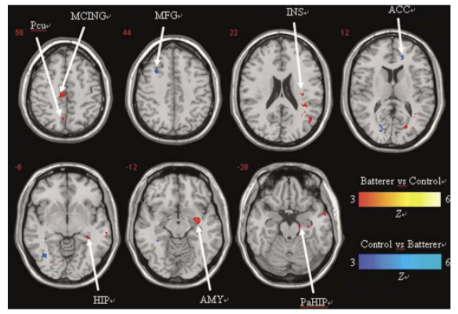
lee et al. (2008) - strong limbic and weak frontal activation to aggressive stimuli in spouse abusers - method
10 male spouse abusers vs 13 male matched controls
fMRI: cognitive and emotional Stroop
between-groups comparison for the aggressive versus neutral words on the emotional Stroop task
lee et al. (2008) - strong limbic and weak frontal activation to aggressive stimuli in spouse abusers - results
behavioural data emotional Stroop:
batterers’ RT were greater for negative-affect stimuli compared to neutral stimuli
male abusers scored higher than control
reaction time: abusers were slowet to respond to emotional words
fMRI data
increased activation of the amygdala, hippocampus, INS
reduced response in MFG and ACC
lee et al (2002) - non-violent ASB: lying - methods
5 participants from Hong Kong
digit and autobiographical memory (remembering things about yourself) tasks
lying is a cognitively demanding ability (good memory, planning ability, executive functions, theory of mind)
digit memory task: presented with 3 digit numbers consecutively, then asked whether a digit was present previously
had to either tell the truth or lie
lee et al (2002) - non-violent ASB: lying - results
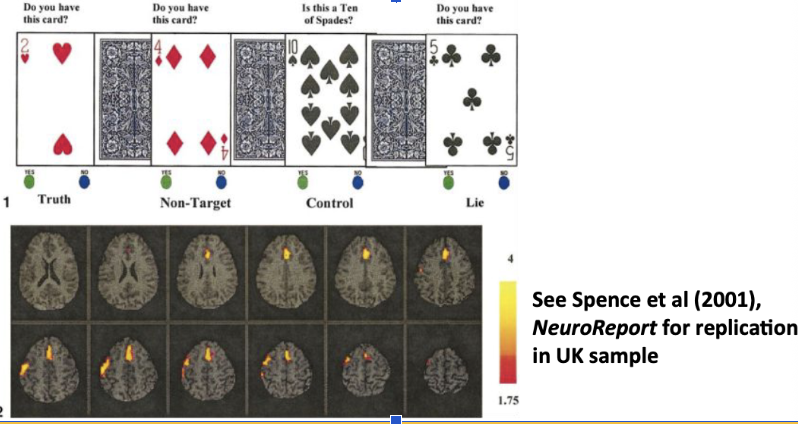
similar results across the two
increased activity in the prefrontal regions in both, and midline and posterior regions

langleben et al. (2002) - lying: fMRI evidence
18 students from university of pennsylvania
guilty knowledge test
ppts presented cards, and sometimes had to tell the truth about the card or lie
2 control conditions
additional support that lying engages regions of the prefrontal cortex
green et al. - moral decision-making - personal
the five people will die if left alone
would you push the man off the bridge to stop the train?
around 85% of people would say no
patients who had sustained lesions in the ventromedial PFC are more likely to push the man

green et al. - moral decision-making - impersonal
can push the lever to change direction of the train to kill one person
the proportion of people increases to changing direction rather than actually pushing the person off the bridge

green et al. - moral decision-making - results
moral-personal
more activity in areas associated with emotion
moral-impersonal and non-moral
areas associated with working memory

koenigs et al. (2007) - damage to the prefrontal cortex increases utilitarian moral judgements
lesions in the vmPFC had a substantial change in personality
pseudopsychopathy: acquired
behaviour resembled that of psychopaths
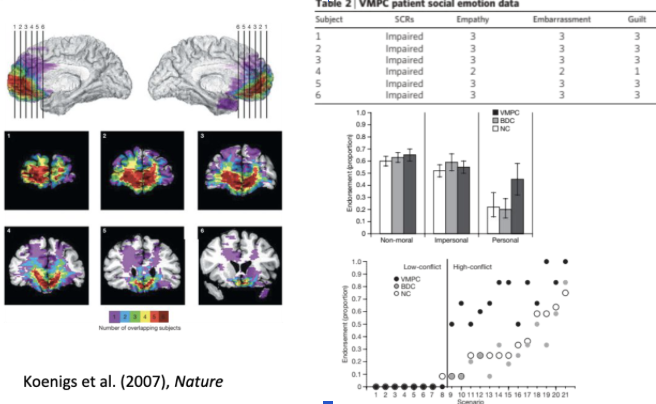
all 6 patients had impairments in skin conductance response
vmPFC lesion:
more likely to act in personal moral dilemmas
recorded ppts with other lesions to check the outcome is specific to vmPFC lesions
scenarios rated from low conflict to high
no differences between the 3 groups for low conflict
patients with vmPFC lesions were more likely to say yes to the high conflict dilemmas
koenigs et al. (2012) - utilitarian moral judgement in psychopathy - group differences
group difference was limited to the impersonal scenario
primary psychopaths show little anxiety, compared to secondary
does splitting the psychopaths by anxiety help identify potential differences?

koenigs et al. (2012) - utilitarian moral judgement in psychopathy - anxiety differences
low anxiety
more likely than high and none to say yes to personal scenarios
anxiety within psychopathy moderated the relationship between psychopathy and saying yes to the scenarios
high-conflict scenarios
low-anxiety psychopaths are more likely to say yes to moral judgments
demonstrates equifinality

the neural correlates of moral decision-making in psychopathy
looked at the association between psychopathy score and pattern of brain responses
psychopathy during scenarios high in moral dilemma:
the greater the psychopathy, the lower the amygdala activity
higher psychopathy scores were associated with reduced activity in brain regions involved in emotion and moral reasoning
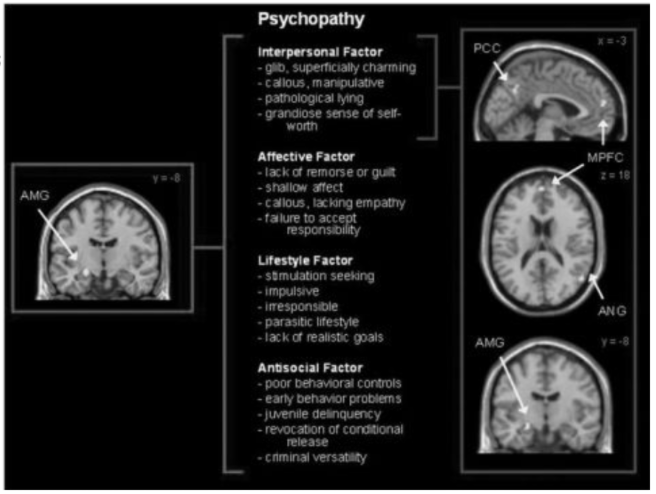
raine & yang (2006) - brain regions implicated in moral reasoning and ASB
looked at correlated associated with ASB and moral decision-making
amygdala and angular gyrus

contreras-rodriguez et al. (2014) - disrupted neural processing of emotional faces in psychopathy - method
interested in how psychopathic brains respond to facial expressions of emotions
task
ppt lying in a scanner, and presented with different facial expressions or shapes
had to say which of the two facial expressions matches the top
implicit emotion processing
control: asking the same questions with shapes
control group: from the community
experimental: prisoners (high PCL-R score)
matched on age, gender, education
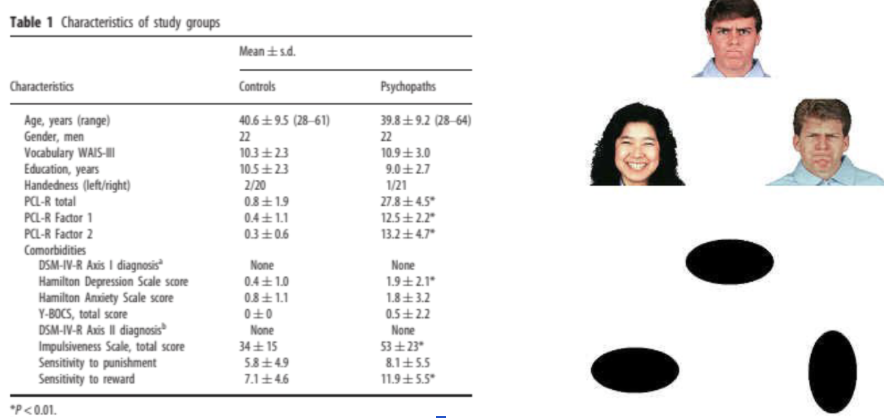
contreras-rodriguez et al. (2014) - disrupted neural processing of emotional faces in psychopathy - face vs. shapes
happy vs shape; fearful vs shape first, then combined the results to ask where in the brain there is greater activation for faces than shapes
increased activation in the visual cortex and parietal cortex
in terms of brain responses, the psychopaths showed increased response to faces vs shapes in cortical and prefrontal regions
regions associated with cognitive control/processing, not emotion
all the p-values are not significant for RT
control and psychopaths perform equally for RT and accuracy
psychopaths were as good but there were still differences in brain processing of facial expressions

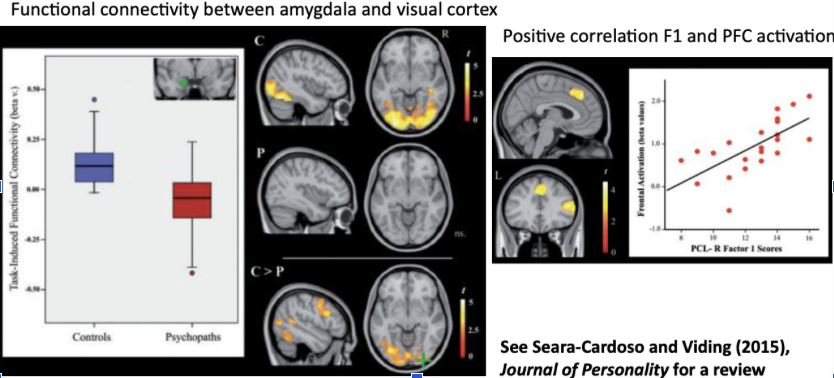
contreras-rodriguez et al. (2014) - disrupted neural processing of emotional faces in psychopathy - functional connectivity
in control ppts, the amygdala was ‘talking’ to visual parts of the brain
in psychopathy ppts, the amygdala did not show connectivity when processing facial expressions to any part of the brain
positive correlation:
relationship between F1 of PCL-R and how much psychopaths use the prefrontal regions when processing facial expressions
greater the PCL-R, the greater the activity p
poeppi et al. - a view behind the mask of sanity: meta-analysis of aberrant brain activity in psychopaths
identified that psychopathy across many studies is reliably associated with reduced response in the amygdala, dmPFC, left and right lPFC
evidence of increased response in FIC
tried to relate activity to different domains
demonstrated reduced amygdala responses were related to emotion processing

passamonti et al. (2010) - neural abnormalities in early-onset and adolescence-onset CD - methods
males with CD
task with fmri
presented with blocks of sad, neutral or angry facial expressions
had to say whether the face was female or male
implicit emotion processing
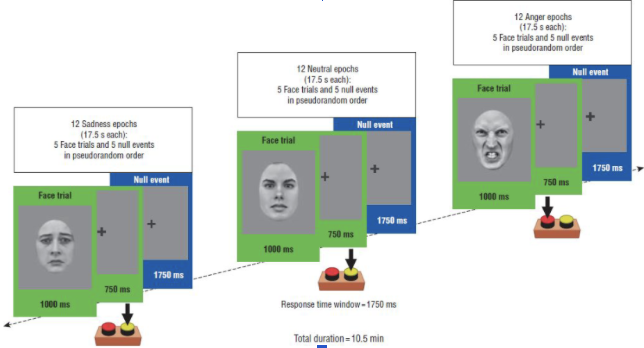
passamonti et al. (2010) - neural abnormalities in early-onset and adolescence-onset CD - results
angry vs neutral
the two groups vs the control: how lower activation in the different regions
reduced response to angry faces
sad vs neutral
only those who were EO showed a reduced response to sad faces
both subtypes are characterised by lower responses to angry, but only EO for sad vs neutral

fairchild et al. (2014) - sex differences - females with CD
follow-up from previous study
only females, compared to previous all-male
difference in orbitofrontal cortex
females with CD show reduced response to all facial expressions
in anterior insula
females with CD show heightended response to facial expression
considering sex as a variable is important

frick & viding (2009) - two subgroups of childhood-onset CD
CU traits:
lack of guilt and empathy
callous use of others
included as a specifier in DSM-V
there is evidence for distinct neurocognitive profiles and differing aetiologies
CD+CU subtype = lack of emotional responsiveness to negative emotional stimuli
CD-CU traits = emotional reactivity/poor emotion regulation
childhood onset with high CU traits
show a more severe, stable, and aggressive pattern of behaviour
deficits in the processing of negative emotional stimuli (e.g. fearful and sad faces)
less sensitive to punishment cues
show more positive outcomes expectancies in aggressive situations with peers (bullying)
fearless and thrill-seeking and show lower levels of anxiety
temperamental features which can interfere with the normal development of conscience
adolphs et al. (2005) - language of the eyes (super stimuli)
amygdala and attention, social gaze
patient SM, bilateral amygdala damage (rare genetic condition)
fine at processing other facial expressions, but an issue with fear
is the amygdala necessary to process fear?
SM eye tracking data:
was not looking at the eye region of the face compared to the controls
SM had a low accuracy when not instructed to look at the eyes
however, was the same as control when she did look at the eyes
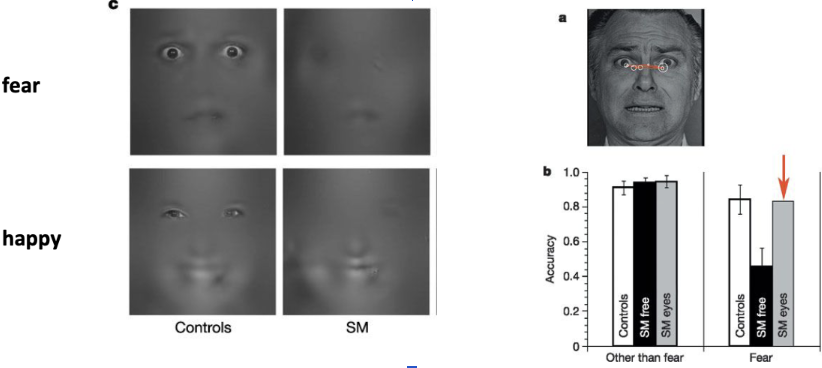
dadds et al. (2010) - CU traits and face processing
those with low CU traits looked at the eye region of the face
high CU traits did not look as much at the eyes, but more at the mouth
psychopathy and CU traits may be associated with abnormalities in the amygdala

jones et al. (2009) - brain response to facial expressions
reduced amygdala response to fearful expression from boys with CD and CU traits
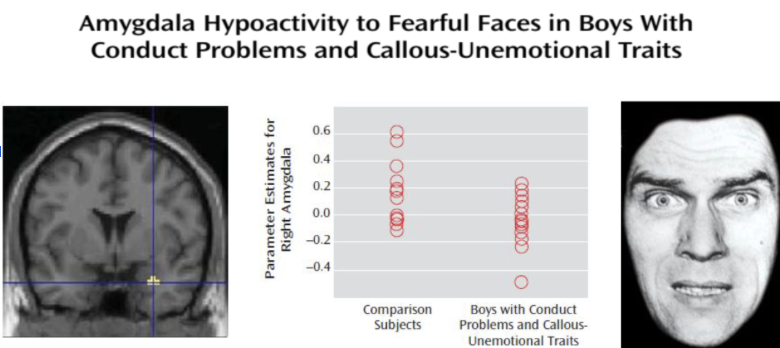
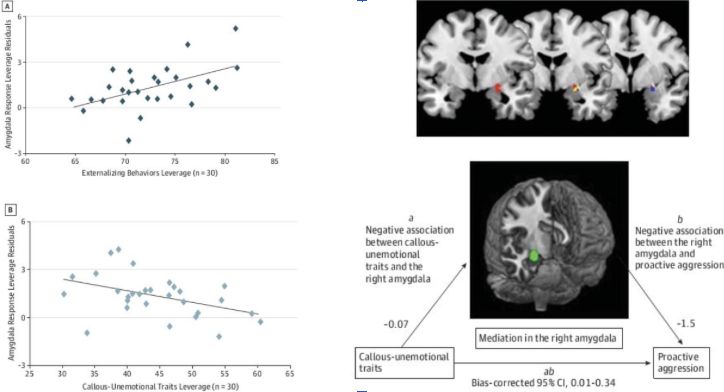
lozier et al. (2014) - mediation of the relationship between CU traits and proactive aggression by amygdala response to fear among children with conduct problems
the greater the ASB, controlling for psychopathy and CU, the greater the amygdala response to fearful facial expressions
high CU traits, controlling for ASB, are associated with lower amygdala activity
the greater the CU trait, the greater the proactive aggression
was partially mediated by the amygdala responses to those faces s
summary: CP with high CU traits
the fMRI findings suggest a functional neural basis for why adolescents with CP+CU traits lack empathy for others’ distress and display high levels of proactive/instrumental aggression
structural brain abnormalities might contribute to these functional abnormalities
childhood-onset with low CU traits
typically do not show problems in empathy and guilt
high rates of anxiety, and they appear to be highly distressed by the effects of their behaviour on others
impulsivity and low verbal intelligence
show a hostile attribution bias in social situations
more likely to come from families with high rates of hostile and inconsistent parenting practices
less aggressive and more reactivity aggressive
aggressive behaviour here involves deficits in the cognitive or emotional regulation of behaviour
viding et al. (2012) - amygdala response to preattentive masked fear in children with conduct problems: the role of CU traits
presented the faces in the scanner extremely rapidly
how is the brain responding automatically
how is this different across the three groups

subliminal face processing with backward masking - methods
the kids with high CU traits would show low amygdala responses to fearful expressions
vice versa for low CU traits
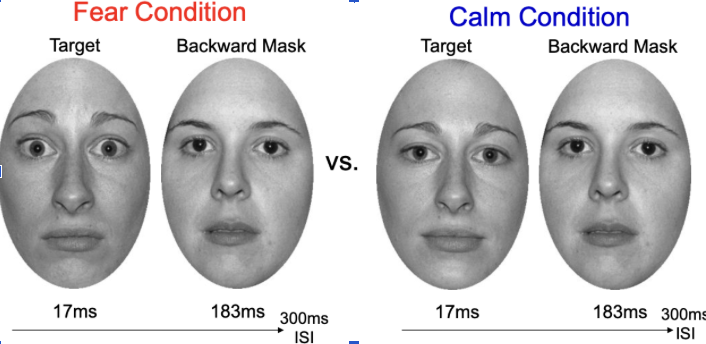
subliminal face processing with backward masking - results
heightened reactivity in conduct problems with low CU traits
when exposed to subliminally presented fearful faces via backward masking, youth show a strong, positive BOLD response in the right amygdala
reduced/blunted reactivity in conduct problems with high CU traits
deactivation to subliminal fearful versus calm expressions in the same right amygdala region
impaired autonomic neural sensitivity to others’ distress cues
the right amygdala’s pre-attentive response to fearul faces in the low CU group is significantly greater than both controls and high CU

decreasing amygdala response with increased CU traits
the study demonstrates
equifinality
can have two groups of young people with CD, but the mechanisms underpinning that can be drastically different
study had a very small, male sample

summary: CP with low CU traits
these findings of abberant activity in the amygdala indicate functional neural bases for why some youths with conduct problems can react aggressively even in the face of minimal provocation
maltreatment could be an important environmental factor recalibrating the brain’s basic threat response system of youths with CP with low levels of CU traits
lecture summary
violent individuals show abnormal brain functioning
the pattern of abnormality varies depending on the form of violence
multiple brain areas are implicated (i.e. network)
non-violent forms of ASB are also associated with a specific pattern of brain activity
there is overlap in the network of brain regions implicated in moral decision-making and ASB
psychopathy is characterised by a lack of integration of emotion into cognition
in youths with CD, age of onset of CD and sex are important to take into consideration in relation to brain response to facial expressions
subgroups of youths with ASB distinguished by their levels of CU traits are characterised by different brain responses to facial expressions conveying threat