CHEM 1st Exam Vocab
 Call Kai
 Learn
Learn Practice Test
 Spaced Repetition
 Match
Match Flashcards
 Knowt Play
1/47

There's no tags or description
Looks like no tags are added yet.
Name | Mastery | Learn | Test | Matching | Spaced | Call with Kai | Chat |
|---|
No analytics yet
Send a link to your students to track their progress
48 Terms
Electromagnetic Radiation
Any form of radiant energy in the electromagnetic spectrum
Electromagnetic Spectrum
The range of radiant energy includes gamma rays, X-rays, ultraviolet radiation, visible light, infrared radiation, microwaves, and radio waves
Wavelength (λ)
Distance between successive peaks of a wave.
Frequency (ν)
Number of wave cycles per second.
Hertz (Hz)
Unit of measurement for frequency (1 s^-1)
Speed of light (c)
3.00 x 10^8 m/s
Fraunhofer lines
A set of dark lines in the otherwise continuous solar spectrum.
Atomic Emission Spectra
Characteristic patterns of bright lines are produced when atoms are vaporized in high-temperature flames or electrical discharge
Atomic Absorption Spectra
Characteristic patterns of dark lines are produced when an external source of radiation passes through gaseous atoms
Quantum
The smallest discrete quantity of a particular form of energy (E=hv)
Photon
A quantum of electromagnetic radiation
Photoelectric Effect
The emission of electrons from a material when light of certain frequencies shines on the surface of the material
Threshold Frequency
the minimum frequency of light required to produce the photoelectric effect
Excited State
An energy level above the ground state
Electron Transitions
movement of an electron between energy levels
Quantum Numbers
specify the properties of atomic orbitals and the properties of electrons in orbitals
n (principle quantum #)
Energy level(distance from nucleus)
Any integer 1-infinity
l (angular momentum #)
specifies the general shape of the orbitals. Possible values are 0...(n-1)
Magnetic Quantum Number (ml)
Specifies the orientation in space of the orbital. Possible values depend on l, can be -l to +l in steps of one.
ms (spin quantum #)
Electron's spin (up/down)
+1/2 or -1/2
Shell
Described only use n
Subshell
Described only using n & l
Orbital
Described using n, l, & ml
Pauli Exclusion Principle
An atomic orbital may describe at most two electrons, each with opposite spin direction
Hund's Rule
orbitals of equal energy are each occupied by one electron before any orbital is occupied by a second electron, and all electrons in singly occupied orbitals must have the same spin
Exceptions to Electron Configuration
Cr, Mo, Cu, Ag, Au (Missing an electron in their s orbital to complete their d orbital)

Ionization Energy
The amount of energy required to remove an electron from an atom
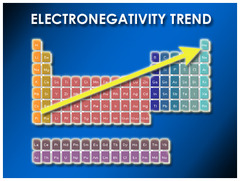
Electronegativity
A measure of the ability of an atom in a chemical compound to attract electrons

Atomic Radius
size of an atom

Ionic Radius
Distance from the center of an ion's nucleus to its outermost electron
Ionic Bond
Formed when one or more electrons are transferred from one atom to another. Metals & nonmetals (lattice)
Covalent Bond
A chemical bond that involves sharing a pair of electrons between atoms in a molecule. Nonmetal & nonmetal/metalloids
Metallic
metal and metal
Polyatomic Ions
Covalent molecules w/ extra/fewer e- to make them ions
Acetane
C2H3O2-/CH3COO-
Hydroxide
OH-
Cyanide
CN-
Ammonium
NH4+
Oxyanion
a polyatomic ion composed of an element, usually a nonmetal, bonded to one or more oxygen atoms
Carbonate
CO3 2-
Chlorate
ClO3-
Nitrate
NO3-
Phosphate
PO4 3-
Sulfate
SO4 2-
Binary Covalent Molecules Naming Conventions
Prefix (omit mono if just 1)-1st element prefix-2nd element-ide
Acids
A covalent molecule that produces H+ (proton) when dissolved in water
Binary Acids Naming conventions
A single non-metal w/ H+
hydro-2nd element-ic acid
Oxyacids Naming Conventions
Oxyanions w/ H+
If an oxyanion ends in "ate" --> "-ic acid"
If an oxyanion ends in "ite" --> "ous acid"