pseudomonas & burkholderia
 Call Kai
 Learn
Learn Practice Test
 Spaced Repetition
 Match
Match Flashcards
 Knowt Play
1/72

There's no tags or description
Looks like no tags are added yet.
Name | Mastery | Learn | Test | Matching | Spaced | Call with Kai | Chat |
|---|
No analytics yet
Send a link to your students to track their progress
73 Terms
Pseudomonas
Gram-negative rods
P. aeruginosa
Most veterinary diseases are caused by
Burkholderia mallei
Previously names pseudomonads of veterinary importance have been reclassified:
Pseudomonas malle →
Burkholderia pseudomallei
Previously names pseudomonads of veterinary importance have been reclassified:
Pseudomonas pseudomallei →
Pseudomonas & Burkholderia
Medium sized, straight or slight curved Gram-negative rods
Strict aerobes
Non-spore forming
Oxidative
Catalase-positive
P. oryzihabitans and P. luteola
Pseudomonas & Burkholderia
oxidase positive except
B. mallei
Pseudomonas & Burkholderia
Mostly motile by one or several polar flagella except
soluble pigments
Pseudomonas & Burkholderia
Some zpecies produce ______
water, soil, plants, fruits, and vegetables
Have predilectiom for aqueous environment
Environmental microorganisms (worldwide distribution)
Opportunistic pathogens
_________ of:
animals
Humans
Plants
disinfectants
Ointments
Soaps
Eye drops
Irrigation fluids and equipments
Aerators
Traps of sinks
Pseudomonas aeruginosa
potential sources
Resistant
Pseudomonas aeruginosa
________ to many antimicrobials
Frequently causes infection in animals undergoing antibiotic treatment or immunocompromised hosts.
skin
Mucous membranes (GI tact)
Pseudomonas aeruginosa
sometimes found as microbial flora of healthy animals
trauma to tissue (burns and wounds)
Debilitation due to malignancy or immunodeficiency
Transplant recipients
Pseudomonas aeruginosa
rarely involved in primary disease
Predisposing cuases:
_____
infection occur at “moist sites”
Due to intrinsic and acquired resistance
Formation of biofilms
Pseudomonas aeruginosa
treTment is often difficult
Pneumonia in farmed mink and pigs
Otitis, pneumonia, sepsis and sudden death in chinchillas
Sepsis in poultry
Mastitis in ruminants
Otitis externa in dog
Pseudomonas aeruginosa
Can infect many species, at a variety of anatomical sites
Some presentations associated with this organism include:
Otitis externa and pyoderma
Pseudomonas aeruginosa
isolated from compromised aeruginosa
Isolated from compromised animals
_______ - following roudns of therapy
ulcerative keratitis
Cause of “melting ulcers” in horses
Pseudomonas aeruginosa
infecting corneal tissues
P. aeruginosa
Melting ulcers
Left - horse
Right - dog
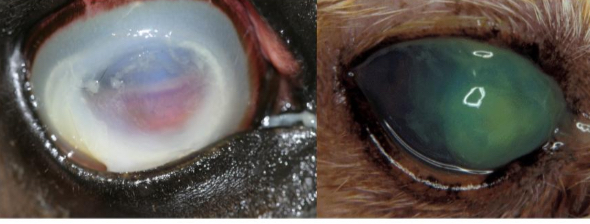
P. aeruginosa
Melting ulcer in a dog. Note, the green colour here is a result of fluoroscein dye used to visualize the ulcer not due to P. aeruginosa pigments

ability to quorum sense
Elastase
Siderophores
Type III secretion systems
Alginate biofilms
P. aeruginosa virulence factors
Ability to quorum sense
involved in different phases of infection (biofilm maturation, motility etc.)
Elastase
damage to blood vessels and lung tissues, disrupts neutrophil function
Siderophores
pigmented iron scavenging molecules pyoverdine (green), pyocyanin (blue) – Results in characteristic color
Type III secretion systems
secretion of effector molecules to damage host tissues or other bacteria
Alginate biofilm
slimy matrix produced by some strains which prevents phagocytosis
Burkholderia mallei
Obligate parasite with restricted host range
Cannot survive in environment for more than 2 weeks
Easily killed by desiccation, sunlight and common disinfectants
Once had worldwide distribution
Now, mainly seen in China and Mongolia
Reports of infection in India, Iraq, Turkey and Philippin
Equids
Burkholderia mallei
primarily affects _____
Humans and cats are also susceptible
Transmission by ingestion of food water contaminated by nasal discharges
B. mallei
_______ is a facultative intracellular parasite and spread between cells in a manner similar to L. monocytogenes
pulmonary infection
Septicemia
Farcy
Burkholderia mallei
3 forms of disease
Pulmonary infection
Burkholderia mallei
inhalation causes severe
pneumonia,
lung abscess and
chest pain
Septicemia
Burkholderia mallei
rapidly fatal systemic infection
Bacteria enters the bloodstream
Causes widespread pustules and abscesses in internal organs
Farcy
Burkholderia mallei
cutaneous
Bacteria enters through skin abrasions or wounds
Nodules which may ulcerate are seen along tracks of lymphatics on skin
donkeys and mules than horses
Burkholderia mallei
Acute disease more common in ______
Begins with pyrexia, depression and anorexia
Watery discharge from nostril (often unilateral), coughing
Nodules and ulcers develop on septum and discharge becomes thicker (copious yellow mucopurulent discharge)
Enlargement of lymph nodes
In animals that survive, nasal septum may be perforate
carnivores in zoos (large cats)
Burkholderia mallei
Other species can also be affected
Infections of ______ fed glanderous meat
Camels are also susceptible
infected animals,
bodily fluids, or
contaminated equipment
Burkholderia mallei
is transmitted through direct contact with
Biological warfare
Burkholderia mallei
possible agent of ________
Thought to have been used by Germans in WW1
Japanese in WW2
B. mallei

B. mallei

B. mallei

Burkholderia pseudomallei
primarily found in tropical and subtropical regions
Rice-growing areas of Thailand, Vietnam and India
Found also in Northern Territory of Australia
Melioidosis
Burkholderia pseudomallei
glanders like disease called
Muddy water and humid soil
Consumption of infected animals
Exposure often occupational
Laborers, cleaners, rice paddy workers
Burkholderia pseudomallei
facultative intracellular pathogen
Broad host range
Contracted by contaminated food or water
Melioidosis
Burkholderia pseudomallei
In people many infections are self-limiting flu like illnesses
Typical lesions are abscesses which can occur anywhere in the body
In people the lungs and brain are the most common site
Infections can be latent and reactivate after years
High rates of infection in US soldiers in the Vietnam war
acute
Subacute
Chronic
Burkholderia pseudomallei
3 distinct forms
Acute
Burkholderia pseudomallei
septicemia with metastatic lesions and abscesses
Subacute
Burkholderia pseudomallei
“tuberculosis-like” oneumonia, lymphangitis
Chronic
Burkholderia pseudomallei
localized chronic cellulitis
intrinsically resistant
Burkholderia pseudomallei
_________ to many antimicrobials
High mortality rate (95%) if untreated
Mortality rates even high in developed countries among bacteremic patients (19%
ruminants
Pigs
Horses
Deer
Camels
Dogs
Dolphins
Koala
Kangaroo
Non-human primates
Burkholderia pseudomallei
reported in numerous animal species
Fatal or subclinical
Burkholderia pseudomallei
disease can be rapidly ________
Horses
Burkholderia pseudomallei
_______ - may mimic glanders
Goats and pigs
Burkholderia pseudomallei
_______ - respiratory and CNS infections, arthritis, and mastitis
Dogs
Burkholderia pseudomallei
______ - localized abscessations with pyrexia
B. pseudomallei

B. pseudomallei

Pseudomonas fluorescens
Cause of septicemia primarily in high intensity aquaculture operations
Fish are lethargic
May have cutaneous lesions
These organisms are ubiquitous within the environment
More common in waters with organic pollutants
Treatment is challenging due to intrinsic resistance
Drugs available for use in aquaculture not effectiv
P. fluorescens
Skin infection w _____ in CARP

P. fluorescens

Strict safety precaution must be enforced (Biosafety Level 3)
Collect discharges from lesions for culture
Blood for serolog
Burkholderia specimen collection
biosafety lvl 2
Standard collection and transport
Pseudomonas - Specimen Collection
Mallein Test
Prescribed test to demonstrate hypersensitivity developed after infection with B. mallei
Mallein
glycoprotein extracted from the bacterium
Subcutaneous test
results in swelling at the injection site and fever
Opthalmic test
inflammatory and purulent reaction in the eye
Intrapalpebral test
gives a localized, edematous swelling and purulent conjunctivitis
medium-sized,
Gram-negative rods with no other distinctive characteristics.
Direct microscopy from specimens is of little diagnostic use as Pseudomonas and Burkholderia are
Safety pin appearance
direct microscopy of Gram-stained smears with B. pseudomallei will often reveal small Gram negative bacilli with bipolar staining
B. mallei and
B. pseudomallei
A fluorescent antibody technique may be useful for
Readily grows on routine test media
Pseudomonas
B. mallei and pseudomallei
Grows on blood and MacConkey agar
Identified based on colony morphology
PCR based assays
Immunological tests helpful
Serology (B. pseudomallei) cross reactivity between B. mallei and B.pseudomallei
Susceptibility testing
Pseudomonas and should be treated based on the results of _______
porin expression
Intrinsic resistance partially due to low level of _______ – drugs can’t get through the cell membrane