Unit 2: Population & Migration
 Call Kai
 Learn
 Practice Test
 Spaced Repetition
 Match
 Flashcards
 Knowt Play
1/61

There's no tags or description
Looks like no tags are added yet.
62 Terms
Site Factors
The physical attributes of a location- its terrain, its soil, vegetation, and water sources

Situation Factors
The external influence of a location's surrounding area.

Distribution
The arrangement of something across Earth's surface.

Density
The frequency with which something occurs in space
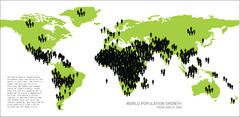
Arithmetic Density
The total number of objects in an area

Physiological Density
The number of people per unit area of arable land

Agricultural Density
The ratio of the number of farmers to the amount of arable land

Carrying Capacity
Largest number of individuals of a population that an environment can support

Overpopulation
The number of people in an area exceeds the capacity of the environment to support life at a decent standard of living.

ESPeN
Economic, Social, Political, eNvironmental

Demography
The scientific study of population characteristics (ie. age, gender, occupation, fertility...)

Population Pyramid
A bar graph representing the distribution of population by age and sex.

Dependency Ratio
The number of people under age 15 and over age 64 compared to the number of people active in the labor force

Sex Ratio
The number of males per 100 females in the population.

Life Expectancy
The number of years a person can expect to live

CBR
Crude Birth Rate. The total number of live births in a year for every 1,000 people alive in the society.

CDR
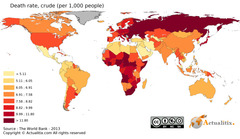
Crude Death Rate. The total number of deaths in a year for every 1,000 people alive in the society.
NIR
Natural Increase Rate. The percentage growth of a population in a year, computed as the crude birth rate minus the crude death rate.

IMR
Infant Mortality Rate, the total number of deaths in a year among infants under 1 year old for every 1,000 live births in a society

TFR
Total Fertility Rate. The average number of children a woman will have throughout her childbearing years.
Replacement Rate
The total fertility rate needed for a population to replace itself. 2.1 TFR

Doubling Time
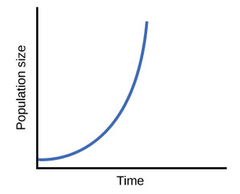
The number of years needed to double a population, assuming a constant rate of natural increase.
Demographic Transition Model
A sequence of demographic changes in which a country moves from high birth and death rates to low birth and death rates through time.
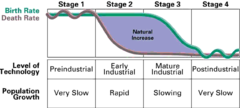
Stage 1: Low Growth
Very high CBR
Very high CDR
Very low NIR

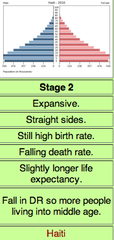
Stage 2: High Growth
High CBR, rapidly declining CDR, very high NIR
Stage 3: Moderate Growth
Rapidly declining CBR
Moderately declining CDR
Moderate NIR

Stage 4: Low Growth
Very low CBR
Low or slightly increasing CDR
Zero or negative NIR
Epidemiological Transition
The process of change in the distinctive causes of death in each stage of the demographic transition

Thomas Malthus
Eighteenth-century English intellectual who warned that population growth threatened future generations because, in his view, population growth would always outstrip increases in agricultural production.

Ester Boserup
Argued that population growth actually stimulates societies to innovate and produce more food.
People and technology will adapt with challenges

Green Revolution
(1950s - 1980s) Agricultural Revolution that increased production through improved seeds, fertilizers, and irrigation; helped to support rising Asian populations.

Neo-Malthusians
People who believed in Malthusian Theory and in the idea that population was not only outstripping food but other resources

Pronatalist Policy
Government policy that supports higher birth rates

Antinatalist Policy
Government policy that supports lower birth rates

Migration
Movement of people from one place to another

Push Factors
Incentives for potential migrants to leave a place, such as a harsh climate, economic recession, or political turmoil.
Pull Factors
Positive conditions and perceptions that effectively attract people to new locales from other areas
Immigration
Migration to a new location

Emigration
Migration from a location

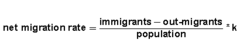
Net Migration Rate
The difference between the number of immigrants and the number of emigrants per 1000 people
Intervening Obstacle
An environmental or cultural feature of the landscape that hinders migration.

Intervening Opportunity
An environmental or cultural feature of the landscape that helps migration.

Voluntary Migration
Permanent movement undertaken by choice.

Earnest Ravenstein
Laws of migration established in the 1980s based on studies carried out in the U.K.

Forced Migration
Human migration flows in which the movers have no choice but to relocate.

Transnational Migration
Migration into a new country

Remittances
Money migrants send back to family and friends in their home countries, often in cash, forming an important part of the economy in many poorer countries

Internal Migration
Migration within a country

Interregional Migration
Movement from one region of a country to another

Intraregional Migration
Movement within one region of a country.

Transhumance Migration
Traditional seasonal movement of livestock (highlands in the summer and lowlands in the winter)

Chain (Family Based) Migration
Migration of people to a specific location because relatives or members of the same nationality previously migrated there

Step Migration
Migration to a distant destination that occurs in stages, for example, from farm to nearby village and later to a town and city

Guest Worker Programs
A policy that allows labor immigrants to enter a country temporarily to work

Circular Migration
The temporary movement of a migrant worker between home and host countries to seek employment.

Rural-to-Urban Migration
The movement of people from the countryside to the city

Enslaved Person
A person held against his or her will and forced to work for no pay

Asylum Seeker
Someone who has migrated to another country in the hope of being recognized as a refugee

Refugee
A person who has been forced to leave their country in order to escape war, persecution, or natural disaster

IDP (Internally Displaced Person)
someone who is forced to flee his or her home but who remains within his or her country's borders

Quotas
In reference to migration, laws that place maximum limits on the number of people who can immigrate to a country each year.

Brain Drain
Large-scale emigration by talented people. Scientists, researchers, doctors, and other professionals migrate to countries where they can make better use of their abilities
