MATH 645
 Call Kai
 Learn
 Practice Test
 Spaced Repetition
 Match
 Flashcards
 Knowt Play
1/15

There's no tags or description
Looks like no tags are added yet.
16 Terms
Axiom 1
u+v∈V
Axiom 2
u+v=v+u
Axiom 3
(u+v)+w=u+(v+w)
Axiom 4
0∈V s.t 0+u=u
Axiom 5
−u∈V s.t u+(−u)=0
Axiom 6
c⋅u∈V
Axiom 7
c(u+v)=cu+cv
Axiom 8
(c+d)u=cu+du
Axiom 9
c⋅(du)=d(cu)
Axiom 10
I∈Vs.t I⋅u=u
What are all the addition Axioms
u+v∈V
u+v=v+u
(u+v)+w=u+(v+w)
0∈V s.t 0+u=u
−u∈V s.t u+(−u)=0
What are the scalar Axioms
c⋅u∈V
c(u+v)=cu+cv
(c+d)u=cu+du
c⋅(du)=d(cu)
I∈Vs.t I⋅U=U
How to find the Null Space
Make problem into Ax = 0
Row reduce
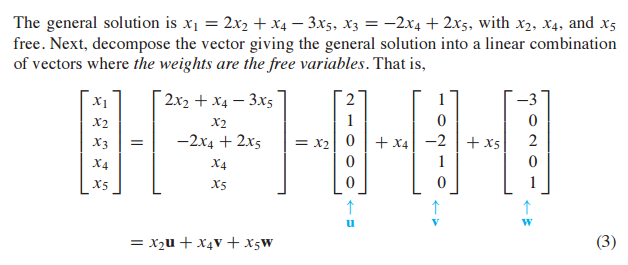
Set all the pivots equal to the free variables (non pivots)
Have an X column with all the variables
Separate the free variables into separate columns (This is span)
Each column is a null space vector
Inverse of a 2×2
ad−bc1[d−c−ba]
Diagonalization Process
Get Diagonal Matrix with eigenvals of A
Find all linearly independent eigenvectors of A
If the amount of vectors is less than n for an A = n x n matrix, the matrix is not diagonalizable
Construct P using the eigenvectors,
Construct D from the eigenvalues like an Identity matrix
For repeated roots, just have the repeats show twice
Have A=PDP−1
Multiply the Matrices Left to Right
Diagonalization k Identity
When A=PDP−1, we getAk=PDkP−1