meats - exam c
 Call Kai
 Learn
 Practice Test
 Spaced Repetition
 Match
 Flashcards
 Knowt Play
1/50

There's no tags or description
Looks like no tags are added yet.
51 Terms
Appraisal of market animals
Knowledge necessary to evaluate market animals:
Relative merit
Market situation (supply & demand, recession, tariffs)
Relative Merit is determined by:
Age
Weight
Sex
Fatness
Muscling
All lead to value differences
Factors affecting Relative Merit - age
As animals increase in age, they are likely to become:
Less tender: less soluble collagen, less fat
More flavorful: flavor stored in fat
Darker in lean color: myoglobin
Yellow in fat color: keratin in fat, mostly seen in beef cattle (dairy, white fat, beef, yellow fat)
Diseased: weaker immune system/ exposure to diseases
Fatter: metabolism slows
Not all species are affected equally!
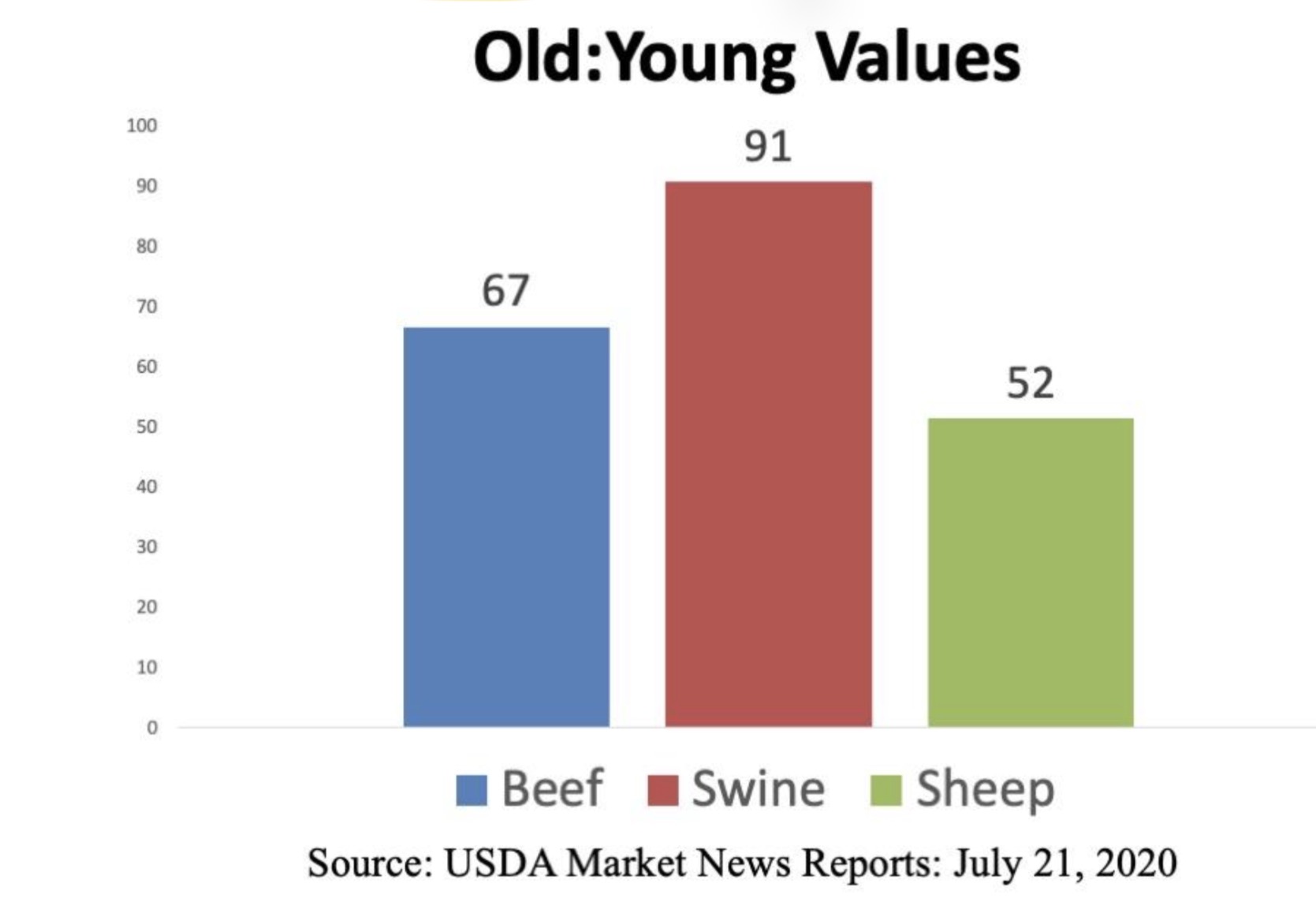
Comparative effects of age on market value by species (old:young ratio)

Old:Young Ratios for Beef, Swine and Sheep
Reasoning for old:young ratios - why?
Beef
Less tender
More intense in flavor
Darker lean color
Yellow fat color
Swine
Fatter
Sheep
Undesirable flavor
Higher condemnation rate due to higher incidence of disease
In summary, swine are the least impacted species of meat animals, while sheep are the most impacted with respect to the negative effects of increasing age on the value of older animals
Factors affecting Relative Meritt - weight
As animals increase in weight:
• Their carcasses become fatter
• Their retail cuts become larger
Discounts for heavy beef carcasses
Consumers object to both fatness and excessively large (too costly/unit serving) cuts.

Factors affecting Relative Merit - sex
Sexes differ in:
• Dressing percentages
• Carcass proportions
• Cutability
• Palatability
• Acceptability
These differences are the result of age at marketing versus age at puberty
Beef: Market at 18 months, Puberty at 12 months
Swine: Market at 7 months, Puberty at 7 months
Sheep: Market at 8 months (Spring lamb) or at 14 months (old crop lamb), Puberty at 8 months
Issues seen in beef and old crop lamb
Dressing percentage
Beef: Decrease 4 to 10% (heifers, some bulls). Heifers due to pregnancy; bulls due to heavier hides (and testicles) and heads and less fat
Swine: No effect Decrease 4 to 10% in old crop lambs.
Sheep: Same general reasons as for beef
Carcass proportions
Beef: Chuck +2% in bulls due to crest development; flank +2% in heifers due to udder fat deposition
Swine: No effect
Sheep: Shoulder +3% in old crop rams due to development of secondary sexual characteristics
Cutability
Beef: Bullock > steer > heifer
Bullock is young bull less than 30 months old
Ranked based on leanness due to testosterone
Swine: Boar > gilt > barrow
Gilt faster maturing than not intact male
Sheep: Ram > wether > ewe
Palatibility
Beef: Palatability Bullock (tenderness problem)
Swine: Boar (flavor problem - “boar odor”)
In fat, pheromone
Sheep: Ram (flavor problem)
Acceptability
Beef: Acceptability Class designation, “Bullock” because of toughness problems
Swine: No effect
Sheep: Ewes may have class designation of “Yearling Mutton” because of earlier maturity
Net effects
Net effects → intact males and females are usually priced lower than the castrated males of the species (with the exception of swine)
Fatness
• Firmness and appearance to cuts
• Retards cooler shrink
• Retards cooking shrink
• Contributes to palatability
Fat is deposited in the following sequence:
Mesenteric
Kidney
Intermuscular
Subcutaneous
Intramuscular
Mesenteric, kidney and intermuscular fat contribute little to firmness and appearance, retarding shrink and to palatability, but subcutaneous and intramuscular fat do.
Subcutaneous fat and intramuscular fat
Correlation of subcutaneous fat to marbling is .24, explains about 5.8% of the variation

Red vs White muscle fibers
Because of the relationship between red (Type I) versus white (Type IIB) muscle fibers and fatness-muscling, it is difficult to select for very muscular animals that marble.
Red type 1 muscle, slow twitch, FA energy
White, type IIB muscle fiber, glycolytic
Predominately red (Type I) fibers: Angus, Jersey, Longhorn, Shorthorn (“running”)
Predominately white (Type IIB) fibers: Charolais, Limousin, Maine Anjou, Gelbvieh
Continental Europe breeds
Designed tripurpose, usually heavily muscled and lean
Breeds with superior ability to deposit marbling
• Duroc
• Southdown
• Angus
Breeds with inferior ability to deposit marbling
• Yorkshire
• Merino sheep
• Limousin
Impact of marbling on price/cwt of beef strip loins
Marbling plays an important role in the price of beef. A large portion of this price deals with supply/demand.
Shows small changes in intramuscular fat can have a great impact on the price of beef subprimals.

Price/cwt for carcasses that vary in USDA yield grade

Muscling - growth gradients for muscling
• Starts at extremities (forelimbs and hindlimbs)
• Moves upward (chuck and round)
• Progresses forward from rump and backward from withers
• Meets at rib-loin juncture
Theories regarding muscling and responses 1&2:
That long-bodied, tall stretchy animals are more muscular and/or yield higher percentages of steaks from certain areas of the carcass.
False! With increased length of loin and rib sections, the flank and plate sections are longer, too. Thus, no net effect from a percentage standpoint.
That you can select for heavy muscling in the loin and/or round (or leg or ham) and select against muscling in the chuck or shoulder.
False! Muscles grow in concert. Thus, as you select for increased muscle in the round, muscles in the chuck will also increase.
“Expensive Muscle Group” (rib, loin, round, chuck) makes up 56% of total muscle weight of cattle of very different shapes and appearance (Butterfield and Berg).
Theories regarding muscling and responses 3
That muscle is always present in constant ratio and proportion to bone
False!
Thinly muscled 2.5:1
Normally muscled 3.5:1
Thickly muscled 4.5:1
Double muscled 5.5 to 8.5:1
Myostatin deficiency (Belgian blue), not selected bc c-sections and lower meat quality
Effect of cattle type on the ratio of major cuts (1/2-inch external fat trim) to bone
Cattle do vary in muscle to bone and thus you cannot predict muscle:bone
Differences among English (Angus, Hereford), exotic (charolais and limousin), <50% bos indicus (Brahman), >50% bos indicus (Brangus/ Santa Gertrudis) breeds
Steer has more bone than heifer
Heifer stops maturing earlier
Holstein has most amount of bones/ larger bones
Interaction of fatness and muscling on cutability
Leanness Ratio of total muscle to total fat
Muscling Ratio of total muscle to total bone
Meatiness Ratio of total muscle plus “acceptable” fat to total bone plus “trimmable” fat
Grades
Groups of livestock of similar market desirability in terms of predictions of the type of carcass they will provide.
Carcass value depends upon:
Age, Weight, Sex, Fatness, Muscling
Of these, weight and sex are easily described, but age, fatness and muscling have endless combinations.
It became obvious in the early 1920's that some common terminology (development of grades) had to be developed to facilitate:
Market news reporting
Transactions sight unsee
Estimated palatability (words)
Beef: Prime, Choice, Select, Standard, Commercial, Utility, Cutter, Canner
Pork: U.S. and U.S. Utility
Lamb: Prime, Choice, Good, Utility, Cull
Estimated cutability (numbers)
1 best 5 worse
Beef 1, 2, 3, 4, 5
Pork 1, 2, 3, 4
Lamb 1, 2, 3, 4, 5
Grading concepts
Once the purpose is defined, specific traits in carcasses can be used to identify and stratify carcasses into homogeneous groupings.
Heterogenous supply → homogenous groupings (A, B, C, D, etc.)
Grading schemes
Dichotomous – two categories
Acceptable
Unacceptable
Hierarchical – several entities arranged in a graded series
Superior
Good
Average
Inferior
Original concepts of beef carcass grading
Group for elite consumers where taste was the only issue
Groups for retail consumers with different priorities for taste and leanness
Groups for further processed (ground, comminuted or prepared beef items)
Prime was identified for the elite consumers
Choice, Select and Standard for retail consumers
Commercial, Utility, Cutter and Canner for manufacturing beef
Cutability grades - beef
Developed in the 1960's as more accurate ways to segment carcasses based on the yield of closely trimmed, boneless retail cuts because it was possible to have very lean and very fat Choice carcasses. In the cutability systems for beef, pork and lamb, the following are important measures that are closely related to carcass composition:
Beef
Size: carcass weight (decreases cutability)
Muscling: ribeye area
Trimmable fat: adj fat thickness, 12th rib
Internal fat: kidney, pelvic, heart fat %
Cutability grades - swine, lamb
Swine
Size: none
Muscling: muscling score
Trimmable fat: backfat, last rib
Internal fat: none
Lamb
Size: none
Muscling: none
Trimmable fat: adj fat thickness, 12th rib
Internal fat: none
Fatness and muscling impacts on retail cut yields
Fatness – as fatness increases, retail cut yield decreases.
Muscling – as muscling increases, retail cut yield increases
To produce a desirable carcass:
• Full feed
• Market when ready
• Do not hold
Full feed
Why full feed? Well-bred animals with high inherent potential for growth will produce most efficiently on a full feeding program (high plane of nutrition).
Priority of nutrient utilization (tissues with the greatest importance to life are first priority):
A. Highest priority: nervous tissue, in head, perinephric fat deposit
B. Middle priority: skeletal tissue, in neck and shoulder, intermuscular fat deposit (seam fat)
C. Low middle priority: muscle tissue, in hind limb, subcutaneous fat deposit
D. Lowest priority: fat, in rib and loin, intramuscular fat deposit (marbling, most important to us)
Full feed - High vs low plane of nutrition
The higher the plane of nutrition, the more rapidly optimum composition is achieved

Market When Ready - Growth curves

Market ready - slaughter point for optimal carcass tissue proportions
At some point and with the inherent growth potential of the specific animal involved, the proportions of muscles, bone and fat are optimal.
Based on the majority of the animals with which we work, optimal carcass tissue proportions are attained at 1,300 pounds for cattle, 280 pounds for swine and 120 pounds for lamb.
If slaughter later, over fat carcass (over finished), slaughter too early, too lean (under finished)

Market ready - sex class/ breed differences in composition at different slaughter points
Slaughter Angus at point 1, Charolais point 2 for optimal finishing, doesn’t exactly happen in packing due to mixing of cattle

Average vs value based marketing
Value based marketing: each carcass gets graded individually, highest valued carcass gets benefits, lower ones don’t
Average based marketing: putting cattle together as an average (mixing them together) to balance prices if some cattle don’t grade
Only downside is higher grading carcasses bring up value of lower grading cattle
Optimum carcass composition
Obviously, optimal weight or age at which to slaughter market animals differs among sex classes and among breeds: Steers versus heifers, steers versus bulls, Charolais versus Angus, Chianina versus Shorthorn, etc. This is primarily a difference in composition caused by either hormonal activity or by frame size and maturity.

Marbling between frames

Adjusted fat thickness, 12th rib among frames

Do not hold (and what happens if want to hold)
What happens if we allow the animal to go beyond the point in weight at which it would produce the optimal carcass composition
Decreased rate of gain
Decreased feed efficiency
Undesirable carcass composition
Holding happens because withdrawal period or catastrophic events like COVID or 9/11 happen in market
