Fluids 5: Fluids for Hypovolemia and Shock: Lesson 48
 Call Kai
 Learn
Learn Practice Test
 Spaced Repetition
 Match
Match Flashcards
 Knowt Play
1/21

There's no tags or description
Looks like no tags are added yet.
Name | Mastery | Learn | Test | Matching | Spaced | Call with Kai | Chat |
|---|
No analytics yet
Send a link to your students to track their progress
22 Terms
Fluids for shock: large animals
80-90 ml/kg, fluid BOLUS ¼ of this volume
Shock dose: small animals
Cats, a fluid bolus is 5-10 ml/kg
Dogs, a fluid bolus is 15-20 ml/kg
Shock official definition
Life threatening, generalized maldistribution of blood flow resulting in failure to deliver and/or utilize adequate amounts of oxygen, leading to tissue dysoxia
Clinical signs of shock
A syndrome characterized by severe clinical signs and abnormalities in perfusion
Cellular Level Pathophysiology of shock
Shock → hypoxia
Hypoxia → switch from aerobic to anaerobic metabolism → 2 lactate + 2 ATP
hypoxia-induced cell damage and organ failure in shock

6 “core” perfusion parameters
Mentation, HR, Pulse quality, MM color, CRT, Rectal and distal extremities temperature + Blood pressure, Urine output, lactate and more
Many classifications of shock: patient may have multiple at one time
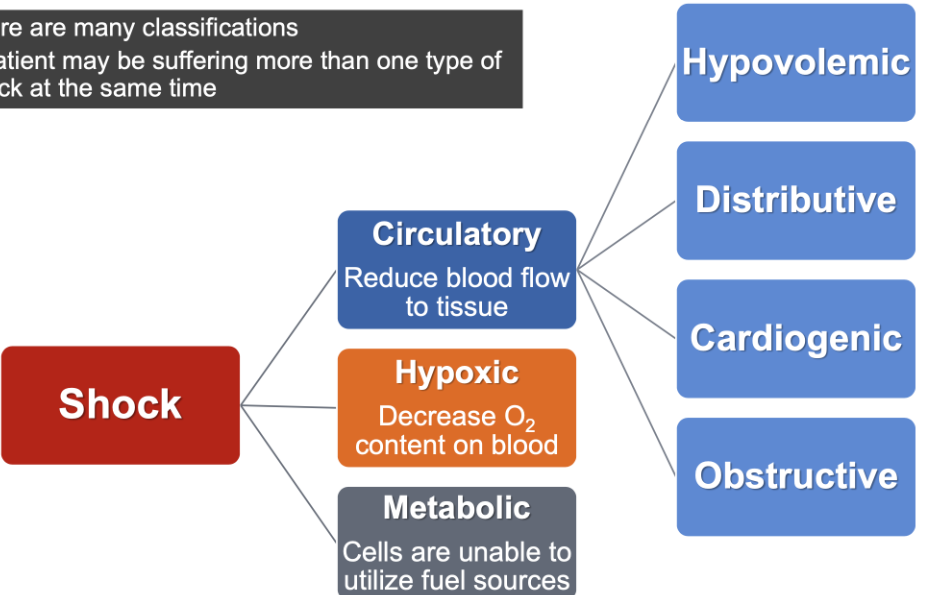
Cardiogenic shock

Hypovolemic shock

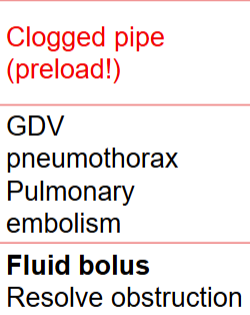
Distributive shock
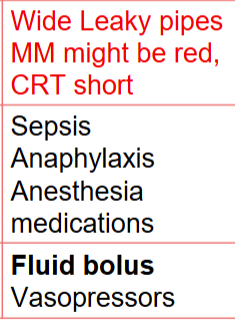
Obstructive shock
Large Animals: Example
Weight: 425 kg
Horse fluid bolus = 1/4 of “shock dose”
Shock dose is 80-90 ml/kg, Let’s calculate 90 ml/kg
425 kg X 90 ml/kg = 38,250 ml, Convert to L → 38.25 L
Give 1/4 as a bolus: 38.25 ÷ 4 = 9.5 L
Give 9.5 L isotonic crystalloid IV fast
Cats: Example
Weight: 4 kg
Cat fluid bolus = 5-10 ml/kg
Let’s calculate 10 ml/kg: 4 kg X 10 ml/kg = 40 ml
Give 40 ml isotonic crystalloid IV over 15 mins
Treatment of Hypovolemic Shock: How fast?
FAST: Each bolus over 10–15 minutes
treatment of hypovolemic shock: How much?
Reassess after each bolus
If shock signs persist → give another bolus
Treatment of hypovolemic shock: When do we stop?
Goal-directed therapy
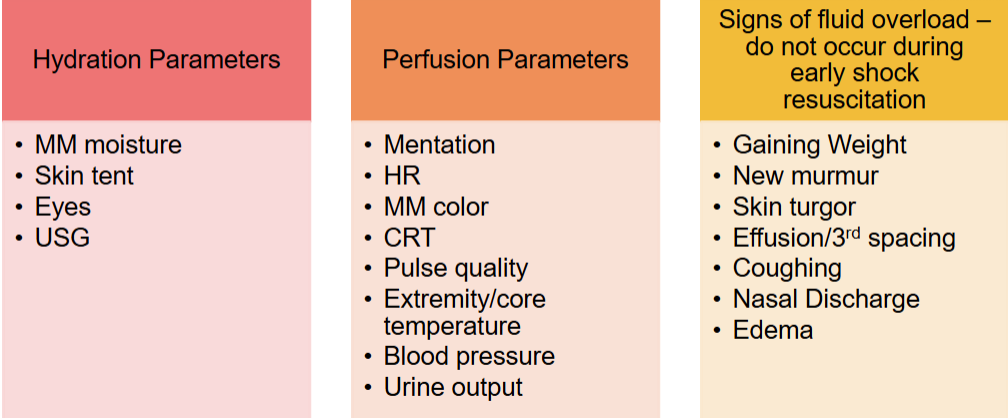
Stop when perfusion parameters normalize
Treatment of hypovolemic shock: important
Early resuscitation rarely causes immediate edema or effusion
Fluid overload signs develop later
If >2–3 boluses are needed → consider other types of shock
usually start with balanced crystalloid
Monitoring fluid therapy
Hypertonic saline
RAPID volume expansion, pulls fluid from interstitial space to intravascular → after using for volume expansion, will have to “pay it back” with isotonic crystalloid (IV or PO)
Dose: 2-4 ml/kg IV
Colloids for Treating Shock
Plasma or synthetic colloids can be used for shock: Dose= 5-10 ml/kg IV over 15 mins
Whole blood or packed red blood cells – for hemorrhagic shock
if crystalloid boluses are attempted and patient is still showing signs of hypovolemia or patient needs oncotic support(colloids)
What should you do next after giving the hypertonic solution IV?
Isotonic crystalloid in gold standard
Give oral fluids in field, actual practice