LECTURE 13- photosynthesis light reactions
 Call Kai
 Learn
Learn Practice Test
 Spaced Repetition
 Match
Match Flashcards
 Knowt Play
1/17

There's no tags or description
Looks like no tags are added yet.
Name | Mastery | Learn | Test | Matching | Spaced | Call with Kai | Chat |
|---|
No analytics yet
Send a link to your students to track their progress
18 Terms
where does photosynthesis take place
in the leaves below the epidermis of plants
how many chloroplasts can cells have
up to 50
how are thylakoids arranged
arranged in stacks called stroma and absorb light
what are the 2 reactions in photosynthesis
light reaction and carbon fixation
what occurs during light reaction
light energy is captured to create energy (NADPH) and ATP to fix CO2 and make sugars
light reaction creates high energy molecules by removing electrons from water
what occurs during carbon fixation
occurs in stroma and doesn’t require light. Drives calvin cycle to produce sugars from CO2
why are chloroplasts green
because chloroplasts mainly absorb red/blue light, and reflect green light
what are carotenoids
part of the chloroplasts. Help capture some of the light
what is light energy captured by in plants
chlorophyll
how does energy transfer occur in photosynthesis
light captured by atoms in chloroplasts (antenna complex) using chlorophyll molecules
molecules become energised and emit energy through photons
other chlorophyll molecules can capture and pass around energy
photons jump between antenna complex
energy eventually reaches special chlorophyll in the centre that transforms photons into electrons

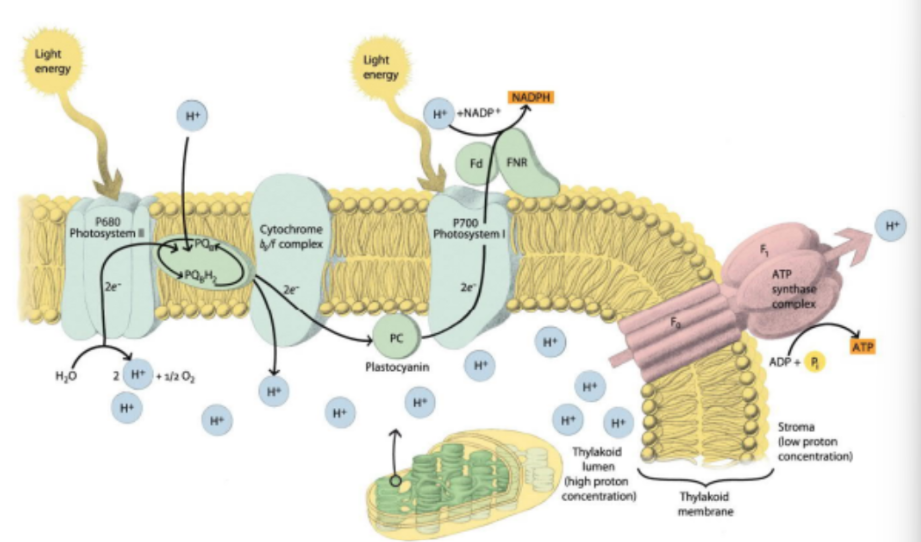
how does photosystem 2 work
light energy captured and bounces around until it hits chlorophyll A molecule
molecule can then capture electrons that come from water (using water splitting complex Mn)
chlorophyll moves electron to pheophytin
electron moves from pheophytin to plastoquinone → plastoquinone B → cytochrome Bf6 complex
hydrogen ions are then moved to the inside of the membrane to create ATP

how does photosystem 1 work
electron moves to from photosystem 2 to plastocyanin in photosystem 1
light energy bounces until it hits special chlorophyll molecules
electron is taken from plastocyanin and moved to electron accepters
electron loss energy and creates NADPH in process

what does the photosystem process create
ATP and NADPH: high energy molecules
what is energy used for
used in calvin cycle to produce sugars
what occurs during Chemiosmotic coupling of photophosphorylation
occurs inside stroma membrane
light energy is captured by photosystem 2
water in lumen splits to make hydrogen ion and oxygen
electrons are moved around to take its hydrogen ions and release it outside of membrane to increase hydrogen gradient
electron moves → cytochrome b6F compress → plastocyanin → photosystem 1 with light energy present
electrons are moved to other side. hydrogen is removed and bound to NADP+ to increase proton gradient
hydrogen moved from one side of membrane to the other
ATP synthase complex produces ATP for creating sugars
what does cyclic electron flow produce
only ATP. Can occur in photosystem 1 without photosystem 2
why does cyclic electron flow produce ATP
production of sugars in carbon fixation process uses more ATP than NADH, which causes additional requirement of ATP
what is the cyclic electron flow process
light energy capture electrons from plastocyanin and moves it up in energy
energy activates cytochrome complex → pumps protons from stroma to the lumen
proton gradient increases ATP
extra ATP is used in calvin cycle
