Ethics Proposal
 Call Kai
 Learn
 Practice Test
 Spaced Repetition
 Match
 Flashcards
 Knowt Play
1/8

There's no tags or description
Looks like no tags are added yet.
9 Terms
Professional practice and career growth
As a CRNA, you may bill for professional anesthesia services within your legal scope and practice arrangement.
Many CRNAs begin by working for a hospital or a contracted anesthesia group to gain experience.
The instructor recommends seeking a broad range of cases and a wide scope early in your career. A narrow specialty right away may limit future options.
Possible later paths include employment, locums, 1099 contracting, or forming a practice group.
Owning a group can be financially rewarding, but it adds business responsibility and stress: employees and their families may depend on the group.
Request for proposals (RFP)
A facility may issue an RFP when it is considering a new anesthesia group or renegotiating its current arrangement. Interested groups submit proposals based on the facility’s needs.
An RFP may include:
Case volume and case mix
Payer mix: commercial insurance, Medicare, Medicaid, and self-pay
Number of operating rooms and anesthetizing locations
Daily and after-hours case volume
Call, weekend, and holiday coverage requirements
A facility may require nondisclosure agreements before sharing detailed information.
Anesthesia staffing models
Anesthesiologist-only: An anesthesiologist covers each location.
CRNA-only: CRNAs provide anesthesia without an anesthesiologist on site, where permitted.
Medical direction: One anesthesiologist medically directs up to four anesthesia locations. TEFRA requirements apply.
Medical supervision: One anesthesiologist supervises more than four locations, according to the lecture’s description.
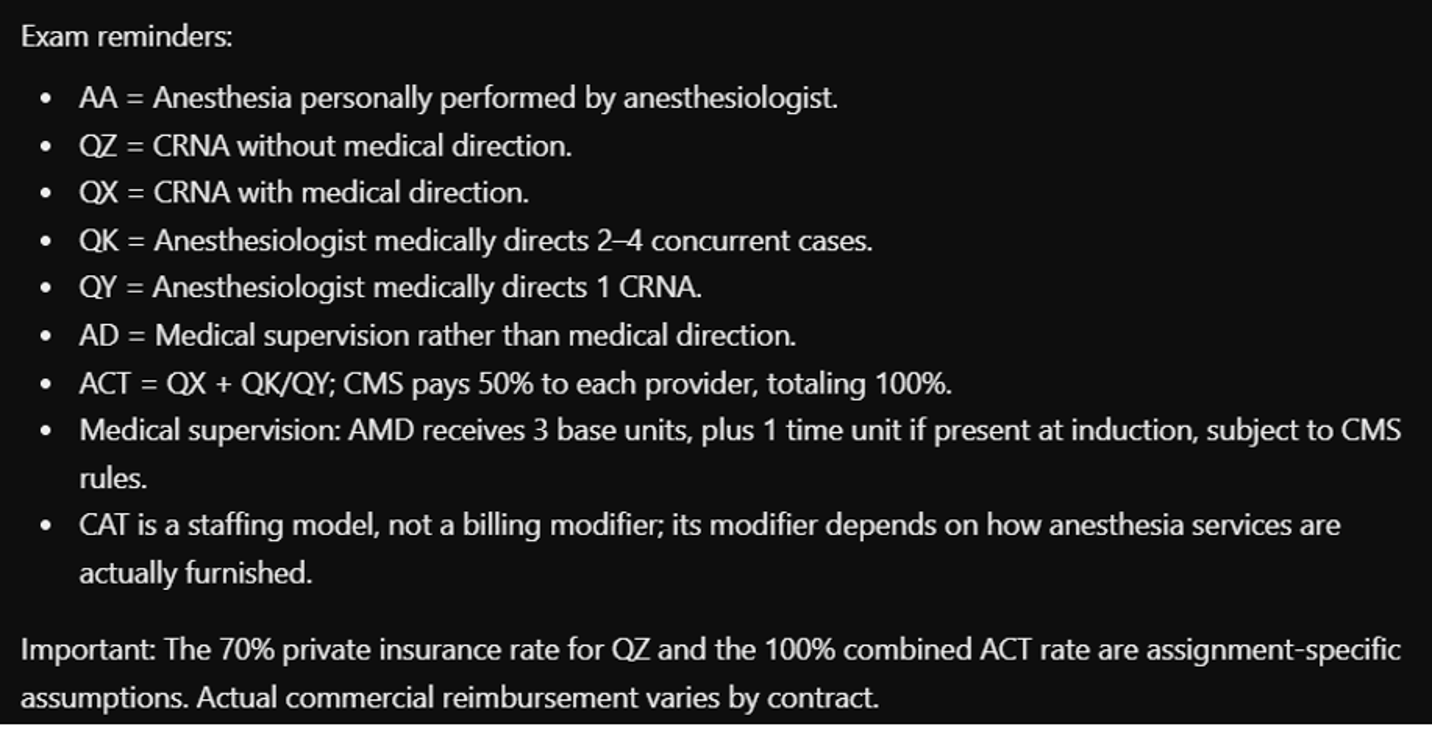
Collaborative anesthesia team (CAT): An anesthesiologist is available during set hours for collaboration, pre-op evaluations, blocks, or consultation; CRNAs bill independently in the model described.
The instructor described AA participation as limited to the medical-direction model. Scope and billing rules depend on applicable laws and contracts, so treat this as the course’s framework.
In the lecture’s example, medical direction requires the anesthesiologist to meet the TEFRA requirements. The instructor cautioned that meeting them in every room can be difficult in a busy practice.
Staffing model and billing model are related, but they are not the same thing.
Billing and reimbursement
Calculate each case using its assigned CPT code and base units. Do not estimate all cases as having the same average number of base units.
Anesthesia billing also accounts for time and applicable modifiers. For this class project, the instructor said to omit modifiers such as emergency, age, or ASA status.
Reimbursement depends on the payer and contract. For the project, the instructor gave these example conversion factors:
Commercial/BCBS Alabama: $75 per unit
CMS/Medicare and Medicaid: about $22 per unit
These are project assumptions from the lecture, not universal or guaranteed current rates. The instructor said to show revenue under both rates to compare the difference.
The lecture gave a separate example of unit allocation under medical supervision. Confirm the exact billing assumptions with the course instructions before using that example in calculations.
Stipends and payer mix
Payer mix affects how much revenue the group can collect. A high proportion of Medicare, Medicaid, or uninsured patients may reduce collections.
A hospital may pay the anesthesia group a stipend when expected collections do not cover the cost of providing the required staffing.
A group that barely breaks even from billing may still need to calculate and request a stipend.
For the project, the instructor said to exclude self-pay cases to keep the calculations simpler. Actual facilities may have different self-pay rates.
Building a staffing budget
The budget includes more than salaries. Account for:
CRNA and anesthesiologist salaries
Health, vision, and dental insurance
Short-term disability and life insurance
Paid time off and vacation coverage
Post-call days off
Call, weekend, holiday, and after-hours coverage
PRN or locum coverage, if used
The instructor suggested using six weeks of vacation for the project and noted that PRN and locum clinicians usually cost more per hour.
Why staffing needs exceed room count
Eight rooms do not necessarily require only eight CRNAs. You must account for clinicians who are:
On vacation
Post-call
Covering another shift or call requirement
Part-time CRNAs can help with call and vacation coverage. A larger group can share coverage across multiple facilities, but the class project is a small hospital and should not assume access to a large staffing pool.
Class-project approach
For each staffing model:
Determine how many locations and shifts need coverage.
Calculate case revenue using each case’s CPT base units and the project’s payer conversion factors.
Estimate staffing costs, benefits, PTO, and call coverage.
Compare revenue with total operating costs.
Calculate the stipend needed if collections do not cover the budget.
The instructor specifically advised that the project should be built for this small facility—not for a large group that can easily pull staff from other sites.
Modifiers and Reimbursement Models