2. History and Refractive Status - Clinical Binocular Vision Fall 2026
 Call Kai
 Learn
 Practice Test
 Spaced Repetition
 Match
 Flashcards
 Knowt Play
1/51

There's no tags or description
Looks like no tags are added yet.
52 Terms
True or False:
Case History is an integral part of the eye exam
True
How can case history be helpful in a vision exam?
Can help you diagnostically as well as coming up with a treatment plan
What birth history should be asked during eye exam on patient with strabismus complaints?
-Complications with birth?
-Premature or Full term?
-Birthweight
-APGAR
What other components of the case history is important to ask patients with strabismus during an eye exam?
-Fam Hx?
-Onset of Strabismus (Acute, chronic, congenital)
-Frequency of the Eye Turn
-Progression of the Deviation
-Previous Treatments/Success
-Symptoms
What symptoms are commonly reported by individuals with strabismus?
-Diplopia
-HA
-Blurred vision
-Asthenopia
-Reduced depth perception
What questions are important to ask patients who complain of strabismus in their pre-verbal child?
-Mobility problems?
-Head turn?
-Eye rubbing?
-Changes in visual behavior (no longer like reading but they used to)
Should you gauge the patients/parents attitude towards the deviation and treatment options when a strabismus presents?
Yes
Should you ask patients if they have cosmetic concerns when strabismus presents?
Yes
What are common chief complaints when patients present with strabismus?
-Cosmesis
-Second opinion
-Signs/Symptoms suggesting strabismus
-Complaints of visual discomfort
-Positive Fam Hx
What are the signs/symptoms that can suggest strabismus and are common chief complaints?
-covering one eye in bright sun
-head turns/tilts/tips
-excessive blinking/rubbing eyes
-diplopia
-asthenopia
-reduced vision
When a patient complains of DOUBLE VISION, what questions must you ask the patient to get a better dx and management plan for the diplopia?
-Monocular or binocular
-Frequency?
-Distance or near?
-Orientation of the images?
-Changes during the day or associated with fatigue?
-Anything to eliminate (turn, tip, tilt, close an eye)
-What and how was this first noticed?
-Associated signs or symptoms (dizziness, ask neurological questions)
-Gotten better or worse over time? Stable? Progressive?
-Previous hx of treatment?
What is a common etiological factor in strabismus and amblyopia?
refractive error
Is correcting refractive error an important part of proper management of strabismus and amblyopia?
Yes
Is correcting refractive error for a patient with strabismus/amblyopia an easy step that can be completed in a primary care setting?
Yes

What increases the odds ratio for developing exotropia the most?
High amounts of astigmatism

_____ amount of astigmatism will 2.5x the chance of developing exotropia
>1.5D
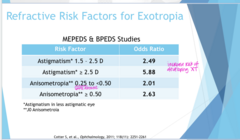
Anisometropia of ____D can lead to a 2x greater chance of developing exotropia
0.25
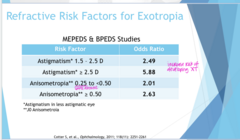
Does increasing amounts of anisometropia increase the odds ratio for exotropia?
Yes

Does increasing amounts of anisometropia increase the odds ratio of esotropia?
Yes

True or False:
As hyperopia increases, the odds ratio for esotropia also increases
true

For a patient with a SE of +5.00 or more, there is a _____x greater chance of developing esotropia
122
When do we want to take objective measurements of refractive error?
-amblyopia
-strabismus
-preverbal children
Which is more reliable?
Objective or subjective measurements of refractive error
objective measurements are more reliable
What are the OBJECTIVE ASSESSMENTS of refractive error?
-Dry Ret
-Damp Ret
-Wet (Cycloplegic) Ret
-Near (Mohindra, Dynamic) Ret
-Autorefraction
What are common sources of error in retinoscopy readings?
-Not controlling accommodation
-Not scoping on axis
Why is scoping on axis so important?
-Astigmatism increases with increasing eccentricity
-Spherical component decreases with increasing eccentricity
Astigmatism (increases/decreases) with increasing eccentricity
Increases
Spherical component (increases/decreases) with increasing eccentricity
decreases
What are the three methods for scoping on axis in strabismic patients?
Introduce prism over the fixating eye
Perform retinoscopy out of the phoropter to better align yourself with the deviating eye
Occlude eyes as needed
How to perform Mohindra Retinoscopy?
-Monocular (occlude the fellow eye)
-Completely dark room
-50cm
-Have patient fixate on the light
-+1.25 is subtracted from the sphere power
When is Mohindra Retinoscopy useful?
If you cannot use a cycloplegic agent on a child
We use _____ MEM to assess refractive error
modified
How to perform modified MEM to assess refractive error?
-50cm
-Grab attention of the child
-Child will be looking at you
-Neutralize the reflex with loose lenses or a lens bar
-DO NOT TAKE OUT WORKING DISTANCE
Cycloplegic agents are _________
anti-cholinergics
What is the function of anti-cholinergics?
Block ACh (inhibit parasympathetic nerve impulses)
What are the side effects of the anti-cholinergics?
-Flushed skin
-Confusion/irritability
-Dry mouth and mucous membranes
-Mydriasis and decreased accommodation
What cycloplegic agents can we use for a wet retinoscopy?
-Tropicamide
-Cyclopentolate
-Atropine
What is the duration of action of Tropicamide?
4-6 hours
What is the duration of action of Cyclopentolate?
Up to 24 hours
What is the duration of action of Atropine?
7+ days
When is max cycloplegia with use of atropine?
3-6hours
Side effects are most common with which anti-cholinergic agent
Atropine
What is the dosage of cyclopentolate to use in children >1 yo?
1%
What is the dosage of cyclopentolate to use in children < 1 yo?
0.5%
Does cyclopentolate provide the needed mydraisis for DFE?
No -- need phenyl or tropicamide
How long after instillation of cyclopentolate before you can check refractive status?
30 min
When should you use cycloplegic agents to check refractive status?
-Strabismus
-Amblyopia
-Hyperopes
-Latent hyperopia suspect
-High esophoria
-Lag of accommodation
-VA problems
-Symptoms inconsistent with manifest RE
-Uncooperative or non-cooperative
-New patients
Does tropicamide do an adequate job esp when determining refractive error?
Yes
Many studies suggest ___ drops of tropicamide are equal to cyclopentolate
2 drops seperated by 5 min
True or False:
Young children can be poor responders to subjective refraction
true
Amblyopic patients may have a (smaller/larger) just noticeable difference than typical 0.25D used in subjective refraction
larger
True or False:
The identification and treatment of RE is very important to initial dx and management of strabismus and amblyopia
true