SHIGELLA SPP.
 Call Kai
 Learn
Learn Practice Test
 Spaced Repetition
 Match
Match Flashcards
 Knowt Play
1/5

There's no tags or description
Looks like no tags are added yet.
Name | Mastery | Learn | Test | Matching | Spaced | Call with Kai | Chat |
|---|
No analytics yet
Send a link to your students to track their progress
6 Terms
Features of SHIGELLA SPP.
4 serogroup based on O antigen
1. Shigella dysenteriae (serogroup A)
Produce Shiga toxin
Severe disease
Cannot ferment mannitol
Complication : hemolytic uremic syndrome
Shigella flexneri (serogroup B)
In sexual transmitted infection
Associated with Reiter’s syndrome
Shigella sonnei
late lactose fermenter
B-D-galactosidase and ornithine decarboxylase +ve
Shigella boydii
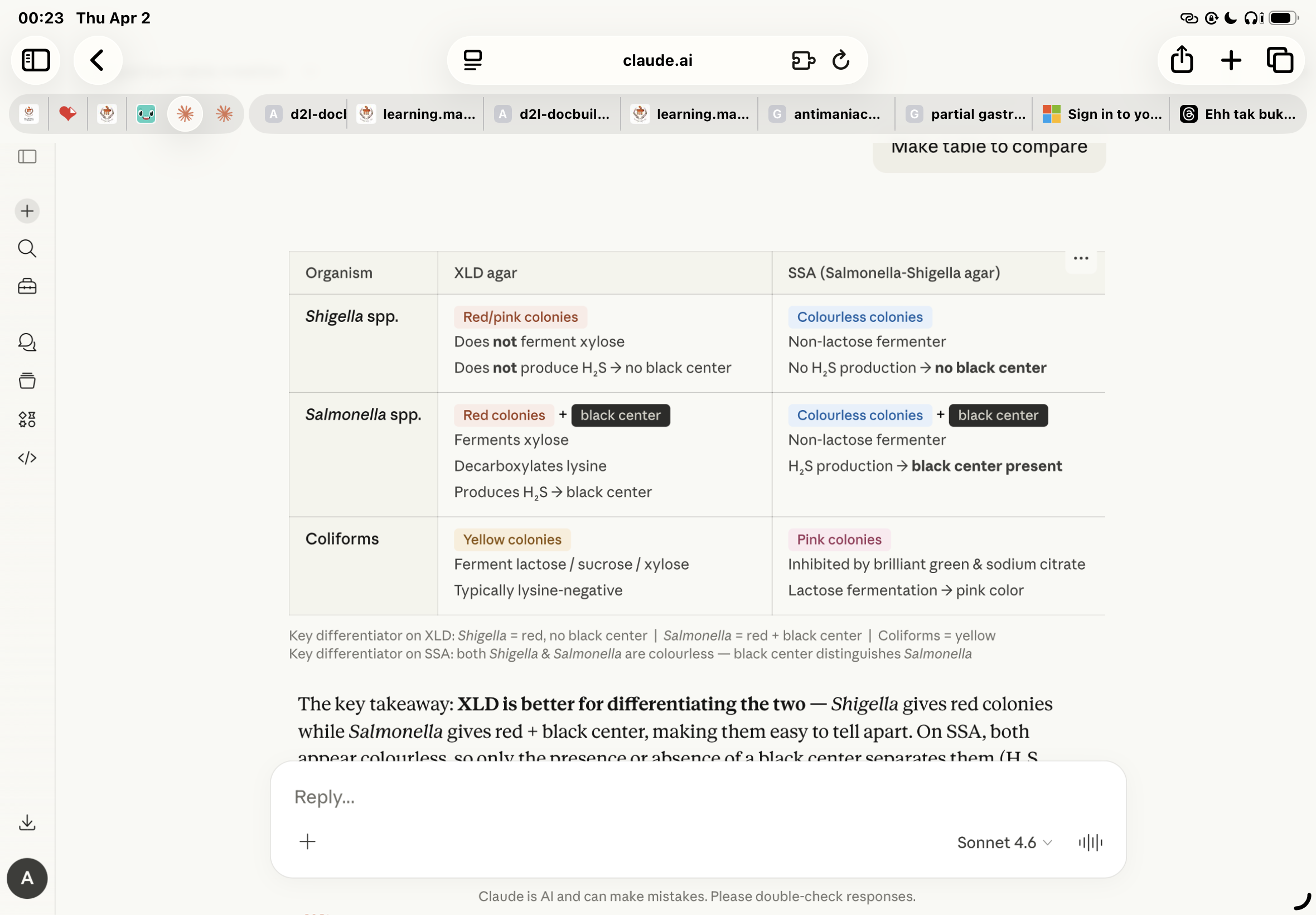
Characteristics of Shigella spp. compared to Salmonella spp.
Highly selective agars
to isolate and identify Gram -ve enteric pathogen Salmonella and Shigella spp.
Xylose-Lysine Deoxycholate agar
Shigella spp.
→ red/ pink colonies
→ not ferment xylose
→ No H2S produce
Salmonella-Shigella agar
Non lactose fermenter
Colorless colonies
No black center
No H2S produced
Virulence factor of Shigella spp.
Shiga toxin
produced by S.dysenteriae type 1
Produce dysentery diarrhea
Lipopolysaccharide
act as endotoxin
Activated once cell is destroyed
Damages adjacent epithelium
Type III secretion system
plasmid encoded
Invasion and entry
Modulate actin tail formation for invasion
Pathogenesis
INTRACELLULAR MOVEMENT
transcytosis via M-cells of epithelium — cross intestinal barrier
Enter intestinal epithelium— M cell engulf Shigella spp in vacuole
Shigella able to escape and travel to laminate propria
Macrophages will phagocytose Shigella
Shigella able to evade degradation by induce apoptosis of macrophages and produce pro inflammatory cell death
INTERCELLULAR MOVEMENT
invade adjacent colonic epithelium cell from basolateral side
T3SS deliver effectors to modulate actin
Develops actin tail and able to moves freely across cells
Shigella reproduce rapidly
Invasion causing acute inflammatory cascade
Massive release of cytokines (IL 1 beta, IL8)
Neutrophil infiltration
Microabscesses and necrotic lesion in mucosa
Acute inflammatory colitis
Dysentery, fever and abdominal pain
SHIGA TOXIN OF S.DYSENTERIAE 1
B subunit of Shiga toxin bind to Gb3 of surface host cell
A subunit internalized the toxin via endocytosis
Transport to Golgi apparatus and endoplasmic reticulum
Cleaves to A1 and A2 subunit
A1 subunit will bind to 28s rRNA and cleaves it
Lead to cessation of protein synthesis
Cell death and necrosis
Tissue destruction and hemorrhagic colitis
Laboratory diagnosis
Sample
stool sample — immediate transport and workup
Stool microscopy
presence of RBC and pus cell
Direct plating on special or selective agar
Mac Conley agar → non lactose fermenter
Salmonella-Shigella agar → good growth, non lactose fermenter, no H2S
Xylose-Lysine Deoxycholate→ non xylose fermentation, no H2S
Biochemical test
TSI agar : A/K, gas-, H2S-
Late lactose fermenter : S.sonnei
Mannitol fermentation : non fermenter for S.dysenteriae
B-D-galactosidase and ornithine decarboxylase → +ve for S.sonnei
Mode of transmission
Fecal oral transmission
Person to person spread