Unit 3 & 4 General math QCAA
 Call Kai
 Learn
 Practice Test
 Spaced Repetition
 Match
 Flashcards
 Knowt Play
1/50

There's no tags or description
Looks like no tags are added yet.
51 Terms
Open WALK
Starts ends @ different vertices
Closed WALK
Starts ends @ same vertex
TRAIL
No repeated edges
Open TRAIL
Starts ends @ different vertices
Closed TRAIL
Starts ends @ same vertex
PATH
No repeated vertices (except 1st and last)
Open PATH
Starts ends @ different vertices
Closed PATH
Starts ends @ same vertex
Eulerian graph
CLOSED trail using every edge is possible
Degree of every vertices is EVEN
Eulerian TRAIL
CLOSED Trail covering every edge of a graph only once (start finish same vertex)
Semi-Eulerian
OPEN trail using every edge is possible (starting at odd vertex)
2 vertices with odd degree
Semi-Eulerian TRAIL
Trail covering every edge of a graph only once (start finish different vertex)
Hamiltonian
CLOSED path using every vertex
Semi-Hamiltonian
OPEN path using every vertex
Total Interest
I = nR - (A0 - An)
OR
I = An + nR - A0
coefficient of determination/R2 meaning
% of total variation explained through linear association
Float time formula
latest start time - activity time - earliest start time
spanning tree
no disconnected vertices
minimum spanning tree
the lowest possible total combined weight that connects all vertices
use 111.2 x angular distance?
when longitudes are the same
use 111.2cos x angular distance?
when latitudes are the same
when do you plus degrees together?
when cardinal directions are different
when do you minus degrees together?
when cardinal directions are the same
1 longitudinal degree =
4 minutes diference

15 longitudinal degrees =
1 hour difference

Latitude

places EAST of the prime meridian are?
AHEAD of UCT (Universal time)
places WEST of the prime meridian are?
BEHIND UCT (Universal time)
Multiple edges
more than one edge connecting the same two vertices

Simple graph
no loops or multiple edges

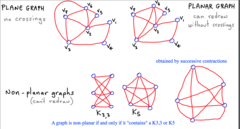
Planar graph
graph that can be drawn on a plane so that its edges only intersect at their endpoints, meaning no edges cross each other
edges only meet at vertices
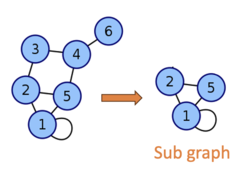
Sub graph
part of graph that is also a graph in its own right
Complete Graph
simple graph where every pair of vertices is connected by an edge

Bipartite graph
graph that has 2 groups of vertices: one group is connected to the other group via edges

Times series plots
trend = increases, decreases
seasonality = periodic movement in year, month, week
structural change = sudden "explained change" in established pattern of plot
outliers = irregular/random flunctuations
interpreting a scatterplot
direction = negative, positive, no association
form = linear, non-linear
strength = strong, moderate, weak
outlier = different from other values
Hungarian algortithm steps
0. Draw matrix
1. Subtract smallest value(minimum cost) or the highest value(maximum cost) in each row from each value in that row
2. Subtract smallest value in each column from each value in that column.
3a. Add smallest uncovered value to any value that is covered by 2 lines. Subtract smallest uncovered value from all uncovered values.
4b. Repreat step 4
5. Draw bipartite graph with an edge for every 0 value in table
6. Make allocation and calculate cost(using original values)
Residual value
= actual data value - predicted data value
Seasonal Index
= value of season(af value) ÷ average
Deseasonalised
= value ÷ SI
Actual (reseasonalise)
= value x SI
Actual value
= df x SI
Convert angles from decimal form to degrees and mins
multiply decimal part of no. by 60
E.g. 34.7°, multiply 0.7° by 60 = 42'
34.7° = 34°42'
Convert angles from degrees and mins to decimal form
÷ minutes by 60
E.g. 34.56° divide 50 by 60 = 0.9333
34.56' = 34.93° (2dp)
Arc length
θ/360 x 2πr
simplified: π x r x θ/190
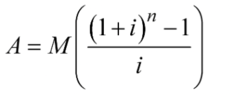
Future annuity
if P = 0 & need to calculate future (A) or M
DEPOSIT: if P is given, A = P(1+i)ⁿ + future annuity
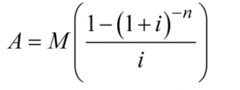
Present annuity
if loan is paid off & need to calculate M or P
WITHDRAWAL/REPAYMENT: if P is given, A = P(1+i)ⁿ - present annuity
Future value of reducing-balance loan
compound interest - annuity
Total interest for deposit phase
I = (An-A0) - nd
Total interest for withdrawal phase
I = nd - (A0-An)
Perpetuity
annuity that has regular withdrawal of a value equal to the interest earned after one compounding period
