Thermodynamics, Enzymes and Catalysis
 Call Kai
 Learn
 Practice Test
 Spaced Repetition
 Match
 Flashcards
 Knowt Play
1/98

There's no tags or description
Looks like no tags are added yet.
99 Terms
True or False: Living organisms exist in a dynamic steady state, at equilibrium with their surroundings
False
surroundings
Following the laws of thermodynamics, living organisms extract energy from their what and employ it to maintain homeostasis and do useful work
system
all the constituent reactants and products, the solvent that contains them, and the immediate atmosphere
does not exchange matter nor energy with its surroundings
isolated
exchanges energy but not matter with its surroundings
closed
exchanges energy and matter with its surroundings biological systems are open
open
which law of thermodynamics: randomness in the universe is always increasing
second
represents the randomness or disorder of the components of a system (s)
entropy
the components of a living system are very what
ordered
entropy can what locally in the system if there is a corresponding increase in entropy in the surroundings
decrease
equilibrium
living cells maintain themselves in a dynamic steady state that is distant from what
energy
maintaining steady state requires the constant input of what
Gibbs free energy
a quantity derived from thermodynamics that measures the maximum amount of usable energy, or "free" energy, available in a system to perform work
heat in a system (h)
enthalpy
spontaneously
The change in Gibbs free energy, ΔG, is a powerful tool for predicting whether a physical process will occur what
If the change in free energy is negative (energy goes down, is released from the system) a process will or will not occur spontaneously
will
If the change in free energy is positive (energy is put into the system), a process will or will not occur spontaneously
will not
free-energy change
amount of energy available to do work
processes require energy (positive DG)
endergonic
processes release energy (negative DG)
exergonic
reaction coordinate diagram
shows free energy as a reaction proceeds
spontaneous reactions only occur when ∆G is what
negative
coupled
energy-requiring (endergonic) reactions are often what to reactions that release free energy (exergonic) in the cell
If the net change in free energy is what, both coupled reactions will occur
negative
additive
Reactions can be coupled, and their free energies become what
metabolism
Coupled reactions allow what to happen
degradative, free-energy-yielding reactions
catabolism
synthetic pathways that require the input of energy
anabolism
ATP
catabolism
– drives what synthesis
catabolism
– produces the what electron carriers NAD(P)H
reduced
True or False: The ΔG of a reaction provides information about the rate (speed) of the reaction
False
The ΔG of a reaction depends only on the free energy difference between reactants and products and is what of how the reaction occurs (the path or mechanism)
independent
activation barrier
the small amount of energy that must be put into the system to start the reaction before getting a big payoff
starting point for either the forward or reverse reaction
ground state
highest energy point, at which decay to substrate or product is equally likely
transition state
free-energy change = ∆G′° = difference between the what state energy of the products and reactants
ground
activation
what energy (∆G‡) = difference between the ground state energy and the transition state energy
accelerate
Enzymes are protein catalysts (usually) that can what the rate of a reaction by factors of a million or more
activation
enzymes = greatly speed up reaction rates of specific chemical reactions by lowering what barriers
enzymes does what to the activation energy (∆G‡) of a reaction
lowers
True or False: enzymes greatly speed up reaction rates of specific chemical reactions without altering the equilibrium
True
enzymes do or do not alter the free energy change (ΔG) of a reaction
do not
balanced
At equilibrium, there is no net change in the amount of reactant or product, the rates of forward and reverse reactions are what
energy
Since nothing is changing, no work is being done, no what is being used or liberated
at equilibrium, ΔG is what
=0
standard Gibbs free energy
ΔG’o
The more what a reaction is, the larger the equilibrium constant will be, and the free energy change will be negative
exergonic
The more what a reaction is, the smaller the equilibrium constant will be, and the free energy change will be positive
endergonic
Cofactors
small molecules that some enzymes require for activity
organic molecules derived from vitamins
coenzymes
prosthetic groups
Tightly bound coenzymes
Without the cofactor, the inactive enzyme is called
apoenzyme
An active enzyme with its cofactor is
holoenzyme
Proteins
Most Enzymes Are what
Enzyme Class Number: 1
Oxidoreductases
Enzyme Class Number: 2
Transferases
Enzyme Class Number: 3
Hydrolases
Enzyme Class Number: 4
Lyases
Enzyme Class Number: 5
Isomerases
Enzyme Class Number: 6
Ligases
Enzyme Class Number: 7
Translocases
Transfer of electrons (hydride ions or H atoms)
Oxidoreductases
Group transfer
Transferases
Hydrolysis (transfer of functional groups to water)
Hydrolases
Cleavage of C—C, C—O, C—N, or other bonds by elimination, leaving double bonds or rings, or addition of groups to double bonds
Lyases
Transfer of groups within molecules to yield isomeric forms
Isomerases
Formation of C—C, C—S, C—O, and C—N bonds by condensation reactions coupled to cleavage of ATP or similar cofactor
Ligases
Movement of molecules or ions across membranes or their separation within membranes
Translocases
the active site contains a nucleophile that is briefly covalently modified during the reaction
covalent catalysis
a molecule (other than water) donates or accepts a proton
acid–base catalysis
metal ions function in several ways, including serving as an electrophilic catalyst
metal ion catalysis
the enzyme brings two substrates together in an orientation that facilitates catalysis
catalysis by approximation and orientation
active sites
Enzymatic reactions occur in specialized pockets where a substrate, a molecule that
is acted on by an enzyme, is converted into a product
Enzymes bind most tightly to the what state of the catalyzed reaction
transition
Enzymes bind most tightly to the transition state of the catalyzed reaction, using binding energy to what the activation barrier
lower
The interaction of the enzyme and substrate at the active site involves multiple what interactions
weak
Enzymes Facilitate the Formation of which State
Transition
transition
A chemical reaction proceeds through a which state, a molecular form that is no longer substrate but not yet product
substrate
The energy required to form the transition state from the where is called the activation energy
“enzymes are structurally complementary to their substrates”
lock and key model
enzymes are complementary to the transition state, an intermediate state between reactant and product
induced fit model
Transition
Enzyme Active Sites Are Complementary to the Reaction what State
induced fit
the enzyme undergoes a conformational change when the substrate binds, induced by multiple weak interactions with the substrate, which stabilizes the transition state
Catalysis
The Binding Energy Between Enzyme and Substrate Is Important for what
binding energy
the free energy obtained upon interaction of the enzyme and substrate
binding energy is derived from what enzyme-substrate interactions: hydrogen bonds, ionic interactions, the hydrophobic effect
noncovalent
True or False: binding energy is greatest when the enzyme interacts with the transition state, thus facilitating the formation of the transition state
True
energy
binding energy is the major source of free what used by enzymes to lower the activation energy of a reaction
chymotrypsin
a protease secreted by the pancreas into the small intestine in response to a meal
the chymotrypsin polypeptide contains how many amino acids. After chymotrypsin is activated form an inactive precursor, it cleaves itself into three chains that associate by disulfide linkages
245
hydrolysis
Chymotrypsin performs what (cleavage) of peptide bonds in proteins selectively on the carboxyl side of large hydrophobic amino acids
hydrolysis
water breaking reaction
specificity
The enzyme has ‘what’ it doesn’t cleave all peptide bonds
acyl-enzyme
The two phases in catalysis by chymotrypsin are explained by the rapid formation of which intermediate, and a slower breakdown of the acyl component to regenerate the free enzyme
The Chymotrypsin Mechanism Involves Two Phases:
the peptide bond is cleaved, and an ester linkage is formed between the peptide carbonyl carbon and the enzyme
acylation phase
The Chymotrypsin Mechanism Involves Two Phases:
the ester linkage is hydrolyzed and the nonacylated (free) enzyme is regenerated
deacylation phase
The ‘Catalytic Triad’ of a Serine, Histidine and Aspartic Acid in the Active Site is Responsible for Chymotrypsin Catalytic Activity:
His 57 removes a proton from Ser 195, generating a highly reactive alkoxide ion. Because of this, Ser 195 becomes a what that attacks the carbonyl group of the protein substrate
nucleophile
tetrahedral
Diagram of Peptide Hydrolysis by Chymotrypsin
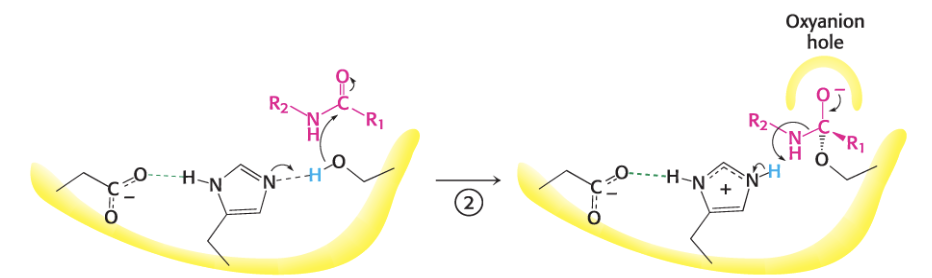
stabilization of the what transition state intermediate

oxyanion
The what hole, a region of the active site, stabilizes the tetrahedral reaction intermediate