Ch. 6 Fats and Other Lipids pt. 1
 Call Kai
 Learn
 Practice Test
 Spaced Repetition
 Match
 Flashcards
 Knowt Play
1/19

There's no tags or description
Looks like no tags are added yet.
20 Terms
Summary slide of nutrition advice :)
look for food that increase fiber intake (28g/day), nutrient dense
reduce food high on sodium (2300mg/day), added sugars (10% DV)
<5% DV = low, 5-20% DV = moderate, >20% DV = high
lipids
class of nutrients that do not dissolve in water
why does oil float on water
lipids are less dense than water
what do lipids include (types of lipids)
fatty acids
triglycerides
phospohlipids
cholesterol
major functions of lipids in the body
providing and storing energy (fat)
maintaining cell membranes
producing certain hormones
insulating the body against cold temperatures
cushioning the body against bumps and blows
contributing to body contours
absorbing fat soluble vitamins and phytochemicals
enhancing the flavor, texture, and aroma of foods
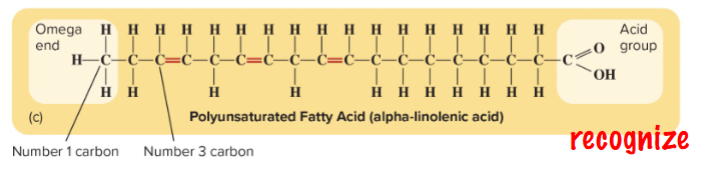
what is the chemical composition of a fatty acid
hydrocarbon chain (carbon and hydrogen atoms) with an omega (CH3) and a charged acid group (COOH)
how do fatty acids vary
number of carbon atoms, how saturated they are
how many carbons do short chain fatty acids have
2-4 carbons
how many carbons do medium chain fatty acids have
6-12 carbons
how many carbons do long chain fatty acids have
14-24 carbons
explain the bonds of a saturated fatty acid
no carbon-carbon double bonds (no C=C bonds) in hydrocarbon chain
hydrocarbon chain
chain of carbon atoms bonded to each other and to hydrogen atoms
saturated fatty acid
molecule is saturated with H, no C=C double bonds
unsaturated fatty acid
the molecule has 1 more C=C double bonds
monounsaturated fatty acid
one double bond in hydrocarbon chain

polyunsaturated fatty acid
2 or more double bonds in hydrocarbon chain
why is glycogen not great for storing energy
has an oxygen group which means it attracts a lot of water, making it heavy to carry
why is glucose not good for storing energy
glucose takes the shape of a hexamer, which is not the ideal structure for compacting
also less energy is extracted from glucose (4 Cal / gram)
structure of fatty acids — why does it make it better for storing energy
fatty acids have two oxygen groups and long hydrophobic tails
fatty acids can stack on each, more compact
also, higher energy density (9 Cal/ gram)