microstructure of metals
 Call Kai
 Learn
 Practice Test
 Spaced Repetition
 Match
 Flashcards
 Knowt Play
1/15

There's no tags or description
Looks like no tags are added yet.
16 Terms
tell me about the structure of metals
atomic structure- diameter of atoms ranges from 0.1 to 0.5nm
crystal structure- metals the atoms arrange themselves into regular patterns
grain structure- diameter of a grain typically ranges from 2,5 to 110 micrometer
metallic structure- solid structure with a continuous mass
what type of interatomic bonding exists in metals? and properties associated
Metallic bonding- The strong electrostatic attraction between a regular lattice of positive metal ions and a shared "sea" of delocalised valence electrons.
Key properties: Free-moving electrons allow high electrical/thermal conductivity, while the flexible electron sea lets ion layers slide without breaking, causing malleability and ductility
what is a crystal? why atoms arrange to crystals?
crystal structure is an ordered arrangement of atoms
it is energetically favourable so it minimises internal energy of material
what is a unit cell? how do u get different types? give examples
unit cell- smallest repeating unit of a crystal
u get different unit cells due to different temp of metal, the cooling rate of metal and other atoms present
body-centred cubic- not densely packed e.g. ferrite( low temp phase of low carbon steel)
face-centred cubic- densely packed, high ductility e.g. austenite (high temp phase of low carbon steel)
hexagonal close packed- very close packed structure e.g. magnesium, zinc
what is a phase? why important to understand? factors that affect phases
phase is condition of material within a region of temp or pressure
different solid phases have different mechanical properties which will effect performance and process
different phases are stable at- diff cooling rate, diff temps, alloying
what is dislocations? why is it sig in processing
dislocation is a line defect in the crystal structure
plastic deformations are caused by movement of dislocations and it is permanent
so dislocations means bad cus too many mean there will be easy plastic deform
what is work hardening?
the process where a metal becomes harder and stronger as it is plastically deformed
when metal deformed lots of new dislocations form these become tangled and jam so they can no longer move so atoms are locked in place which increases hardness
what is tensile strength?
ability of a material to withstand stress without fracture or plastic deformation so tensile is withstand in tension
brittle materials fail with no plastic deformation
ductile will plastically deform before failure

effect of increasing density of dislocations on tensile strength of material
small number of dislocations allow plastic deformation easily so reduce strength of metal
but high number of dislocations increase strength of metal as dislocations tangle up
so optimum density of dislocations for min yield strength
what is a grain? how is it formed? what properties are affected by grain size?
grain is small crystal with one orientation
formed during the solidification process as a liquid metal cools and freezes into a solid.
strength- grain boundaries obstruct movement of dislocations so materials with smaller grains are stronger
fracture toughness- GB deflect propagation of cracks so material with smaller grains are tougher
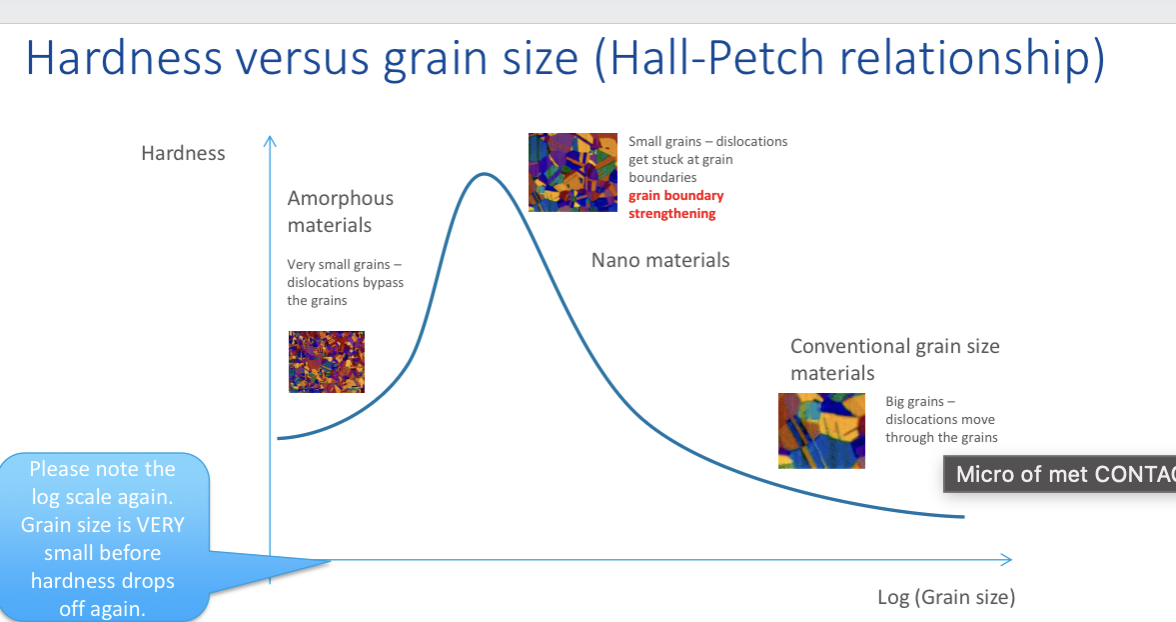
what is hardness?
measure of the resistance to localised plastic deformation induced by mechanical indentation or abrasion
what is a alloy? why them over pure metals ? which properties improved
alloys are mixture of elements in which the primary constituent is a metal
pure metals have poor properties but they can be improved by alloying
strength, corrosion resistance and thermal and electrical conductivity

what are structures alloys?
solid solutions- interstitial and substitutional solid solutions
two phase systems
two phase systems- precipitates distributed in solid solution and grains of different phases see the pic

Intermetallic compounds
