3. Geol C.9
 Call Kai
 Learn
 Practice Test
 Spaced Repetition
 Match
 Flashcards
 Knowt Play
1/19

Earn XP
Description and Tags
Earthquakes
20 Terms
What is an earthquake
Vibration caused by energy release
Underground movement (seismic waves) sourced from focus→surface shaking
Focus vs epicenter
Focus: point on fault where sliding begins
Epicenter: point on Earth’s surface directly above focus
Foreshocks vs Aftershocks
Foreshocks: smaller, weaker earthquakes SOMETIMES PRECEDING mainshock
Aftershocks: smaller earthquake that will ALWAYS FOLLOW mainshock (b/c main fault is left unstable).
largest happens directly after mainshock, but smaller may continue for several years
Seismic waves: P-Wave (direction of movement, speed)
Body wave with compressional (push/pull) motion
Particles move parallel to wave direction
Fastest/1st to arrive
Low amplitude
P=Primary
Seismic waves: S-Wave (direction of movement, speed)
Body wave w/ BILLY shearS motion (side-to-side)
particles move perpendicular to wave direction
Moderate speed
2nd to arrive
S=Secondary
Slightly more amplitude than P-Waves
Only travels thru solids

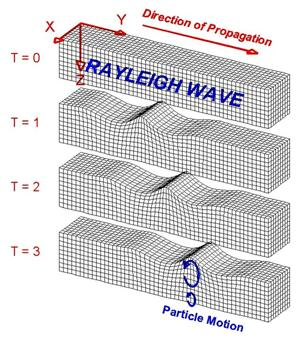
Seismic waves: Rayleigh Wave (direction of movement, speed)
Surface wave w/ ripple motion (up/down, elliptical like ocean water)
Slow
Larger amplitude, but dies out w/ depth
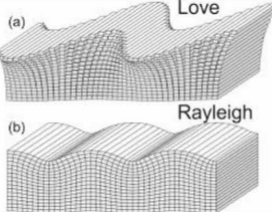
Seismic waves: Love Wave (direction of movement, speed)
Surface wave w/ snake-like motion (side to side shift)
in the horizontal plane perpendicular to wave direction
Slow
Amplitude dies out w/ depth

How many stations are needed to locate earthquake epicenters?
3
Each determines interval between arrival of 1st P and 1st S-WAVE @ location (S-P time)
How is distance from station to earthquake epicenter determined?
Time-travel graphs
(remember S-P time)
Are earthquakes limited to plate boundaries, or just concentrated there?
Activity concentrated within seismic belts
Concentrated at plate boundaries, but others may be intraplate
Depths of earthquakes & relation to plate boundaries
Shallow (0-70km): Divergent, Contrinental TRANSFORM, Convergent (upper subduction zone), Continental Rifts, Continental Collision
Intermed (70-300) & Deep (>300km): Deep subduction landward of deep ocean trenches
Intensity vs Magnitude (MMI vs Richter)
Modified Mercalli Intensity Scale (MMI):
measures destruction thru human perception & damage
Range I-XII
Different values at different locations due to distance from epicenter
Richter Magnitude Scale
Measures AMPLITUDE of LARGEST recorded wave 100kn from center
Defines magnitude
corrected for distance from earthquake
Each unit of Richter magnitude increase = 10x increase in wave amplitude (logmarithmic)
Varies due to local conditions in a single quake
What determines amt of ground shaking and structural damage due to an earhtquake?
Earthquake magnitude
Distance from focus
Substrate strength (unconsolidated)
Wave frequency
Intensity & direction of ground shaking
Type of structure (material, height, earthq. resistant design)
Direction of ground motion ( horiz)
Areas of wave amplitude interference
Other effects of earthq: Liquifaction
Saturated loose sediment loses strength due to shaking
Behaves like a liquid slurry

Other effects of earthq: Seiches
Sloshing of water in lakes, resevoirs, enclosed basins
Can weaken resevoir walls

Other effects of earthq: Tsunamis
Sudden displacement of massive volume of water
Megathrust event lurches & displaces water
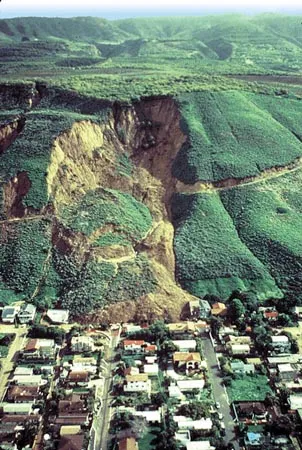
Other effects of earthq: landslides
Shaking destabilizes slopes & weak grounds
Sediment moves downward (downslope)
Other effects of earthq: Fires
Secondary hazard
Spread rapidly
Large= FIRESTORMS
What is the goal of long range earthq forecasting?
Estimate seismic risk within 30-100+yrs to minimize damage
What is used for long range earthquake forecasting
Historical records, trenching, seismic gaps, epicentral maps, earthquake hazard & ground shaking maps, plate motion velocities